
- Meet Umme Habiba
Umme Habiba Clinical Psychologist in Lahore
A child psychologist trained in ABA Therapy, helping families understand and support their children through autism and ADHD assessment, behavioural therapy, and learning difficulties. In Urdu and English, at her Lahore clinic and online across Pakistan and abroad. Practising since 2018.
- In-person in Lahore · Online for families across Pakistan and overseas
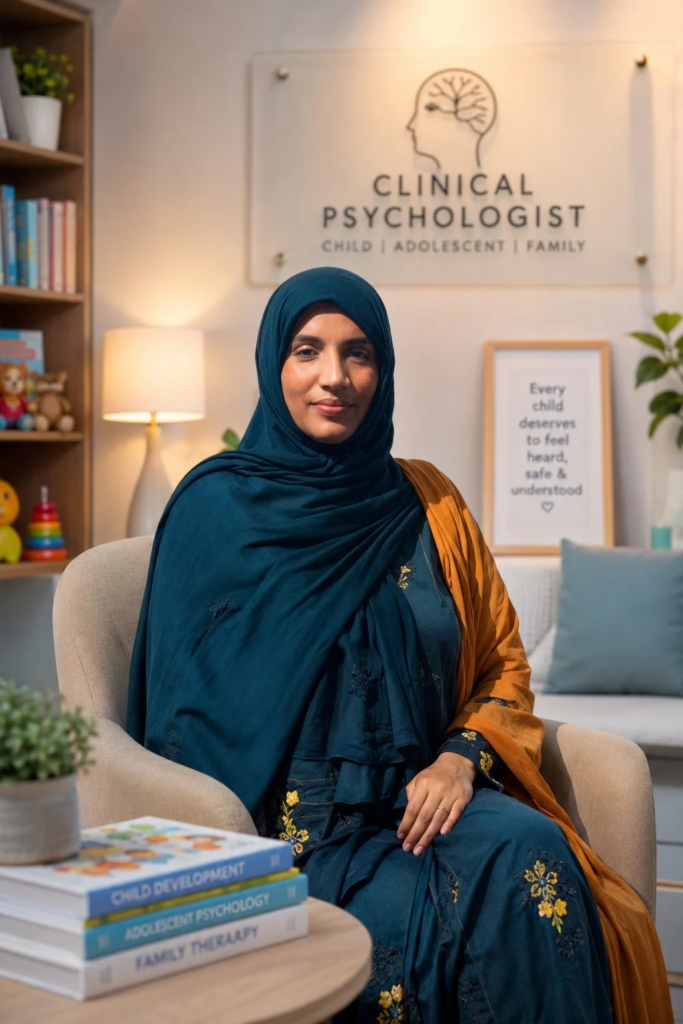
A Practice Built Around Children and Their Families
Since 2018, Umme Habiba has worked with children whose parents arrive with the same worry in different words: “Something isn’t quite right, and I don’t know what to do next.
Professional Narrative
Umme Habiba is a Clinical Psychologist based in Lahore who has specialised in child psychology since beginning clinical practice in 2018. Her work centres on the concerns Pakistani parents most often bring to her clinic: a child who isn’t speaking or connecting the way other children do, a bright child who cannot sit still or finish schoolwork, a child whose reading and writing lag far behind their intelligence, or a child whose worries, meltdowns, or withdrawal are affecting the whole family.
Her training is unusually well-matched to this work. Alongside her clinical psychology qualifications, she holds a Master’s in Special Education, which means she understands children not only in the therapy room but in the classroom. When she conducts an autism assessment, an ADHD assessment, or a learning difficulties evaluation, the outcome is never just a label. It is a practical plan: what to do at home, what to ask of the school, and where therapy, whether ABA-based behaviour support, behavioural therapy, or anxiety counselling, fits in. Parents are treated as partners in every step because, in her experience, the most lasting change happens when the adults around a child change what they do first.
A diagnosis should open doors, not close them. My job is to help parents understand their child, and then give them a plan they can actually use.
Since 2018
In clinical practice with children and families
ABA Therapy
Professionally trained in Applied Behavior Analysis
Academic Foundation
Umme Habiba’s qualifications combine clinical psychology with special education, a pairing that shapes how she assesses and supports children in both home and school life.
MS Clinical Psychology
Riphah International University Advanced clinical training in psychological assessment, diagnosis, and evidence-based therapy.
MSc Applied Psychology
Bahauddin Zakariya University (BZU), Multan Foundation in psychological science, human development, and applied practice.
Master in Special Education
Allama Iqbal Open University (AIOU) Specialised study of learning difficulties, developmental disorders, and inclusive education, directly informing her work on dyslexia, dysgraphia, and school-related challenges.
Specialised Training
Areas of Clinical Expertise
Autism Assessment
Structured developmental and autism assessment: parent interviews, observation, and standardised screening, ending in a written report and plan.
ABA Therapy
Applied Behavior Analysis programmes built from her professional ABA training: skill-building, behaviour support, and parent coaching.
ADHD Assessment & Support
Evaluation of attention, impulsivity, and executive functioning, with strategies for home and school.
Learning Difficulties
Assessment and support for dyslexia, dysgraphia, and dyscalculia, grounded in her Master in Special Education.
Behaviour, Anxiety & Emotional Regulation
Therapy for tantrums, aggression, defiance, worry, and meltdowns using CBT-informed and behavioural approaches.
Parent Counselling & Family Therapy
Guidance for parents on routines, consistency, and behaviour management at home, because parents are the most powerful therapists a child has.
MS Clinical Psychology
Riphah International University
Education
BZU
In Practice Since 2018
Lahore & Online Across Pakistan
How Umme Habiba Helps Autism, ADHD, ABA & Learning Difficulties
ADHD Assessment
An ADHD assessment examines a child's attention, impulsivity, hyperactivity, and executive functioning, the mental skills behind planning, starting tasks, and finishing them. Umme Habiba gathers information from parents and, wherever possible, teachers, since ADHD shows itself differently at home and at school. The result is a clear picture of whether ADHD explains a child's struggles, and a practical plan covering routines at home, classroom accommodations, and behavioural strategies that improve focus and school performance.
Autism Assessment
An autism assessment is a structured process for understanding a child's social communication, play, sensory sensitivities, and developmental history. Umme Habiba combines parent interviews, direct observation, and standardised developmental screening to determine whether a child's differences fit the autism spectrum, and, just as importantly, what those differences mean for daily life. Because early intervention makes the biggest difference, she encourages parents in Lahore and across Pakistan not to "wait and see" when speech, eye contact, or social play seem delayed. Every assessment ends with a written report and a clear next-steps plan.
ABA Therapy (Applied Behavior Analysis)
Applied Behavior Analysis, or ABA, is an evidence-based approach that breaks skills into small, teachable steps and uses positive reinforcement to help children learn, communication, self-help, play, and school-readiness skills, while reducing behaviours that get in a child's way. In Umme Habiba's practice, ABA is closely connected to autism support, but its principles help many children with behaviour challenges. Parents are trained as co-therapists: she designs the behaviour support plan, coaches parents to apply it at home, and reviews progress together, because a few hours in a clinic can never replace what parents do every day.
Learning Difficulties
Some children of normal, often above-average, intelligence struggle persistently with reading (dyslexia), writing (dysgraphia), or other academic skills. A learning difficulties assessment identifies exactly where the breakdown happens, so support can be specific rather than generic tuition. Umme Habiba's Master in Special Education shapes this work: her recommendations translate directly into classroom strategies, and she is comfortable communicating with schools so a child's teachers understand what will actually help.
Parent Counselling & Family Support
Parent counselling is structured guidance for the adults raising a child, often the fastest route to change. Sessions cover behaviour management at home, building routines and consistency, handling screen time and homework battles, and parenting a child with autism, ADHD, or learning difficulties without losing the relationship in the process. Where the whole household is affected, family therapy sessions bring parents (and sometimes siblings) together to change patterns as a unit
Emotional Regulation & Anxiety
Some children feel everything at full volume: meltdowns that outlast any tantrum, anger that erupts over small frustrations, or worries that keep them from school, sleep, or friends. Umme Habiba helps children build age-appropriate coping and self-calming skills through CBT-informed and play-based techniques, and helps parents respond in ways that settle a dysregulated child rather than escalate the moment.
Clinical Philosophy
Understand First, Then Act
Every plan begins with careful assessment. A child's behaviour is information, the work is understanding what it is telling us.
Evidence-Based, Family-Shaped
Methods drawn from ABA, CBT, and behavioural therapy research, adapted to each family's routines, values, and culture in Pakistan.
Parents and Schools as Partners
Children change fastest when home and school pull in the same direction. Parent counselling and school collaboration are built into treatment, not added on.
Ethics & Confidentiality
Working with children requires an especially high standard of care and privacy. Umme Habiba practises according to established professional and ethical standards for psychologists, and treats confidentiality as the foundation of every therapeutic relationship.
“Parents share things with me they have never said aloud. That trust is protected, in every session, every report, and every conversation with a school, which happens only with your consent.”
- Evidence-Based Practice
- Child-Safe, Respectful Environment
- Strict Confidentiality
- Informed Consent
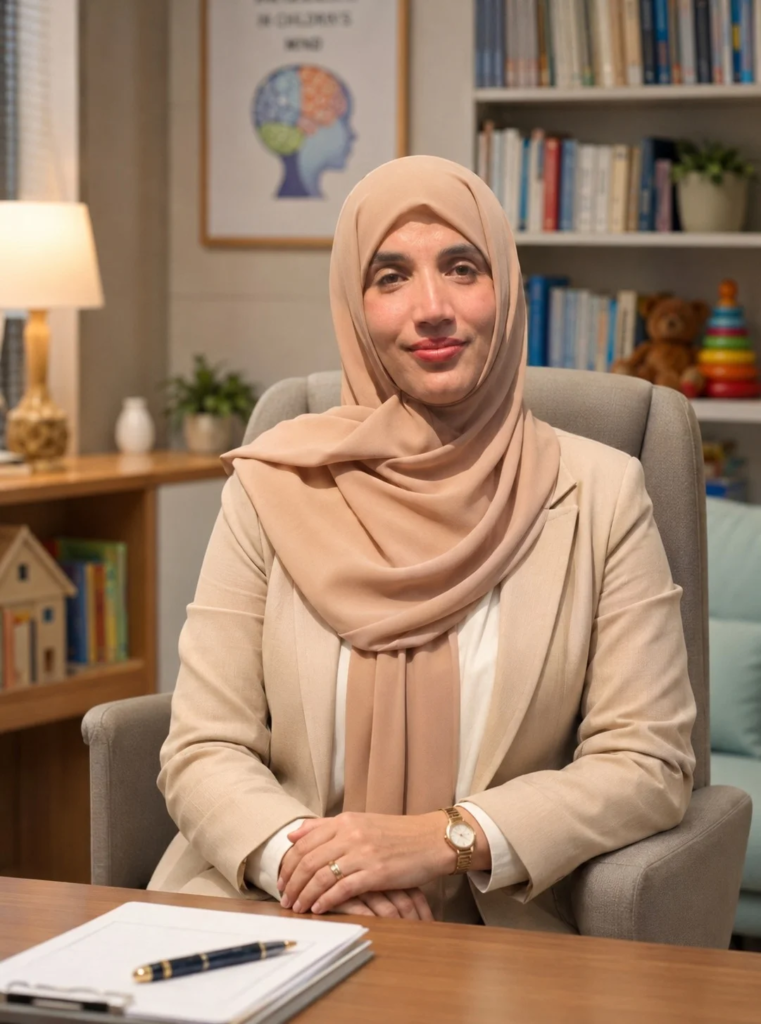
Who She Works With
Families in Lahore
In-person consultations, assessments, and therapy at her Lahore clinic.
Parents Across Pakistan
Online counselling and parent guidance sessions from any city, in Urdu or English.
Overseas Pakistani Families
Online sessions scheduled across time zones, for families who want support in their own language and cultural context.
Schools & Teachers
Consultation on individual children (with parental consent) and guidance on classroom support for autism, ADHD, and learning difficulties.
Overseas Pakistani & South Asian Families
Online sessions scheduled across time zones for families in the Gulf, UK, Europe, North America and beyond, support in Urdu or English, from someone who understands the family and cultural context you're parenting in.
Frequently Asked Questions
Who is Umme Habiba?
Umme Habiba is a Clinical Psychologist in Lahore, Pakistan, specialising in child psychology. She holds an MS in Clinical Psychology from Riphah International University, an MSc in Applied Psychology from Bahauddin Zakariya University, and a Master in Special Education from Allama Iqbal Open University. In practice since 2018, she provides autism assessment, ADHD assessment, ABA-based behaviour support, and therapy for anxiety, emotional regulation, and learning difficulties, in person in Lahore and online across Pakistan.
How do I know if my child needs to see a psychologist?
Common reasons parents consult a child psychologist include delayed speech or social interaction, persistent difficulty with attention or sitting still, ongoing struggles with reading or writing despite effort, frequent meltdowns or aggression, intense fears or worries, and problems at school that home discipline hasn’t resolved. If a concern has lasted more than a few months or is affecting daily life, an assessment can clarify what is happening, and often, that it is very manageable.
What happens in the first session?
The first session is a detailed conversation with parents about the child’s history, strengths, and concerns. Depending on the child’s age and the issue, Umme Habiba may observe or interact with the child directly. By the end, parents receive an initial impression and a plan, whether that is a formal assessment, therapy sessions, parent guidance, or reassurance that no intervention is needed.
Do you offer online sessions?
Yes. Online counselling, parent guidance, and many follow-up sessions are available via video call for families anywhere in Pakistan and for overseas Pakistani families. Some assessments require in-person components in Lahore; this is clarified before booking.
Are sessions conducted in Urdu or English?
Both. Sessions are held in whichever language, Urdu, English, or a mix, the child and family are most comfortable using.
Is everything confidential?
Yes. Session content, assessment results, and reports are confidential and shared with schools or other professionals only with your written consent, except in the rare situations where a child’s safety requires action, which is always explained to parents first.
Is Umme Habiba trained in ABA Therapy?
Yes. Umme Habiba holds professional training in Applied Behavior Analysis (ABA) alongside her MS in Clinical Psychology and Master’s in Special Education. She uses ABA to design structured skill-building and behaviour support programmes, most often for children on the autism spectrum, and trains parents to continue the techniques at home.
What is the difference between a child psychologist and a psychiatrist? Do you prescribe medication?
A child psychologist assesses and treats children’s emotional, behavioural, and developmental difficulties through assessment and therapy; a psychiatrist is a medical doctor who can prescribe medication. Umme Habiba does not prescribe medication. Where medication may be worth considering, for example, in some ADHD cases, she says so honestly and can coordinate with a child psychiatrist while therapy continues.
What ages of children does she work with?
From toddlers through the teenage years. Early-childhood work focuses on developmental and autism assessment and parent-led intervention; school-age work spans ADHD, learning difficulties, behaviour, and anxiety; adolescent work addresses emotional, academic, and family concerns.
Worried About Your Child? Start With a Conversation.
Book a consultation with Umme Habiba, in person in Lahore or online from anywhere in Pakistan. No referral needed. Sessions in Urdu and English.