
Family Therapy, When the Whole Family Needs to Move Forward Together
A child’s difficulty never happens in isolation. Constant conflict changes the atmosphere every member breathes. A diagnosis reshapes every relationship around it. Siblings feel forgotten in the shadow of the child who needs more. Parents stop pulling in the same direction and every child instantly detects the gap. Sometimes the honest assessment is that no single person in the family is “the problem”: the pattern between people is, and treating one member alone would be treating a symptom.
That is what family therapy is for. The client is the family itself, how it communicates, how it fights, how it repairs, how it carries stress and the goal is a system where every member, child and adult, functions better because the whole functions better.
Family therapy here is built for real Pakistani families: joint households where grandparents share authority; fathers working abroad half the year; the weight of log kya kahenge on every decision; teenagers navigating between two value systems. Umme Habiba has run family work since 2018, in Urdu and English, in Lahore and online, including sessions that join family members across cities and countries.
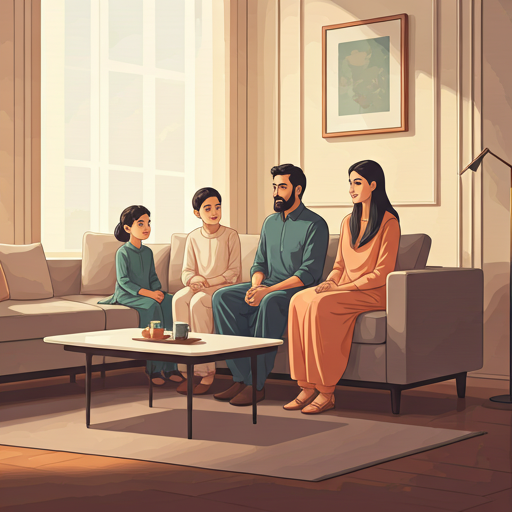
Family therapy is a form of counselling in which family members attend sessions together to improve communication, resolve conflict and change unhelpful patterns of interaction. Rather than treating one person as “the problem,” it examines how the family system functions who reacts to whom, and how and helps every member, including parents, children and sometimes grandparents, respond to each other in healthier ways. It is typically short-term and goal-focused, commonly 6–12 sessions.
What is family therapy?
Constant conflict
Arguing, shouting or cold tension that has become the house's default weather
A child's crisis is straining everyone
A diagnosis, a school breakdown, or behaviour that has the whole family organised around one member
Sibling warfare
Beyond normal rivalry: cruelty, persistent resentment, or a sibling quietly struggling in the shadow of a child with additional needs
A teenager you're losing
Communication reduced to logistics and slammed doors
Major transitions
Relocation, remarriage, bereavement, a new baby, a parent leaving for work abroad, children of separated parents moving between homes
Joint-family friction
In-laws and grandparents holding real authority in the children's lives, with conflicting rules and undermined decisions. Western therapy models often pretend this layer doesn't exist; here it's treated as the reality it is, with respect rather than judgment
After individual therapy stalls
a child's own therapy plateaus because they return daily to an unchanged system
When Family Therapy Helps
What Sessions Look Like
Element
How It Runs
Who attends
Planned around goals, sometimes everyone, sometimes parents + one child, sometimes shifting combinations across sessions
The therapist's stance
Strictly neutral. No villains, no verdicts, ground rules keep sessions respectful and safe, especially for children
Early sessions
Mapping the pattern: who reacts to whom, and how; every member heard, including the quiet ones
Middle sessions
New ways of talking and listening practised live in the room, not described, practised
Between sessions
Small agreed experiments at home; results reviewed without blame
Duration
Goal-focused and typically short-term: commonly 6–12 sessions
Two things surprise most families.
First, how quickly the temperature drops once there’s a neutral room where everyone actually gets heard, including children, whose view of the family is often startlingly perceptive and has usually never been asked for. Second, that the therapist will not referee old arguments or crown a winner. The question in the room is never who is right; it is what pattern keeps producing this fight, and what shall we do differently on Tuesday.
Your Journey to Healing
A structured, clinical path designed to respect your family’s unique privacy and pace.
1
Initial Intake
Comprehensive assessment where every family member's voice is heard.
2
Pattern Discovery
Identifying triggers and circular reactions that maintain familial distress.
3
Active Growth
Implementing new communication tools and healthier emotional boundaries.
4
Review & Support
Consolidating progress and ensuring long-term family stability.
Family Therapy Around a Struggling Child
The most common doorway into family work: one child has ADHD, autism, anxiety or behavioural difficulties, and the family around them is fraying. Family sessions then run alongside the child’s own support, doing the jobs individual therapy can’t:
- Aligning the parents on one approach, because a child in difficulty with two rulebooks makes progress with neither
- Bringing siblings in from the cold helping them understand the diagnosis, voice the unfairness they feel (“he gets away with everything”), and get some spotlight of their own
- Lowering the whole house’s temperature so the struggling child’s individual gains have a calm system to land in
- Getting grandparents onside often the difference between a plan that works and one that’s quietly vetoed at teatime
A distinctive strength of this practice: split-household sessions. A father on rotation in Saudi Arabia or the UAE joins by video while the family sits together in Sialkot or Lahore; separated parents join from two homes; a family scattered between Pakistan and the UK meets in one virtual room. For families whose biggest structural fact is distance, therapy that ignores the absent member treats a limb while the body waits these joint sessions are frequently where the real work happens. Time zones are accommodated as standard.
Culture, Values and Faith
Family therapy is conducted with explicit respect for Pakistani family values and, where families wish, sensitivity to their religious framework. Respect for elders, family honour, collective decision-making and the role of extended family are treated as structures to work with, not pathology to work against. Nothing about this therapy asks a family to become someone else’s idea of a family it asks only that the version of themselves they choose should stop hurting.
Why Choose Psychologist Umme Habiba
Specialized Family Expertise
Umme Habiba specializes in the intersection of child development and systemic family dynamics.
Culturally Adapted
Psychometric instruments optimized for the local context.
Child-Friendly Environment
Private, comfortable testing suites designed for children.

Family Therapy
PKR 12,000/ session
Longer format justifies premium
Session Investment
- Comprehensive whole-family approach
- Detailed summary & action plan
- Priority WhatsApp support between sessions
Clinical Availability
Mon - Thu
02:00 PM - 08:00 PM
Saturday
10:00 AM - 04:00 PM
Fri / Sun
By Appointment Only
- Both In-Person and Online Telehealth sessions are available.
FAQs — Family Therapy
Do all of us have to attend every session?
No. Attendance is planned around goals and can change week to week. A common arc: everyone, parents only, parents + teen, everyone again to consolidate.
Will the therapist take sides?
No, neutrality is the foundation of the method, and it’s protected deliberately. If any member ever feels the room has tilted, that concern goes on the table immediately.
Is what we say confidential?
Yes, under professional ethics and the internal rules (what may be shared between any individual conversations and family sessions) are agreed explicitly at the start, so no one is ambushed.
Our problem involves my in-laws — can they attend?
Yes, where they share caregiving authority it’s often the most productive configuration. Sessions with three generations are conducted with particular care for respect and face.
Is this against our values? Will you tell us to "put ourselves first"?
No. The work runs inside your value system. Families are helped to function better as the family they are collectivist, faith-centred, elder-respecting, whatever their shape.
Family therapy or parent counselling — which do we need?
If the main work is your strategies as parents, start with Parent Counselling. If the problem lives between members conflict, communication, alliances, resentment family therapy fits. The free intro call sorts this in minutes.
Can children speak freely without consequences at home?
Ground rules make sessions safe: what a child says in the room is protected from punishment, and parents agree to this at the start. Children test this quickly and open up remarkably when it holds.
Can family therapy be done online?
Yes, including multi-location sessions across cities and countries, which is one of the most valuable uses of the online format. In-clinic family sessions are available in Lahore.
How long, and what does it cost?
Commonly 6–12 sessions, goal-focused, reviewed openly. Fees confirmed at the free intro call.
How do we start when not everyone agrees to come?
Start with whoever is willing usually the parents. Systems change when any part changes, and reluctant members frequently join once they see the sessions aren’t a tribunal.
“Before working with Umme Habiba, our house was a war zone. We couldn’t go five minutes without an argument. Today, we have the tools to talk through our differences with respect. The transformation in our relationship has been miraculous.”
M. Farooqi
Lahore, Pakistan
Reconnect Your Family Today
Don’t wait for a crisis to seek professional help. Early intervention brings back the peace your family deserves.