
Dose ABA Therapy Actually Work ,If you’ve spent any time researching ABA therapy online, you’ve probably noticed two very different conversations happening at once: clinical and research literature that generally describes ABA as an effective, evidence-based intervention, and a vocal, often personal conversation including from autistic adults themselves raising real concerns about how ABA has been practiced historically. Both conversations are worth taking seriously. This article walks through what the evidence actually says, honestly, without oversimplifying either side.
What the Research Generally Shows
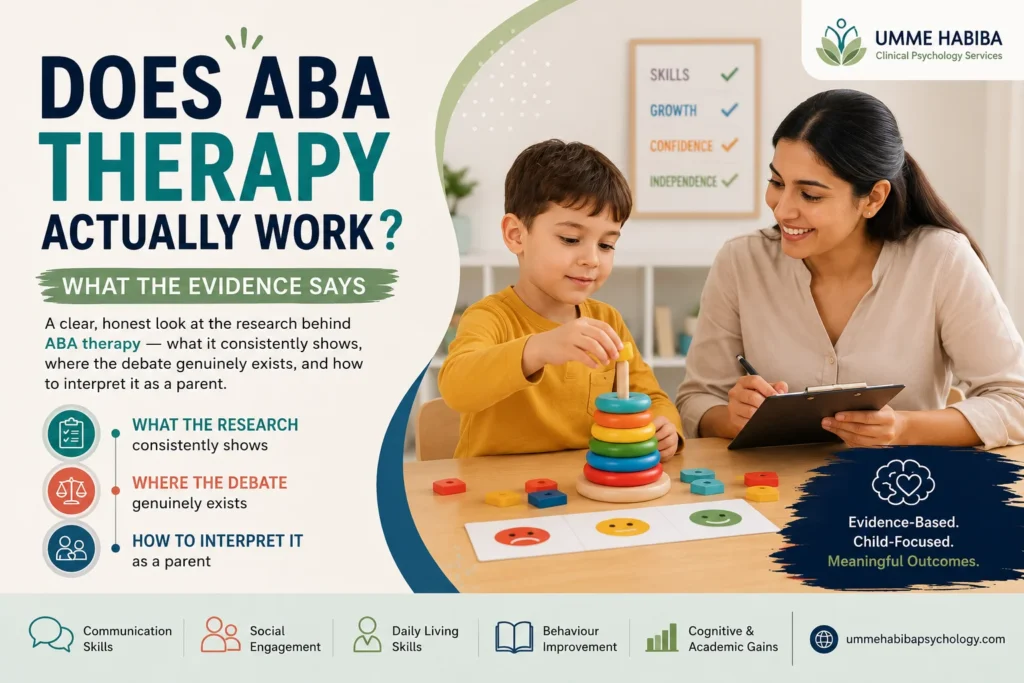
Applied Behaviour Analysis has one of the longest and most extensively studied track records of any autism intervention, with decades of published research behind it. Major reviews and meta-analyses, along with endorsements from bodies like the US Surgeon General’s office and various national autism guidelines internationally, have consistently found that ABA-based interventions can produce meaningful improvements in:
- Communication skills, including spontaneous language and functional requesting
- Social engagement, including joint attention and peer interaction
- Adaptive daily living skills, such as dressing, toileting, and following routines
- Reduction of specific challenging behaviours, including aggression and self-injury, when the underlying function of the behaviour is correctly identified
- Cognitive and academic outcomes, particularly when intervention starts early and is delivered intensively
The strongest, most consistent evidence exists for early, intensive intervention, typically defined as 20 or more hours a week, delivered before age 5 or 6. That said, meaningful benefits have also been documented at lower intensities and in older children, especially when goals are realistic and well-matched to the child.
Where the Genuine Debate Exists
It would be dishonest to present ABA as universally uncontroversial, because it isn’t and the debate deserves to be understood, not dismissed.
Historical practices. Early ABA, developed in the 1960s and 70s, sometimes included punishment-based techniques that would not be considered ethical or acceptable today. Modern ABA practice has moved substantially away from this, toward positive reinforcement-based approaches but the historical association is part of why some autistic adults and advocacy groups remain critical of the field as a whole.
Compliance versus authenticity. Some critics argue that certain ABA goals have historically prioritised making a child appear “typical” for example, suppressing self-soothing behaviours like hand-flapping rather than addressing what genuinely improves the child’s wellbeing and functioning. This is an active, legitimate discussion within the field itself, and it’s part of why the specific goals of any ABA program matter enormously, not just the fact that it’s “ABA.”
Intensity and burnout. Some autistic self-advocates have described high-intensity ABA schedules as exhausting or overwhelming, raising the question of how much therapy is genuinely beneficial versus how much becomes counterproductive for a specific child.
Quality varies enormously by provider. Because ABA has grown quickly as an industry in many countries, the quality, training, and ethics of individual providers vary widely. A well-run, individualised, ethically-grounded ABA program and a poorly-run, rigid, compliance-focused one can both technically be called “ABA,” which makes the provider’s specific approach far more important than the label alone.
How to Read This as a Parent, Practically
The honest summary is this: the underlying science of ABA using structured teaching, reinforcement, and data to build skills and reduce harmful behaviours has strong evidence behind it. Whether a specific program is a good fit for your child depends heavily on:
- Whether goals are chosen because they genuinely improve your child’s safety, communication, and quality of life not simply to make them “look” more typical
- Whether the approach is warm, responsive, and enjoyable for your child, not rigid or punitive
- Whether you, as the parent, are meaningfully involved in setting and reviewing goals
- Whether the provider is transparent about data and progress, and willing to adjust the plan when something isn’t working
A Practical Way to Evaluate Whether ABA Therapy Actually Work for Your Child
Rather than asking a vague question like “is ABA effective,” it’s more useful to track specific, individual outcomes:
- Is my child acquiring new skills communication, social, or self-care that they didn’t have before, at a reasonable pace?
- Are targeted difficult behaviours actually decreasing in frequency or intensity, based on real data, not just impression?
- Is my child generally calmer and more able to participate in daily life, or do they seem more stressed and shut down?
- Are the skills transferring outside of therapy sessions into the home, into school, into interactions with extended family or staying confined to the therapy room?
If the honest answer to most of these is “not really, even after a reasonable amount of time,” that’s worth raising directly with your child’s clinician a good program should welcome that conversation, not be defensive about it.
What This Means for a Program in Lahore
For families considering ABA therapy in Lahore or online, the practical takeaway is: focus less on whether “ABA works” in the abstract, and more on the specific program, the specific clinician’s training, and the specific goals set for your child. A well-designed program built around your individual child’s assessment with clear, measurable, meaningful goals, delivered warmly, and reviewed regularly against real data reflects exactly what the strongest evidence supports. A generic, one-size-fits-all program, regardless of the label attached to it, doesn’t.
The Bottom Line
ABA therapy has a substantial evidence base, particularly for early, individualised intervention. It also has a real, ongoing internal conversation about how it should be practiced ethically and respectfully. Both things are true. As a parent, the most useful stance isn’t picking a side in an online debate it’s asking specific, practical questions about the program in front of you, and paying close attention to how your own child responds to it.
Frequently Asked Questions
Is ABA therapy scientifically proven to work?
There is substantial research support for ABA based interventions, particularly early and intensive programs, showing improvements in communication, social skills, and adaptive behaviour. As with any intervention, individual outcomes vary, and the quality of the specific program matters significantly.
Why do some autistic adults speak negatively about their experience with ABA?
Some autistic adults who received ABA therapy, particularly in earlier decades, describe it as rigid, punishment-based, or focused on suppressing natural behaviours rather than building genuinely useful skills. This has led to meaningful reform within the field toward more individualised, positive, respectful approaches and it’s a perspective worth taking seriously when evaluating any specific program.
How can I tell if an ABA program is ethical and well-run?
Look for positive-reinforcement-based methods, individualised goals tied to your child’s actual quality of life (not just “looking typical”), transparency around data and progress, genuine parent involvement, and a willingness to adjust the plan if something isn’t working.
Does ABA therapy work for every autistic child?
No single intervention works identically for every child. ABA has strong evidence at a population level, but individual response varies based on the child’s specific profile, the program’s quality, and how well the goals match the child’s actual needs.
How long before I should expect to see progress?
This varies by child and goal, but most well-run programs show some measurable movement within 8 to 12 weeks on specific, tracked goals. If there’s no visible progress after a reasonable period, that’s a valid reason to review the plan with your clinician.
Is ABA the only evidence-based therapy for autism?
No. Other approaches, including speech and language therapy, occupational therapy, and developmental social-communication approaches, also have research support and are often used alongside ABA rather than instead of it, depending on the child’s needs.