
Accepting UK clients across England, Scotland, Wales & N. Ireland
Online Psychology Services for Pakistani and Indian Families in the UK
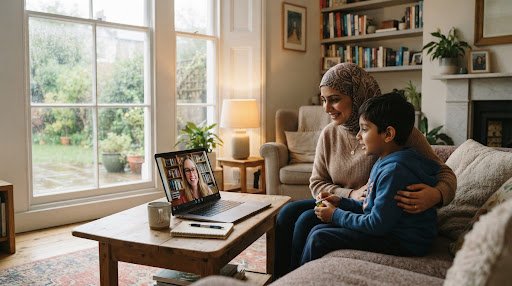
Pakistani and Indian families have been part of British life for generations. Many parents today were themselves born and raised in the UK. Others moved more recently for work or study. Whatever your family’s story, when a child is struggling, you may want support from someone who understands your language, your family structure and the values you’re raising your children with, as well as the pressures of growing up in Britain.Umme Habiba is a clinical psychologist based in Lahore, Pakistan, who works with children, adolescents and their parents. Through online sessions on Google Meet, she offers parent guidance, counselling and therapy to Pakistani and Indian families living in the UK. Sessions are in Urdu and English. These are online services provided from Pakistan. There is no clinic in the UK. Umme Habiba’s only clinic is at House 397-B, Faisal Town, Lahore.
- Zero NHS Waitlists
- Urdu & English Sessions
- UK GDPR & Data Compliant
Accredited Telehealth Standard
Certified Clinical Tele-Care | UK GDPR & Caldicott Aligned
UK Time Zones Accommodated
GMT & BST afternoon, evening & weekend slots
Bilingual Sessions
Fluent in Urdu, Punjabi & English
100% GDPR Compliant
Encrypted UK clinical video room
SEN & School Support
Clinical reports for EHCP & school SENCOs
Who this service is for
This service is for parents and caregivers of children and adolescents living in England, Scotland, Wales or Northern Ireland, including:
The practice doesn’t work with adults as individual clients. Parents are seen in their role as parents, in relation to their child’s needs.
Concerns UK-based families often bring
Waiting for an assessment
Many families in the UK describe long waits for assessments of ADHD, autism and other concerns through NHS services. Waiting can be hard. Parents may see their child struggling at school or at home and feel they have to put everything on hold until the assessment happens. It doesn't have to be like that. Parent guidance while you wait can help you understand your child's difficulties, try practical strategies at home, and work more effectively with school. None of this affects your place on an NHS waiting list.
School and special educational needs
Parents who were educated outside the UK, and even many who weren't, find the special educational needs system hard to navigate. Terms such as SEN support, SENCO and EHCP can be confusing, and it isn't always clear what to ask for or how. Umme Habiba can help you understand your child's needs and think through the questions to raise with school. Decisions about support are made by the school and local authority.
Behaviour at home and at school
Some children behave very differently at school and at home. One child holds it together all day and falls apart in the evening; another is fine at home and in trouble at school. Understanding why is the first step. Online sessions can help parents respond consistently and reduce daily battles.
Anxiety, exams and pressure
From SATs to GCSEs and A-levels, many British-Pakistani and British-Indian children feel strong pressure to succeed, from school and sometimes from family expectations. Some cope well. Others become anxious, perfectionistic, withdrawn or avoidant. Anxiety counselling can help young people manage worry, and help parents support ambition without adding to the pressure.
Identity, belonging and adolescence
Teenagers may be working out where they belong: between home and school, between faith and friendships, between their parents' expectations and their own plans. Some face racism or bullying. Parents may notice a teenager becoming distant, angry or secretive and not know how to reach them. Counselling can give young people a safe place to talk, and help parents keep the relationship strong through the teenage years.
Extended family and differing views
In many families, grandparents, uncles, aunts and cousins are closely involved. Relatives may disagree about discipline, education, or whether a child's difficulties are "real". A child can end up with mixed messages. Family sessions can help the adults agree on a shared approach, with respect for everyone's role.
Understanding a diagnosis
After a UK diagnosis of autism, ADHD or a learning difficulty, families often receive a report but little help in understanding what it means for daily life. Parents may also need help explaining the diagnosis to relatives, some of whom may not accept it. Guidance in your own language can help turn a report into a plan.
What online support can include
Depending on your child’s needs, online sessions may include:
Parent counselling
Practical guidance on behaviour, routines, school, screens and sibling conflict, and on parenting a child with ADHD, autism or learning difficulties.
Interactive Digital Tools
Child anxiety counselling
For worry, school avoidance, separation anxiety and exam stress.
Child-Led Gentle Exposure
Emotional regulation
Help with meltdowns, anger and strong feelings, with coaching for parents. For some adolescents, this may include DBT-informed skills.
Standardized Clinical Tools
Child behavioural therapy
Much of which is delivered through parent coaching.
Urdu & English Consults
Family therapy
Including sessions where relatives join from different places.
Urdu & English Consults
ABA parent coaching
For parents of autistic children.
Urdu & English Consults
Most counselling, parent guidance and many therapy sessions work well over video. Some parts of formal assessments can’t be done online. Standardised observation for autism, such as the ADOS-2, and cognitive testing such as the WISC or WPPSI need to be carried out face to face, at the clinic in Lahore. Parent interviews, review of existing reports and feedback can often be done online. v
What can and can't be done online
Planning an assessment during a visit to Pakistan
Some UK families visit Pakistan in the summer holidays or at other times of year. If an in-person assessment would be helpful, it may be possible to plan it around a trip:
1
Before you travel
An online consultation and parent interview, and sharing school reports and any previous assessments.
2
During your visit
The in-person parts of the assessment at the clinic in Faisal Town, Lahore.
3
After you return
Online feedback and a written report.
Please contact us well before your travel dates, since availability can’t be guaranteed. The length of an assessment depends on your child’s needs.An assessment from Pakistan may not be used by UK schools, local authorities or the NHS in the same way as a UK assessment. Please read the section below before deciding.
Language, culture and family
Sessions are in Urdu and English. Families from India are warmly welcome. If you’d prefer another language, please mention it when you get in touch, so we can tell you honestly whether sessions will work for you.
Your family’s values, faith, traditions and ways of making decisions are respected, and so is your child’s experience of growing up British. Many British South Asian parents feel they have to choose between “the way we were raised” and “the way things are done here”. The aim of sessions is not to make that choice for you. It is to help you find an approach that fits your child and your family.
Important information about online services from abroad
Umme Habiba practises as a clinical psychologist in Pakistan. She is not registered with the Health and Care Professions Council (HCPC) or any other UK regulator. The rules on receiving psychological services from a professional based outside the UK may depend on your circumstances. Before booking, we’ll discuss your situation and what you’re looking for, so you can decide whether this service is appropriate for you. If a UK-based service would be more suitable, we’ll tell you.
Privacy and online sessions
Sessions take place on Google Meet. For privacy:
- Use a quiet room where you can’t be overheard
- Wear headphones if others are at home
- Give a teenager their own private space for their part of the session
What you share is confidential, within the limits set out in the Privacy Policy. Information is shared with a school or other professional only with your written consent.
How online sessions work
1
Get in touch
By WhatsApp or email with your concern, your child's age and where in the UK you live.
2
Initial conversation
To understand what you're looking for and explain what can be offered online. free 15-minute intro call
3
First consultation
Via Google Meet with one or both parents, covering your child's development, health, schooling and family life.
4
An agreed plan
Parent sessions, sessions with your child or teenager, family sessions, or a combination.
5
Regular review
Regular review of progress, with changes if something isn't working.
Fees are discussed during the booking process. Add international payment methods once confirmed.
Scheduling from the UK
Sessions are arranged within clinic hours, 9:00 AM – 8:00 PM Pakistan time. The UK changes its clocks and Pakistan doesn’t, so the difference is four hours in summer and five hours in winter.
Virtual Consultation
£55 GBP / session
Standard 50-Minute Clinical Video Session
- 100% GDPR-compliant secure encrypted video link
- UK Debit/Credit cards, Apple Pay & Stripe accepted
- Post-session action plan & school SEN guidance notes
- Bilingual support (Urdu for elders / English for youth)
Transparent Care
UK equivalent of clinic hours
- Dedicated slots aligned with UK school and work schedules
Slots Open
British Summer Time
After-School & Family Evenings
09:00 AM – 06:00 PM GMT
Monday through Friday
| British Summer Time
Saturday & Sunday Mornings
9:00 AM – 2:00 PM GMT
Pre-booked sessions
- This means sessions are usually in the morning or early afternoon in the UK. Parent sessions during a lunch break or a day off often work well. After-school sessions with children can be harder to arrange, especially in winter. Let us know what suits you and we'll tell you honestly what's possible. If you offer sessions outside 9–8 PKT for UK families, update this section.
- Confidential • High-Definition Video • No Special App Installation Required
Working alongside services in the UK
Online sessions from Pakistan don’t replace UK services. They can sit alongside them.
NHS Services
In the UK, assessments and treatment for children's mental health and neurodevelopmental conditions are usually accessed through your GP, school, health visitor or other professionals, who can refer to services such as CAMHS or community paediatrics. If you have concerns, it's usually wise to speak to your GP, and to stay on any waiting list you're already on. Online sessions don't affect your NHS care.
Schools and special educational needs
Schools in England have a SENCO (Special Educational Needs Coordinator) who can talk with you about SEN support. For children with more complex needs, an Education, Health and Care needs assessment can be requested from the local authority. Scotland, Wales and Northern Ireland have their own systems. Schools and local authorities decide how to use any outside report and may carry out their own assessments. A report from Pakistan should not be relied on as a substitute for these processes.
Medication
Umme Habiba doesn't prescribe medication. Any medication for your child in the UK would need to be prescribed and monitored by a UK doctor. With your written consent, relevant information can be shared with them.
When local support is needed
If your child needs regular face-to-face therapy, or specialist services that must be delivered locally, you may be advised to seek UK-based support. Umme Habiba can continue to support you as parents alongside that care where appropriate.
“Finding a child psychologist in London who truly understands our British-Pakistani cultural context and the pressures our son faced with his grammar school exams was impossible through CAMHS. Umme Habiba made an immediate difference to our home life.”
Farhan & Saima K.- Parents of 9-year-old • Manchester, UK
Questions from families in the UK
Everything UK-based families need to know about our tele-psychology practice.
Is there a clinic in the UK?
No. All sessions for UK families are online. The only clinic is in Faisal Town, Lahore.
Is Umme Habiba registered with the HCPC?
No. She practises as a clinical psychologist in Pakistan. Please read the important information section above.
We're on an NHS waiting list. Should we stay on it?
Yes. Online sessions don’t replace NHS care. They can offer parent guidance and support while you wait.
Can you assess my child for autism or ADHD?
The in-person parts of an assessment happen at the clinic in Lahore, so a full assessment would need a visit to Pakistan. UK schools, local authorities and NHS services decide for themselves whether to use a report from abroad.
Can you help us prepare for a meeting with the SENCO?
Yes. Parent sessions can help you understand your child’s needs and think through the questions you want to raise. The school decides what support it provides.
What times are sessions?
Between 9:00 AM and 8:00 PM Pakistan time, which is early morning to mid-afternoon in the UK.
Can relatives in Pakistan join a family session?
Yes, where it’s helpful and everyone agrees. Family members can join the same Google Meet session from different countries
My teenager won't agree to therapy. What can we do?
Starting with parent sessions is often the best first step. Teenagers are more likely to engage when they have some choice about how and when they take part.
Do you work with adults?
No. The service is for children and adolescents, and for parents in relation to their child’s needs.
How much does it cost?
Fees are discussed during the booking process.
Explore Other International Care Locations:
Start with a conversation
Tell us what you’ve noticed about your child, and we’ll talk through whether online sessions could help.