
Accepting UAE clients across Dubai, Abu Dhabi, Sharjah & Northern Emirates
Online Psychology Services for Pakistani and Indian Families in the UAE
For many Pakistani and Indian families, the UAE is both close to home and a very different place to raise children. Schools are international, friendships change as families come and go, parents often work long hours, and the extended family may be a short flight away rather than down the street.
When a child is struggling, families often want support that understands both their home culture and the realities of expat life.Umme Habiba is a clinical psychologist based in Lahore, Pakistan, who works with children, adolescents and their parents. Through online sessions on Google Meet, she offers parent guidance, counselling and therapy to Pakistani and Indian families living in the UAE. Sessions are in Urdu and English. These are online services provided from Pakistan. There is no clinic in the UAE. Umme Habiba’s only clinic is at House 397-B, Faisal Town, Lahore.
- Zero Waitlists
- Urdu & English Sessions
- Confidential & UAE Clinical Standards
Accredited Telehealth Standard
Certified Clinical Tele-Care | UAE Expat Friendly
UAE Time Zones (GST)
Convenient afternoon & evening slots aligned with Dubai & Abu Dhabi school hours
Bilingual Sessions
Fluent in Urdu, Punjabi & English
100% Confidential & Secure
Encrypted private HD clinical video room
KHDA & School Support
Clinical reports & strategies for UAE British, IB & CBSE schools
Who this service is for
This service is for parents and caregivers of children and adolescents living anywhere in the UAE, including Dubai, Abu Dhabi, Sharjah, Ajman and the other emirates:
The practice doesn’t work with adults as individual clients. Parents are seen in their role as parents, in relation to their child’s needs.
Concerns UAE-based families often bring
Changes and transitions
Expat life often involves change: moving to the UAE, moving between emirates, changing schools or curricula, friends leaving when their families relocate, and uncertainty about how long the family will stay. Some children adapt easily. Others become anxious, clingy, angry or withdrawn. Understanding how change affects your child is often the starting point.
School concerns
Schools in the UAE follow many different curricula, including British, American, Indian, Pakistani, IB and others, and each has its own expectations. Children who move between systems can find that gaps appear in reading, writing or maths, or that expectations suddenly feel much harder. When a teacher raises a concern about attention, learning or behaviour, parents often want to understand what's happening before deciding what to do.
Busy family life and long working hours
Many parents in the UAE work long or irregular hours, and one parent may travel frequently. Children may spend a lot of time with a nanny, a domestic helper or grandparents. None of this is a problem in itself. But it can make consistent routines and responses harder, especially for a child who is already struggling. Parent sessions can help all the adults caring for a child work to the same plan.
Behaviour, screens and emotions
Meltdowns, defiance, sibling conflict and battles over screens are among the most common reasons families get in touch. Practical, consistent strategies, agreed between parents, often make a clear difference.
Anxiety and pressure
Academic expectations can be high, and some children respond with worry, perfectionism, trouble sleeping or reluctance to go to school. Anxiety counselling can help children and teenagers manage worry, and help parents support them without accidentally increasing avoidance.
A parent working abroad
In some families, one parent works in the UAE while the other lives with the children elsewhere, or a parent is away for long periods. Children may miss the absent parent, and the parent at home may carry most of the day-to-day pressure. Online sessions allow both parents to join, even from different countries, so they can agree on how to support their child.
Developmental concerns and diagnoses
Some parents want to understand whether their child's development is on track, or want help making sense of a diagnosis or report. Guidance in Urdu or English can help families understand what a diagnosis means for everyday life, and how to talk about it with relatives.
What online support can include
Depending on your child’s needs, online sessions may include:
Parent counselling
Guidance on behaviour, routines, school, screens, siblings, and parenting a child with additional needs, including how to involve other caregivers.
Interactive Digital Tools
Child anxiety counselling
For worry, school avoidance, separation difficulties and exam stress.
Child-Led Gentle Care
Emotional regulation
Help with meltdowns and anger, with parent coaching. For some adolescents, this may include DBT-informed skills.
Standardized Clinical Tools
Child behavioural therapy
Much of which is delivered through parent coaching.
Urdu & English Consults
Family therapy
Including sessions where a parent or grandparent joins from another country.Guidance after a diagnosis and help understanding reports.
Urdu & English Consults
ABA parent coaching
For parents of autistic children. Confirm this is offered online.Remedial or tutoring support online.Confirm whether offered online
Urdu & English Consults
Counselling, parent guidance and many therapy sessions work well online. Some formal assessments can’t be completed online. Standardised observation for autism, such as the ADOS-2, and cognitive testing such as the WISC or WPPSI need to be carried out face to face, at the clinic in Lahore. Parent interviews, review of existing reports and feedback can often be done online.
What can and can't be done online
Planning an assessment during a visit to Pakistan
Because travel between the UAE and Pakistan is relatively short, some families plan the in-person parts of an assessment around a visit, for example during school holidays or Eid.
1
Before you travel
An online consultation and parent interview, and sharing school reports and previous assessments.
2
During your visit
The in-person parts of the assessment at the clinic in Faisal Town, Lahore.
3
After you return
online feedback and a written report.
4
Review
Regular progress check-ins, targeted adjustments, and learning support liaison documentation as needed.
Please get in touch well before you travel, since availability can’t be guaranteed. The length of the assessment depends on your child’s needs.A report prepared in Pakistan may not be accepted by schools or authorities in the UAE. Please read the section below.
Language, culture and family
Sessions are in Urdu and English. Indian families are warmly welcome. If you’d prefer another language, please mention it when you get in touch, so we can tell you honestly whether sessions will work for you.
Family life in the UAE often includes grandparents who visit for long stays, helpers who care for children during the day, and relatives back home who remain closely involved. Sessions take this wider family into account. The aim is a plan that everyone caring for your child can follow.
Important information about online services from abroad
Umme Habiba practises as a clinical psychologist in Pakistan. She does not hold a health professional licence in the UAE. The rules on receiving psychological services from a professional based outside the UAE may depend on your circumstances. Before booking, we’ll discuss your situation and what you’re looking for, so you can decide whether this service is appropriate for you. If a UAE-based service would be more suitable, we’ll tell you.
Privacy and online sessions
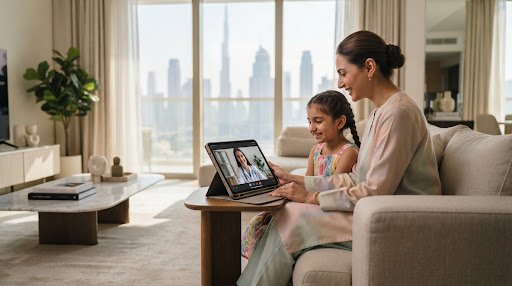
Sessions take place on Google Meet. For privacy:
- Choose a quiet room where you won’t be overheard, including by household staff
- Use headphones if others are at home
- Give a teenager their own private space for their part of the session
What you share is confidential, within the limits described in the Privacy Policy. Information is shared with a school or other professional only with your written consent.
How online sessions work
1
Get in touch
By WhatsApp or email with your concern, your child's age and which emirate you live in.
2
Initial conversation
To understand what you're looking for. free 15-minute intro call
3
First consultation
Via Google Meet with one or both parents.
4
An agreed plan
Parent sessions, sessions with your child or teenager, family sessions, or a combination.
5
Regular review
With changes if something isn't working.
Fees are discussed during the booking process. Add international payment methods once confirmed.
Scheduling from the UAE
Accessible, world-class telehealth tailored directly to UAE time zones with seamless international payment options.
Virtual Consultation
250 AED / session
Standard 50-Minute Clinical Video Session
- 100% encrypted secure clinical link
- UAE Debit/Credit cards & Apple Pay accepted
- Post-session action plan & school learning support notes
- Bilingual support (Urdu for parents / English for youth)
Transparent Care
UAE Telehealth Hours
- Dedicated slots aligned with Dubai & Abu Dhabi school and work hours
Slots Open
Gulf Standard Time (GST)
Dubai & Abu Dhabi Evenings
09:00 AM – 06:00 PM GST
Monday through Friday
Weekend Family Slots
Saturday & Sunday Mornings
10:00 AM – 3:00 PM GST
Pre-booked sessions
- This makes scheduling easier than for families further away. After-school sessions for children and early-evening sessions for working parents are usually possible. Weekend availability depends on the clinic's schedule. Please ask.
- Confidential • High-Definition Video • No Special App Installation Required
Working alongside services in the UAE
Online sessions from Pakistan don’t replace services in the UAE. They can sit alongside them.
Schools
Many schools in the UAE have their own learning support or inclusion teams, and education authorities in different emirates have their own policies on supporting students with additional needs. Some schools may ask for an assessment from a professional licensed in the UAE before putting certain support in place. Please ask your child's school what they require before relying on a report from Pakistan.
Health services and medication
Umme Habiba doesn't prescribe medication. If medication might be worth considering, your child would need to see a doctor licensed in the UAE, such as a paediatrician or child psychiatrist. With your written consent, relevant information can be shared with them.
When local support is needed
If your child needs frequent face-to-face therapy, or services that must be delivered locally, such as speech and language therapy or occupational therapy, you may be advised to seek UAE-based support. Umme Habiba can continue to support you as parents alongside that care where appropriate.
Language, culture and family
Sessions are in Urdu and English. Indian families are warmly welcome. If you'd prefer another language, please mention it when you get in touch, so we can tell you honestly whether sessions will work for you.
Family life in the UAE often includes grandparents who visit for long stays, helpers who care for children during the day, and relatives back home who remain closely involved. Sessions take this wider family into account. The aim is a plan that everyone caring for your child can follow.
“Finding a child psychologist in Dubai who truly understands both the rigorous British school environment and our Pakistani cultural family dynamics felt impossible until we consulted Umme Habiba. The change in our son’s confidence and our household peace has been incredible.”
Khurram & Ayesha S. - Parents of 10-year-old • Arabian Ranches, Dubai
Questions from families in the UAE
Everything UAE-based families need to know about our tele-psychology practice.
Is there a clinic in the UAE?
No. All sessions for UAE families are online. The only clinic is in Faisal Town, Lahore.
Is Umme Habiba licensed in the UAE?
No. She practises as a clinical psychologist in Pakistan. Please read the important information section above.
What times are sessions?
Between 8:00 AM and 7:00 PM UAE time, which matches clinic hours in Pakistan.
Can my child's school use a report from Pakistan?
That’s the school’s decision. Some schools require an assessment from a professional licensed in the UAE, so please check with the school first.
We're visiting Pakistan this summer. Can we arrange an assessment?
Possibly. Please get in touch well before your trip. The online parts can be done before you travel, and the in-person parts at the clinic in Lahore.
husband works in the UAE and I live with the children in Pakistan. Can we both join?
Yes. Both parents can join the same Google Meet session from different countries.
Can our child's nanny or grandparent be involved?
Where it’s helpful and you’re comfortable with it, other caregivers can be included in parts of the plan. Consistency between the adults caring for a child often makes a real difference.
My teenager doesn't want to talk. What can we do?
Parent sessions are often a good place to start. Teenagers are more likely to take part when they have some choice in how and when.
Do you work with adults?
No. The service is for children and adolescents, and for parents in relation to their child’s needs.
How much does it cost?
Fees are discussed during the booking process.
Explore Other International Care Locations:
Start with a conversation
Tell us what you’ve noticed, and we’ll talk through whether online sessions are a good fit for your family.