
ABA therapy isn’t only for toddlers. Here’s how it’s adapted for older children and aba therapy for teenagers, and why “too late” is almost never the right way to think about it.
A question that comes up often, and with real emotional weight behind it, is some version of: “My son is 11 is it too late for ABA Therapy for Teenagers and Older Children : Is It Too Late?y to actually help?” or “We only just got a diagnosis for our 14-year-old is there any point starting now?” This guide answers that directly: no, it is not too late, but the approach, the goals, and the whole framing of therapy legitimately need to change for an older child or teenager. Here’s how.
Why “Too Late” Is the Wrong Frame
The idea that ABA only works in early childhood comes from real research showing especially strong outcomes with early, intensive intervention but this research describes an advantage of early intervention, not a cutoff after which intervention stops working. The brain retains the capacity to learn new skills and adapt throughout life, including adolescence. What genuinely changes with age isn’t whether learning is possible it’s what’s being taught, why, and how.
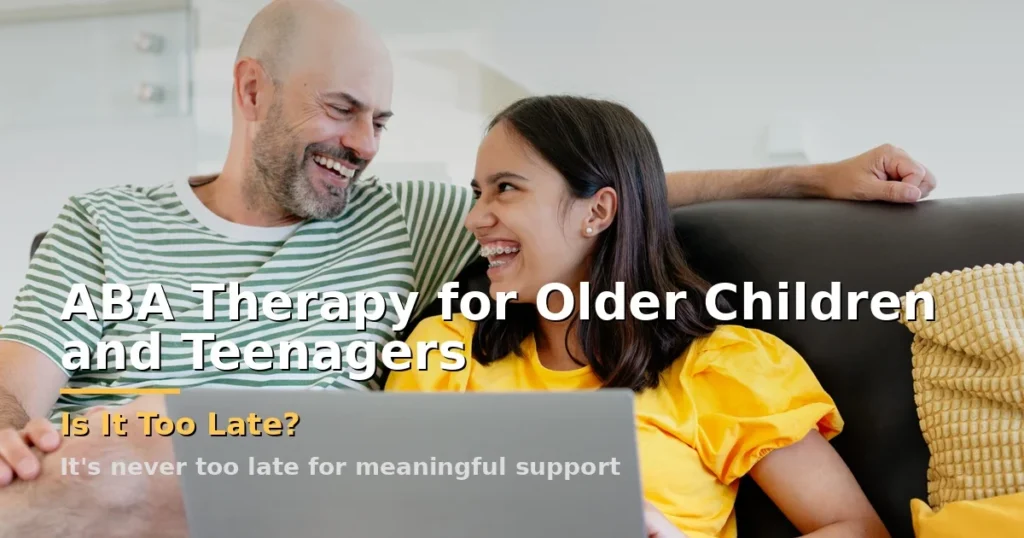
How ABA therapy for Teenagers Differs From ABA for Toddlers
The goals shift toward independence and real-world functioning. For a toddler, early goals often centre on foundational communication and social engagement. aba therapy For teenagers, goals are far more likely to focus on: managing emotions and frustration, navigating peer relationships, developing independence in daily routines (personal hygiene, managing a schedule, using money), preparing for further education or vocational paths, and building self-advocacy skills.
The teenager is an active participant, not just a recipient. Unlike a toddler, an older child or teenager can and should be meaningfully involved in choosing their own goals. A program built entirely around what parents or clinicians want, without the teenager’s own buy-in, is far less likely to succeed and can understandably feel disrespectful of their autonomy.
Sessions look completely different. Structured tabletop teaching is rarely appropriate for a teenager. Instead, sessions often look more like coaching conversations, role-playing real social scenarios, working through actual homework or organisational challenges together, or practicing specific skills in real community settings a shop, a bus stop, a social outing.

Self-awareness becomes part of the work itself. Many older children and teenagers, especially those diagnosed later, benefit from directly understanding their own diagnosis and how their brain processes things differently which is rarely a focus with younger children, but is often central to effective, respectful work with an older child.
Common Goals for Older Children and Teenagers
- Managing frustration and emotional regulation without escalating to aggression or shutdown
- Building and maintaining friendships, including understanding social cues that don’t come naturally
- Increasing independence with daily routines getting ready, managing homework, personal care
- Developing safety awareness for increasing independence, such as travelling locally or being home alone
- Preparing for transitions a new school, university, or eventually employment
- Reducing specific behaviours that are creating real barriers, such as significant meltdowns at school or aggression at home
- Building self-advocacy the ability to communicate their own needs and preferences to teachers, employers, or peers
Why Late Diagnosis Doesn’t Mean Late Opportunity
Many teenagers, particularly girls and children whose presentation was more subtle, are diagnosed with autism or ADHD later than younger peers with more obvious early signs. For these families, there’s often a real sense of grief or frustration “why didn’t anyone catch this sooner?” That feeling is understandable, but it’s worth being clear: a later diagnosis simply means a later starting point for targeted support, not a permanently limited outcome. Many teenagers make significant, meaningful progress once they finally receive support that’s actually matched to their real needs, sometimes for the first time.
Respecting a Teenager’s Autonomy in Therapy
This deserves particular emphasis, because it’s one of the most common ways ABA-informed support for teenagers goes wrong if not handled thoughtfully. A teenager is far more likely to engage meaningfully with therapy that:
- They understand the purpose of, explained honestly and age-appropriately
- They had a genuine voice in shaping, not simply had imposed on them
- Respects their identity and their own way of experiencing the world, rather than framing every difference as something to be “fixed”
- Focuses on skills that matter to their actual goals a driver’s license, a friendship, managing university applications not only what parents or clinicians think should matter
A good clinician working with aba therapy for teenagers will spend real time simply listening and building trust before pushing forward with a formal plan, in a way that looks quite different from an assessment-to-intervention pipeline with a toddler.
What Parents of an Older Child Can Realistically Expect
- Progress may look different than it did or would have for a younger sibling. Change in a teenager is often more gradual and more tied to real-life outcomes (fewer conflicts at school, growing independence) than dramatic new skill acquisition.
- The teenager’s own motivation matters enormously. Progress tends to track closely with how genuinely engaged and bought-in the teenager is, more so than with younger children.
- Family dynamics are often part of the work. Especially for teenagers, addressing how the whole family communicates and manages conflict is often just as important as individual sessions with the teenager themselves.
For Families Considering This in Lahore
If you’re the parent of an older child or teenager and have been putting off seeking support because you assumed it was “too late,” or because your child resisted the idea of “therapy,” it’s worth having a direct, honest conversation with a clinician experienced in working with this age group specifically the approach, tone, and structure used with teenagers is genuinely different from what’s used with younger children, and a program that understands that distinction is far more likely to be something your teenager will actually engage with.

The Bottom Line
Age is not a barrier to meaningful support the approach simply needs to change to match aba therapy for teenagers developmental stage, autonomy, and real-world goals. If your older child or teenager has recently been diagnosed, or you suspect they may need support they haven’t yet received, the right next step is the same as it would be at any age: a proper assessment, followed by a plan genuinely built around their specific, current needs.