
Generalisation in ABA Your child can do it in therapy but not at home? This is one of the most common and misunderstood challenges in ABA therapy. Here’s what generalisation means and how to actually fix it.
It’s one of the most common and most frustrating things parents report: “He asks for things perfectly in therapy, but at home he just screams instead.” Or: “She can identify all her colours with the therapist, but when I ask her at home, it’s like she’s never seen them before.” This isn’t a sign that therapy isn’t working, and it isn’t a sign your child is being deliberately difficult. It’s a well-documented phenomenon in ABA called generalisation, and understanding it genuinely understanding it is one of the most useful things a parent can do to support their child’s actual progress.
What Generalisation in ABA Actually Means
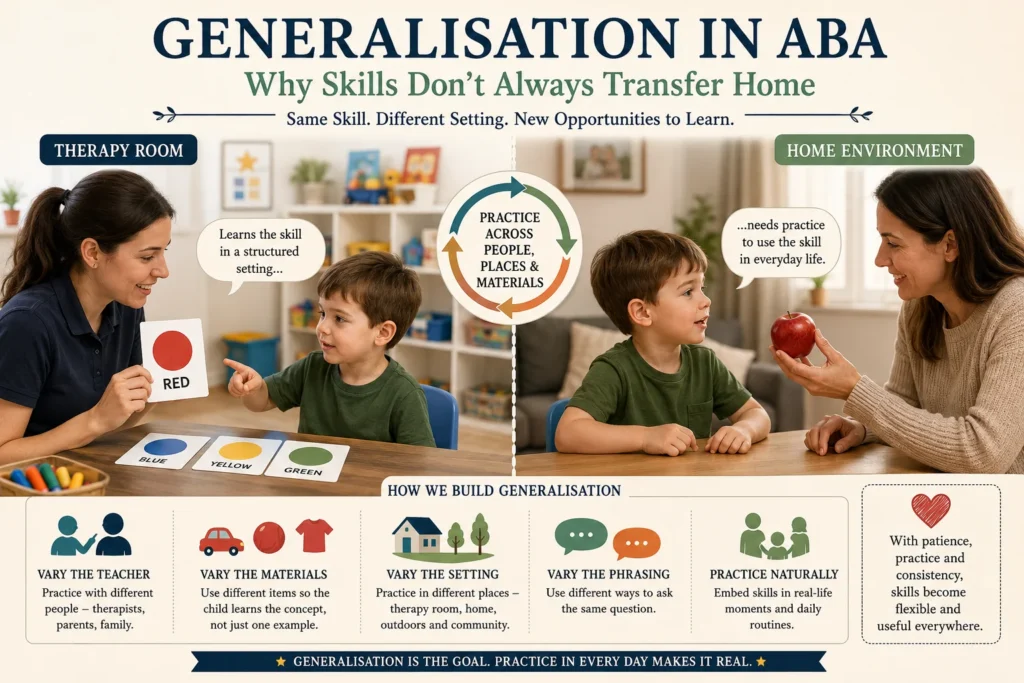
Generalisation refers to a child’s ability to use a skill they’ve learned in one specific context a certain person, place, set of materials, or time of day across other contexts too. A skill that’s only demonstrated in the exact setting it was taught in hasn’t fully generalised yet, even if the child has technically “mastered” it in that original context.
This isn’t unique to children with developmental differences it’s a genuine feature of how all learning works. But it tends to be a more pronounced, more deliberate part of the process for many children receiving ABA therapy, which is exactly why good programs build generalisation in as an explicit, planned step, rather than assuming it will happen automatically.
Why It Happens
A skill first learned in a highly structured setting a quiet therapy room, with one specific therapist, using specific materials, following a specific routine is, in a very real sense, learned in connection with all of those surrounding details, not just the skill itself in isolation. When any of those details change a different room, a different person asking, background noise, a slightly different phrasing of the same question the child may not yet recognise that the same skill applies, even though, to an adult, it obviously does.
This is a genuinely common pattern, not a rare complication, and it’s part of why a single, isolated skill mastered in one narrow setting isn’t the actual finish line of a therapy goal full generalisation is.
A Concrete Example
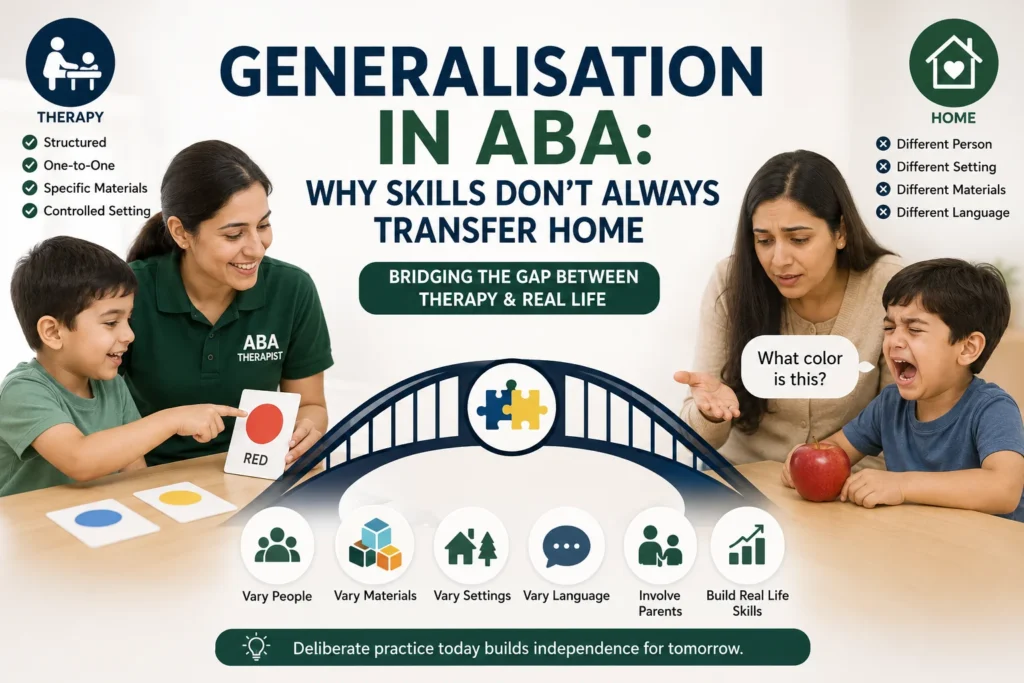
A child learns to identify the colour “red” reliably in therapy, using a specific set of laminated colour cards, with their usual therapist, in the clinic. At home, a parent points to a red apple and asks “what colour is this?” and the child doesn’t respond, or responds incorrectly.
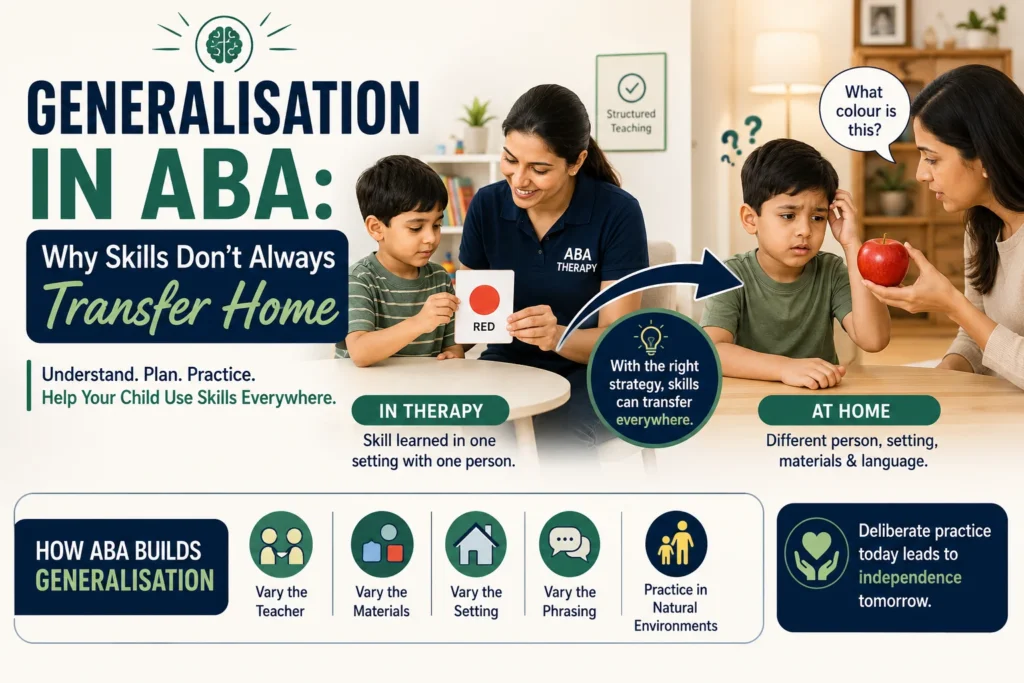
This isn’t the child forgetting, or being uncooperative it’s very likely that the skill hasn’t yet generalised across: a new person (the parent instead of the therapist), a new setting (home instead of clinic), new materials (a real apple instead of laminated cards), and possibly a slightly different phrasing of the question. Each of those differences is a genuine variable the child hasn’t yet practiced the skill across.
How Good ABA Programs Build in Generalisation Deliberately
Varying the teacher. A skill is practiced not just with the primary therapist, but ideally with multiple team members, and explicitly with parents, so the skill isn’t tied to one specific person.
Varying the materials. Instead of teaching “red” using only one set of cards, a well-designed program uses multiple different red objects a car, a ball, a piece of clothing so the child learns the actual concept, not a memorised association with one specific item.
Varying the setting. Deliberately practicing a skill across the therapy room, a different room, outdoors, and eventually at home and in the community, rather than assuming a skill taught in one place will automatically appear everywhere else.
Varying the phrasing. Asking “what colour is this?” as well as “can you tell me the colour?” or simply “colour?” so the child responds to the underlying concept, not one specific memorised script.
Explicit practice in the natural environment. This is exactly what Natural Environment Teaching is designed for taking a skill built through structured teaching and deliberately practicing it in real, everyday moments, which is often the single most direct way to close the generalisation gap.
What Parents Can Actually Do
This is genuinely one of the areas where parent involvement has an outsized, measurable impact:
- Ask your child’s therapist specifically which mastered skills are ready to practice at home, and how to prompt and reinforce them in exactly the same way therapy does, at least initially
- Use the same core language your child’s therapist uses for key skills, rather than inventing your own phrasing, especially early on
- Create low-pressure opportunities to practice mastered skills in daily life asking your child to identify colours during a walk, practicing a greeting with a family member, requesting a snack using the target communication method
- Don’t assume failure at home means the skill wasn’t really learned it usually means the skill needs more deliberate practice across settings, which is a normal, expected part of the process, not a setback
Why This Isn’t a Sign of a Bad Program (or a Bad Parent)
It’s worth saying directly: a generalisation gap is not evidence that therapy isn’t working, and it’s not evidence that you’re doing something wrong at home. It’s simply a well-documented, expected part of how skill acquisition works for many children in ABA therapy the meaningful question isn’t “why hasn’t this transferred yet,” it’s “what’s the specific plan to help it transfer,” which is exactly the conversation worth having directly with your child’s therapist.
When to Be Concerned
While some generalisation gap is normal and expected, it’s worth raising directly with your therapist if:
- A skill has been “mastered” in therapy for a long period (many weeks or months) with no visible attempt at generalisation practice
- You haven’t been given specific guidance on how to practice the skill at home
- The gap between therapy performance and home performance isn’t narrowing at all over time, despite consistent effort
A good program should have a clear, active plan for generalisation as a normal part of every goal, not treat it as an afterthought once a skill happens to transfer on its own.
The Bottom Line
If your child seems to “know” something in therapy but not at home, that’s one of the most common patterns in ABA therapy, not a sign of failure. The fix isn’t more frustration it’s deliberate, planned practice across different people, places, and materials, ideally with you as an active, informed part of that plan.