
A clear, step-by-step walkthrough of what an autism assessment process actually involves for Pakistani parents who want to know what to expect before booking one.One of the biggest sources of anxiety before an autism assessment isn’t usually the outcome itself it’s simply not knowing what’s actually going to happen. Will it be a single conversation? A day-long ordeal? Will your child be “tested” like an exam, with a pass or fail result? This article walks through, step by step, what a properly conducted autism assessment genuinely involves, so you can walk in prepared and informed rather than anxious about the unknown.
Why a Proper Assessment Takes More Than One Meeting
Autism can’t be reliably identified through a single conversation, a brief observation, or a quick opinion offered on the spot it requires looking carefully at a child’s development, behaviour, and communication across multiple sources of information, gathered over more than one session. A rushed, single-appointment “diagnosis” is one of the clearest warning signs of a low-quality provider, not evidence of efficiency or expertise. A responsible clinician will explain this multi-step process to you clearly from the very first conversation, rather than promising a same-day answer.
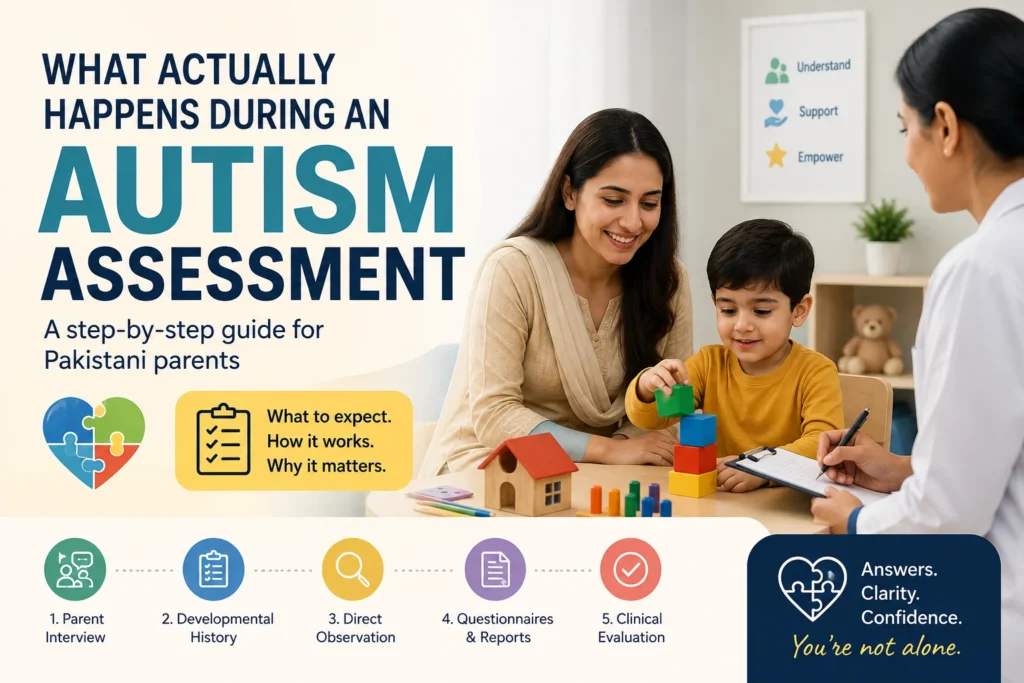
The First Session: Gathering Your Child’s History
The first session is almost entirely about gathering detailed information, not testing your child directly. This typically includes an in-depth conversation with parents covering pregnancy and birth history, developmental milestones from infancy through to now, current concerns described in your own words, family history of autism or related neurodevelopmental conditions, your child’s daily routines, behaviours, sensory responses, and social interactions, and any relevant input already gathered from teachers, daycare staff, or other caregivers who know your child well. This conversation genuinely shapes everything that follows in the assessment, and a good clinician will listen carefully and ask thoughtful follow-up questions, rather than working through a rigid checklist.
Direct Observation of Your Child: What It Actually Looks Like
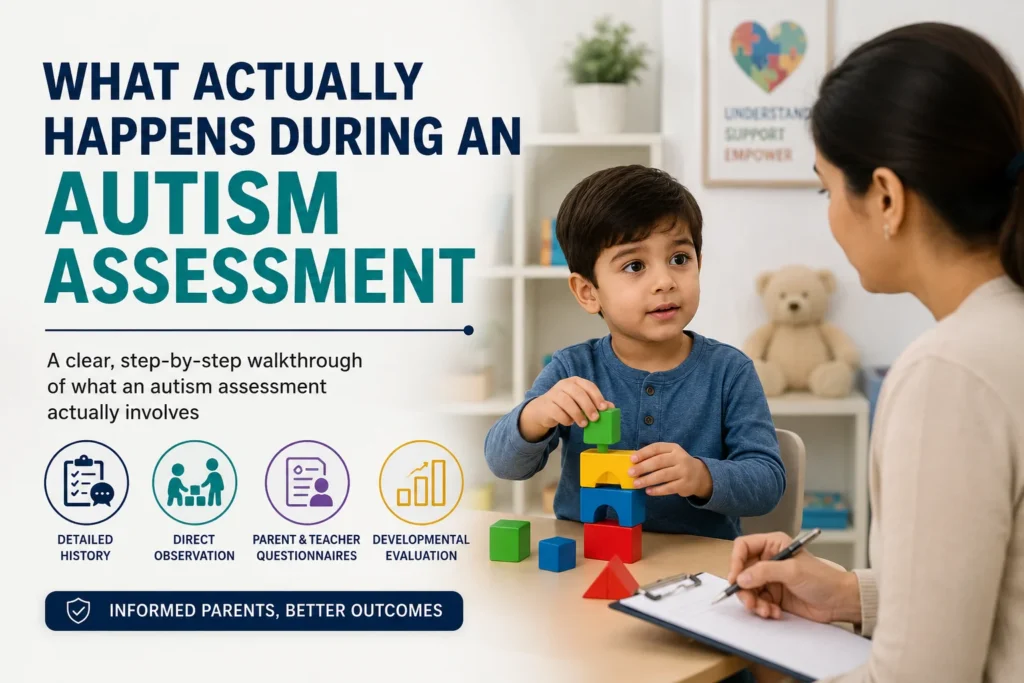
This is usually the part parents are most curious and often most anxious about beforehand. Direct observation typically uses a structured, standardised tool, most commonly the ADOS-2 for autism specifically (see our dedicated guide on exactly what the ADOS-2 involves), in which the clinician engages your child in a carefully designed series of semi-structured activities and play-based tasks intended to reveal social communication patterns, play behaviour, and any repetitive or restricted behaviours, in a way that feels as natural and low-pressure as possible. It is not a written test, and your child isn’t being asked to “pass” anything it’s careful, structured observation woven into genuinely engaging activity, using toys, pictures, and simple games matched to your child’s age and language level.
Will I Be in the Room With My Child?
This depends on your child’s specific age and the exact tools being used. For younger children, particularly toddlers, parents are typically present in the room or very close by, since a young child’s most natural behaviour tends to be most visible around a trusted caregiver. For some older children, part of the observation may take place with the clinician alone with the child, which allows for clearer observation of how your child engages with someone less familiar to them but a good clinician will explain exactly what to expect for your child’s specific age and situation well before it happens, rather than presenting it as a surprise on the day itself.
Is My Child Being Compared to Other Children?
Structured observation tools are standardised, meaning they’ve been designed and validated to be used and scored consistently across a very large number of children, which allows a clinician to interpret your specific child’s behaviours against well-established, research-backed patterns. This isn’t a competitive comparison or a ranking against other individual children it’s a structured, consistent method for gathering genuinely meaningful information about your own child’s specific development, not a test they can “fail” relative to anyone else in particular.
What Other Information Gets Collected Beyond Direct Observation?
A genuinely thorough assessment typically also includes a structured developmental history interview (sometimes using a formal tool like the ADI-R alongside a more general conversation), questionnaires completed by parents and, where relevant, by teachers, and where available review of any prior reports from a paediatrician, speech therapist, or school. Some assessments also incorporate cognitive or adaptive functioning measures, particularly when there are additional questions about a child’s broader learning profile, not autism alone.
How Long Does the Whole Process Actually Take?
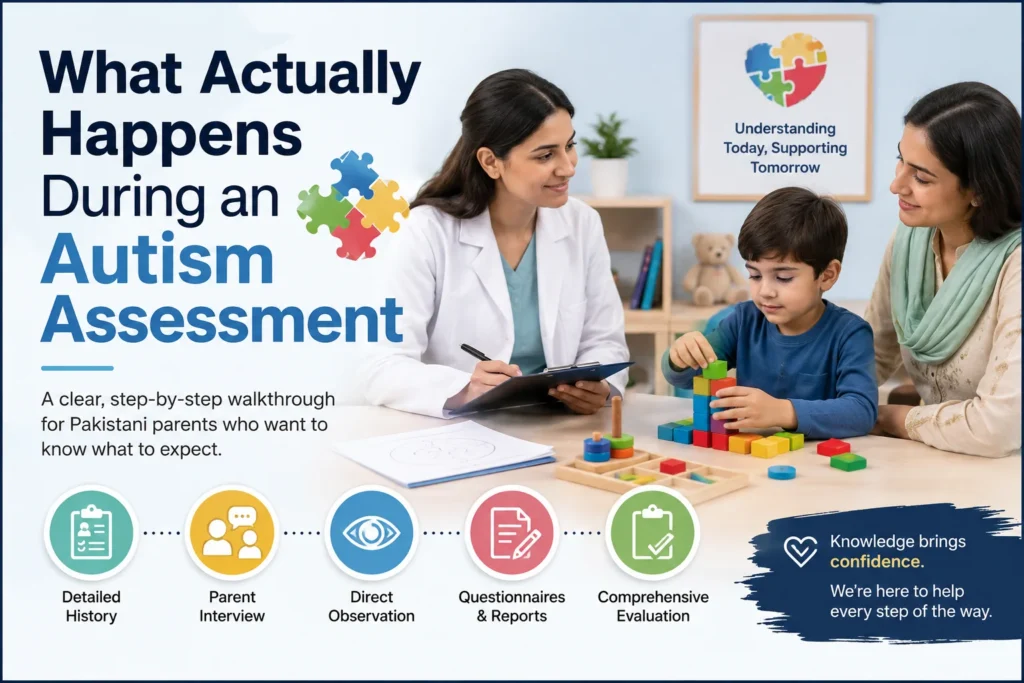
This varies somewhat by provider and by your child’s specific situation, but a properly conducted assessment commonly spans two to four separate sessions across the course of a few weeks, rather than being compressed into a single visit. This isn’t the process being deliberately slow it reflects the genuine work of gathering enough reliable information to reach a well-supported, defensible conclusion, and it also allows the clinician to observe your child more than once, which matters, because any single day can be an unusually good or unusually difficult one for any toddler or young child.
What Happens After the Sessions Are Complete?
Once all the necessary information has been gathered, the clinician analyses everything together the developmental history, the direct observation, the questionnaires, and any additional input rather than basing a conclusion on any single piece of evidence in isolation. This careful analysis leads to a full written report (our separate, detailed guide on understanding an autism report walks through this section by section) and a dedicated feedback session, during which the findings are explained to you directly, in plain, accessible language, with genuine space for your own questions.
What Should I Bring to an Assessment?
It’s genuinely useful to bring any prior reports you already have (from a paediatrician, a speech therapist, or an earlier evaluation), a baby book or any notes on developmental milestones if you kept them, a specific list of the behaviours or concerns you’ve noticed, with rough timing if you can recall it, and where possible short videos of your child’s typical, natural behaviour at home, since a single clinic visit only ever captures a small, potentially unrepresentative slice of time. (Our dedicated guide on preparing your child for assessment day covers getting your child themselves ready in more depth.)
Will the Assessment Feel Stressful for My Child?
A well-run assessment is deliberately designed to feel like structured play and natural interaction, not an exam or a stressful ordeal to be endured. Experienced clinicians build in regular breaks, follow a child’s pace to a genuinely reasonable degree, and use engaging, age-appropriate materials throughout. Some children do find any new environment or unfamiliar adult a little unsettling at first, which is entirely normal and something an experienced clinician will account for as a matter of course, not treat as a problem with the assessment itself.
Can the Assessment Happen Online?
Certain parts of the process the developmental history interview, questionnaires, and the feedback session translate genuinely well to an online format. Structured direct observation is often best conducted in person, particularly for very young children, though online-adapted observation is increasingly common and can be genuinely valid when conducted by an experienced clinician, especially for families based outside Lahore or living overseas. (Our honest, balanced answer on this exact question goes into far more detail.)
What If My Child Doesn’t Cooperate on the Day?
This happens far more often than parents typically expect, and experienced clinicians are thoroughly used to working with it. A skilled assessor adapts to a child’s mood in the moment, uses additional sessions where needed, and factors a genuinely difficult day into their overall interpretation, rather than drawing firm conclusions from a single, possibly unrepresentative interaction. If this is a specific worry for you, it’s worth raising directly with your clinician beforehand a good provider will reassure you plainly that this is fully accounted for in how the process works.
Who Should Actually Be Conducting the Assessment?
This matters more than many parents realise when choosing a provider. A proper autism assessment should be led by a clinical psychologist or a similarly qualified professional with specific training and genuine experience in developmental and autism assessment not simply general practice experience. It’s entirely reasonable to ask a potential provider directly about their specific training in tools like the ADOS-2, how many autism assessments they conduct regularly, and whether assessments are reviewed or supervised by a senior clinician where a team is involved. A confident, established provider will answer these questions plainly rather than treating them as an unusual challenge to their expertise.
What Does the Assessment Cost, and What Does That Cost Actually Cover?
Cost varies by provider and by exactly what’s included, but it typically covers the full process described above the history-taking session, the direct structured observation, any additional questionnaires or tools used, the analysis time required to bring everything together, the written report itself, and the feedback session where results are explained. It’s worth asking any provider directly what’s included in a quoted price, since a lower headline cost sometimes reflects a shorter, less thorough process, rather than simply better value.
How Should I Choose Between Different Assessment Providers?
Beyond cost, it’s worth directly comparing: the specific tools each provider uses (standardised tools like the ADOS-2 carry more weight than an informal, unstructured process), how many sessions the process typically involves, whether a full written report is provided or just a verbal summary, and how thoroughly the provider explains their process to you before you commit. A provider willing to walk you through exactly what to expect, in the kind of detail covered throughout this article, is generally a strong sign of a properly structured, professional process.
What If I Disagree With Something in the Process Itself?
If, during the assessment, something feels rushed, unclear, or inconsistent with what’s described here a single-session diagnosis, an assessor who seems unfamiliar with standardised tools, or a lack of clear explanation at any stage it’s entirely reasonable to pause, ask direct questions, and, if needed, seek a second opinion before accepting the conclusions reached. A properly conducted assessment should be able to withstand your questions comfortably at every stage, not discourage them.
How Does an Assessment Differ for a Toddler Versus an Older Child?
The overall structure history-taking, structured observation, analysis, feedback remains similar, but the specific content shifts considerably with age. A toddler assessment relies heavily on play-based observation and close attention to parent-child interaction, since a young child’s verbal self-report isn’t yet a reliable source of information. An assessment for an older, more verbal child incorporates more direct conversation with the child themselves, more discussion of their own perspective on social situations and friendships, and observation tools specifically matched to their language level rather than toddler-focused play materials.
Will Siblings or Other Family Members Be Involved in the autism assessment process?
This varies by provider and by what’s clinically useful for your specific child, but it’s common for a clinician to ask general questions about family history and dynamics, and occasionally to ask about a sibling’s development for context, particularly where there’s a family history of autism or related conditions. Siblings themselves aren’t typically part of the direct assessment sessions unless there’s a specific reason to involve them, and any such involvement should be explained to you clearly in advance.
How Should I Prepare Questions in Advance for the Assessment?
Coming in with a short, specific written list of concerns and questions tends to produce a more useful history-taking session than trying to recall everything relevant in the moment. Concrete examples are especially valuable not “he doesn’t talk much,” but “he has about five words, mostly uses them to label objects rather than request things, and doesn’t yet combine words together” since specific, detailed information helps a clinician build an accurate picture far more efficiently than general impressions alone.
What Happens if My Family Has Already Had Another Child Assessed Before?
If you have an older child who’s already been through the assessment process, it’s natural to expect a similar experience for a younger sibling but it’s worth going in without assuming an identical process or outcome. Each child is evaluated on their own individual presentation, and a provider may reasonably use a somewhat different combination of tools or session structure depending on your younger child’s specific age and profile, even within the same family and the same clinic.
What Does a Good Assessment Feel Like, From a Parent’s Perspective?
You should come away from a well-conducted assessment feeling genuinely listened to throughout, with each stage of the process clearly explained to you as it happened, and with the eventual conclusion whatever it turns out to be making clear, evidence-based sense based on what was actually observed and discussed, rather than being handed to you as an unexplained final verdict at the end of a single meeting.