
Autism in girls often looks different and gets missed more often than in boys. Here’s why, and what Pakistani parents should watch for instead.
For decades, most autism research, most diagnostic tools, and most public understanding of “what autism looks like” was built around observing boys, largely because boys were referred for evaluation far more often and in far greater numbers during the field’s formative research years.
The result is a genuine, well-documented gap that persists today: girls are diagnosed with autism later than boys on average, often by a period of years rather than months, and a significant number are missed entirely through childhood, only to be identified if ever as teenagers or adults, sometimes after a long, exhausting period of feeling that something didn’t quite add up without being able to name it. This article explains why that gap exists and, more importantly, what actually helps close it for your own daughter.
Why Does Autism Present Differently in Girls, on Average?
Research and clinical observation increasingly point to genuine, meaningful differences, on average, in how autism tends to show up in girls compared to the more “classic,” historically well-studied presentation more commonly documented in boys.
Girls with autism are more likely to show subtler, less overtly disruptive social differences that don’t immediately draw attention the way more visible presentations might; they often develop more sophisticated surface-level social imitation skills, effectively learning to copy social behaviour they observe in peers even without it coming naturally; and their intense, narrow interests, while just as genuinely intense and narrow as in any autistic child, are more likely to fall into categories seen as socially typical for girls animals, particular fictional book series, specific celebrities or fictional characters rather than the more visibly atypical interests sometimes more readily associated with autism in boys, like train timetables or specific mechanical systems.

What Is “Masking,” and Why Does It Matter So Much Specifically for Girls?
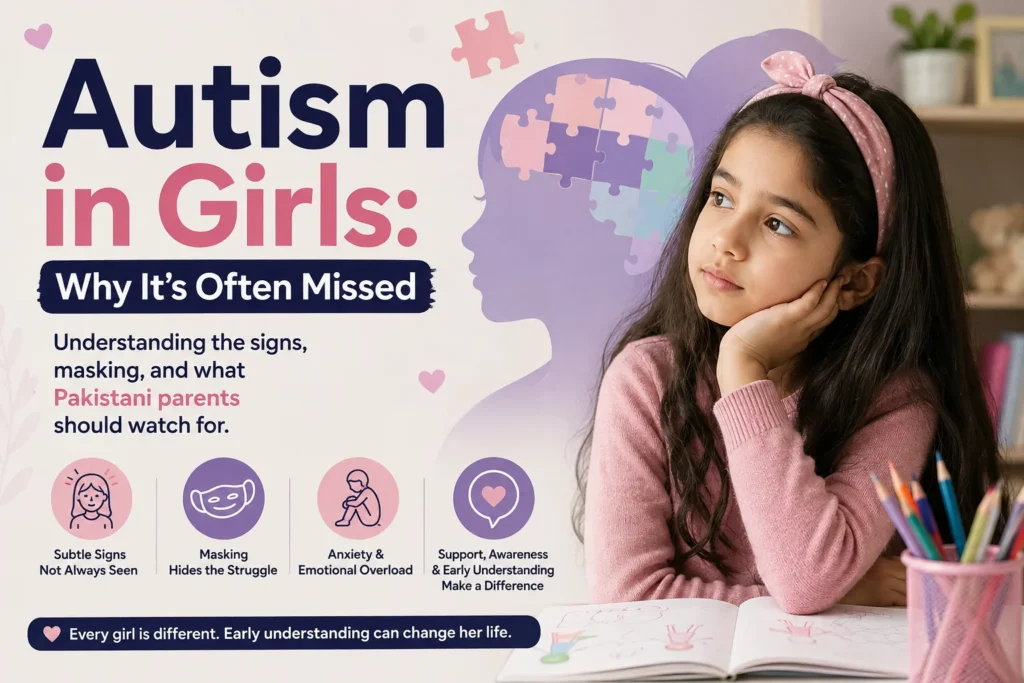
Masking refers to the effortful, often genuinely exhausting process of consciously observing and copying “typical” social behaviour carefully practised eye contact, memorised conversation openers, deliberately mimicking peers’ facial expressions and reactions in social situations specifically to blend in socially, even when none of it comes naturally or comfortably.
Masking is documented across genders, but it’s particularly well-researched and especially pronounced in girls, likely shaped by stronger, earlier social pressure placed on girls specifically to be socially agreeable, well-behaved, and “easy” from a young age. A girl who masks well can look, on the surface, like she’s managing socially just fine genuinely fooling teachers, relatives, and sometimes even her own parents while privately finding the whole ongoing effort profoundly depleting, sometimes for years without anyone around her fully realising it.
What Does Autism in Girls Actually Look Like Day to Day?
Some patterns come up often in clinical observation, though it’s worth remembering every child remains genuinely individual within these broader tendencies. Intense friendships with just one or two specific peers, rather than broader social ease across a wider group, is common, and can easily look like normal shyness or a simple personality preference rather than an autism-related trait.
Significant exhaustion, meltdowns, or complete shutdowns specifically at home after a day of holding everything together at school is another frequently reported pattern, sometimes called “after-school restraint collapse” a girl who seems entirely fine at school and then falls apart the moment she walks through the front door. Strong anxiety, sometimes hidden carefully beneath a calm or high-achieving exterior, appears often. Deep, narrow interests that are more socially camouflaged than a boy’s might typically be, and genuine, persistent difficulty specifically with unstructured social situations open playtime, group work, the unpredictable flow of a birthday party more than structured one-on-one interaction, round out the more commonly observed pattern.
Why Do Teachers and Even Paediatricians Sometimes Miss It Entirely?
Many professionals, like the broader public, were trained on a picture of autism shaped heavily by research conducted predominantly on boys, and a girl who’s quiet, polite, academically capable, and maintains at least one close friend often simply doesn’t match that internalised picture, even when she’s genuinely struggling significantly beneath a carefully maintained surface.
A girl’s underlying distress is also more likely to be interpreted by adults around her as ordinary anxiety, shyness, or “being a sensitive child” rather than considered as a possible sign of autism specifically which isn’t necessarily an inaccurate observation on its own (anxiety genuinely co-occurs with autism very commonly), but it can mean the fuller underlying picture goes only partly understood, sometimes for a very long time.
Why Might This Take Even Longer to Notice Specifically in a Pakistani Household?
A few patterns come up often in clinical practice worth naming directly and honestly. Girls are frequently socialised from a genuinely young age to be accommodating, agreeable, and not to draw undue attention to their own struggles or discomfort, which can reinforce and strengthen masking behaviour even further than it might develop otherwise.
A quiet, well-behaved, obedient daughter is sometimes actively held up and praised as an ideal within the family, rather than considered as a possible signal that something meaningful is being missed underneath the surface. And family structures with several female relatives frequently present and involved in a child’s day-to-day life can genuinely mean a daughter’s more limited peer engagement outside the family is simply less visible day to day than it might be in a smaller, more socially exposed household. None of this reflects any failing on a family’s part it’s simply useful, honest context for understanding why the signs can hide in plain sight for so long.
What Should a Parent Actually Watch For, Specifically?
Rather than looking only for the more commonly recognised, “classic” autism signs, it’s worth paying close attention to a somewhat different set of cues: genuine exhaustion or meltdowns specifically after school or social events, even when the day itself appeared to go entirely fine from the outside; a consistent pattern of one very close friendship rather than broader social ease,
especially where that one specific friendship ending causes disproportionate, significant distress; strong anxiety around unstructured or unpredictable social situations specifically, more so than structured, adult-directed ones; sensory sensitivities that might otherwise be dismissed by relatives as simple pickiness or fussiness; and a persistent underlying sense hers, or your own quiet instinct as her parent that she’s working considerably harder to “keep up” socially than it appears from the outside looking in.
Does a Late Diagnosis in a Girl Mean Anything Was Done Wrong by Her Parents?
No, and this deserves to be stated plainly and without hedging. Given how genuinely well-documented and widespread this specific pattern is across research and clinical practice internationally, a late diagnosis in a girl reflects a genuine, systemic gap in how autism has historically been researched, recognised, and understood not a failure of attentiveness, care, or observation by parents or teachers who simply didn’t have the fuller picture available to them at the time. What matters most now is putting the right support in place going forward, at whatever age that clarity eventually arrives.

What Happens if Autism in a Girl Goes Unidentified Into the Teenage Years?
The underlying assessment process itself remains the same a thorough developmental history, structured direct observation, and a full, considered clinical picture but an experienced clinician assessing a girl will specifically and deliberately probe for masking, internalised distress, and the more subtle presentation patterns described throughout this article, rather than relying primarily on the more overt, “classic” indicators that a girl may well have learned, consciously or not, to camouflage effectively over time.
How Does Puberty Change the Picture for an Autistic Girl?
Adolescence tends to significantly increase the social and emotional demands placed on any Autism in a Girl , and for an autistic girl already working hard to keep pace socially, this shift can be particularly difficult. Friendship groups become more complex and less structured, social communication becomes more reliant on subtle, unspoken cues and rapidly shifting group dynamics, and physical changes bring their own sensory and emotional adjustments layered on top of everything else. It’s genuinely common for signs that were manageable, or even entirely unnoticed, in earlier childhood to become considerably more visible or alternatively, for masking to intensify even further as a girl works harder still to keep up appearances during this more socially demanding stage.
What Co-Occurring Difficulties Are Common Alongside Autism in Girls?
Anxiety is particularly common alongside autism in girls, sometimes becoming the more visible, presenting concern that a family or clinician notices first, with the underlying autism only identified later through a more thorough evaluation. Depression, particularly in adolescence, and in some cases patterns related to eating and body image, have also been documented at meaningfully higher rates among autistic girls compared to the general population sometimes connected to the exhausting cumulative effort of masking and the sense of not quite fitting in despite trying hard to. Recognising these co-occurring patterns matters because addressing anxiety or mood difficulties alone, without also identifying and addressing the underlying autism, often leaves a girl without the fuller support she actually needs.
Why Do So Many Girls and Women Discover They Might Be Autistic Only in Adulthood?
A growing number of women reach adulthood sometimes only after their own child is diagnosed and they begin recognising strikingly familiar patterns in themselves before ever considering that their own lifelong experiences might reflect autism rather than simply anxiety, introversion, or “being different.” This pattern reflects the same underlying gap described throughout this article, compounded further over additional decades of effective masking, increasing life demands, and a historical near-total absence of research or public awareness specifically addressing how autism presents in women. It’s a genuinely common story in clinical practice, worth mentioning here because it illustrates just how deep and persistent this recognition gap has been.
How Should Extended Family Reactions Be Handled if They Differ Based on Gender?
It’s worth naming directly a pattern that sometimes emerges in Pakistani families specifically: a son’s differences are occasionally more readily accepted or excused (“he’s just like his father was”), while a daughter’s identical differences attract more concern about her future prospects, particularly around marriage and social reputation within the extended family. This asymmetry, where it exists, deserves gentle but firm pushback your daughter’s genuine needs and wellbeing matter regardless of how her differences are being culturally interpreted by relatives, and a proper evaluation and appropriate support shouldn’t be delayed or minimised because of gendered assumptions about what matters more for a daughter’s future.
What Should I Do if This Sounds Like My Daughter?
Trust the overall pattern rather than the absence of the most stereotypical signs you may have read about elsewhere. If your daughter seems to be working unusually hard to manage socially, experiences disproportionate distress around social unpredictability specifically, or consistently falls apart at home after successfully holding everything together elsewhere, that pattern is genuinely worth a proper professional evaluation regardless of how well she appears to be “coping” on the surface to teachers, relatives, or even to you most of the time, and regardless of her current age.