
A practical guide for Pakistani parents on getting real school accommodations for an autistic child what to ask for and how to advocate effectively.
Getting a diagnosis is one thing. Translating that diagnosis into actual, meaningful support at your child’s school in Pakistan is a different, often considerably harder challenge particularly in a system that doesn’t always have the same formal accommodation structures more familiar from countries like the UK or the US. This guide focuses specifically on what’s practically achievable within the Pakistani school system, and how to advocate for it effectively without burning bridges you’ll need for years to come.
What Does “Accommodation” Actually Mean in a Pakistani School Context?
Unlike some countries with legally mandated, formally documented accommodation plans, Pakistani schools vary enormously in how structured their support process actually is ranging from well-established special education departments in some private schools, through to entirely informal, teacher-dependent arrangements in others where support depends heavily on which specific teacher your child happens to have that year. This means accommodations here are often less about following a fixed legal process and considerably more about building a genuine, ongoing working relationship with your child’s school, backed by clear, specific information drawn from your child’s assessment.
What Should I Bring to the School Conversation?
Your child’s written assessment report is your single most useful tool in this conversation not because every school will read it in full, but because it gives you specific, professionally grounded language to draw from rather than relying purely on your own informal description of your child’s needs. Bring a concise summary of the key recommendations specifically relevant to school, rather than the entire clinical report, and be genuinely ready to translate clinical language into practical, day-to-day classroom terms the teacher can actually use immediately.
What Kind of Accommodations Are Realistic to Ask For?
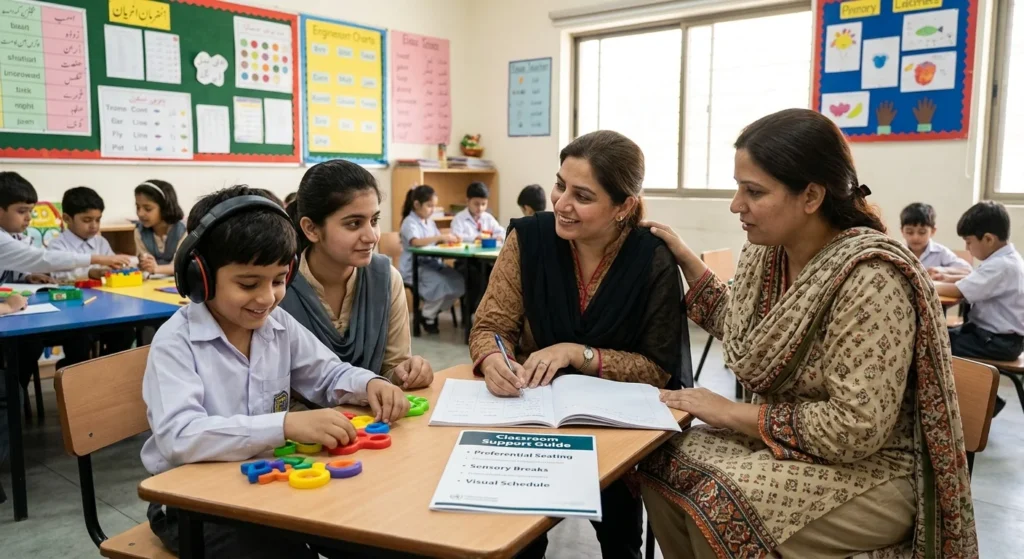
Common, genuinely achievable accommodations include preferential seating away from high-distraction areas like doors or windows, advance warning before transitions or schedule changes wherever possible, permission for brief sensory breaks when your child becomes overwhelmed, modified or reduced homework load specifically where academic demands are contributing to significant distress, extra time for written work or exams where genuinely relevant, and a quiet space available during particularly overwhelming school moments like assemblies or fire drills. Starting with two or three specific, clearly explained requests tends to work considerably better in practice than presenting an exhaustive list all at once in a single meeting.
Should I Consider a Shadow Teacher?
Framing matters enormously here, and it’s worth thinking through carefully before the conversation happens. Approaching the school as a genuine partner trying to help your child succeed rather than presenting a list of demands or implying the school has somehow already failed tends to produce far better, more sustained cooperation over the following months and years. It’s also genuinely useful to acknowledge the classroom teacher’s own real constraints, such as large class sizes and limited specific training in this area, rather than assuming any initial resistance necessarily reflects a lack of care on their part.
What If the School Says They “Don’t Do” Accommodations?
This response is unfortunately common, particularly in schools without an established special education framework already in place. In this situation, it’s often more productive to reframe specific requests as simply practical, general classroom management tips rather than formal “accommodations” that require an official commitment for example, framing advance transition warnings as good general classroom practice that benefits many children, rather than a formal, named policy the school has to officially adopt. Building a genuine relationship with one or two specific, sympathetic staff members often the class teacher directly, rather than only school administration can also make a real, practical difference even in the complete absence of any formal school policy.
What If the Current School Genuinely Isn’t a Good Fit?
Sometimes, despite genuine, sustained effort on both sides, a specific school environment simply isn’t well suited to a particular child’s needs overcrowded classrooms, rigid structure, or limited staff flexibility can all represent real, practical barriers that no amount of advocacy fully overcomes. This is worth acknowledging honestly rather than continuing to push against a fundamentally poor fit indefinitely, at real cost to both your child and your own energy. (Our separate guide on choosing a supportive school for a neurodivergent child goes into more depth on evaluating this specific decision.)
How Do I Handle Bullying or Peer Difficulties Connected to My Child’s Differences?
Address this directly and promptly with the school rather than assuming it will simply resolve on its own over time autistic children can be particularly vulnerable to bullying, sometimes without recognising or reporting it themselves in quite the same way another child might. Keep a simple, dated record of specific incidents as they happen, and don’t hesitate to escalate to school leadership directly if a classroom-level response alone isn’t proving sufficient.
Should I Tell the Classroom Teacher About the Diagnosis Directly?
In most situations, yes, guided by your own judgment about the right timing and framing for your family. A teacher working from clear, accurate information tends to respond far more effectively and appropriately than one left guessing at explanations for behaviour they don’t understand. You’re entitled to share as much or as little clinical detail as feels right to you, keeping the conversation focused on practical, actionable information rather than an exhaustive clinical history the teacher doesn’t actually need.
How Can I Support My Child’s Learning at Home Alongside What’s Happening at School?
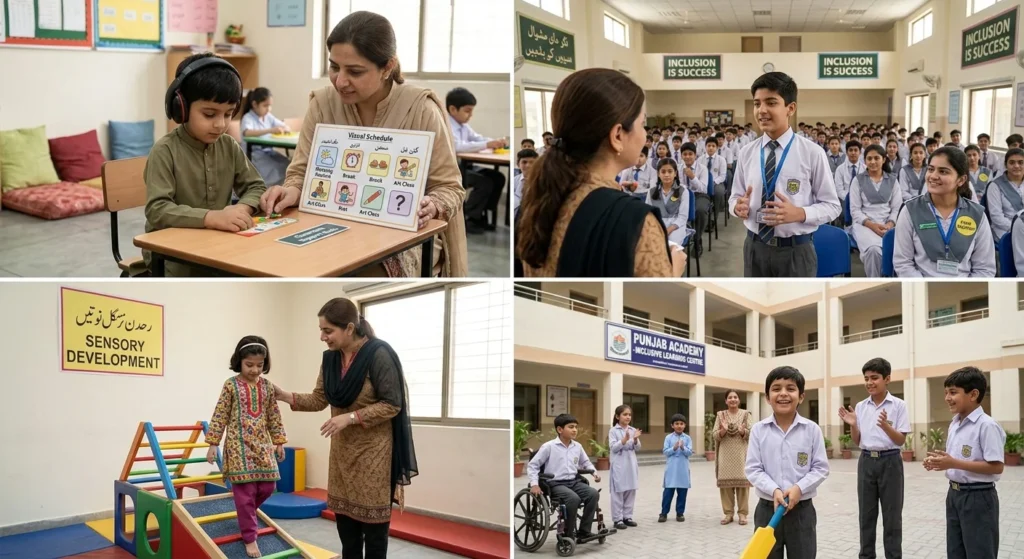
Genuine consistency between home and school meaningfully helps your child using similar visual schedules, similar transition warnings, and similar calming strategies in both settings reduces the number of entirely different “systems” your child has to learn and navigate at once. (Our guide on supporting learning at home without pressure covers this specific overlap in more depth.)
What About Exams and More Formal Assessments?
For older children, it’s worth proactively discussing exam accommodations extra time, a quieter exam room, or breaking a long exam into shorter sessions well before exam periods actually begin, rather than scrambling to arrange something at the last possible moment. Schools offering formal board exams, such as Matric or O-Levels, sometimes have more established, documented accommodation processes than day-to-day classroom support does, which is genuinely worth researching specifically for your child’s particular exam board well in advance.
How Do I Handle a School Year Transition or a Change of Teacher?
Each new academic year, or any change in teacher, effectively resets a considerable amount of the informal understanding you may have carefully built up with a previous teacher over time. It’s worth treating the start of each school year as an opportunity to proactively reintroduce your child’s specific needs to the new teacher, rather than assuming that understanding automatically carries forward without any active effort on your part.
What if I Feel Like I’m the Only One Advocating for My Child?
This is a genuinely exhausting, remarkably common feeling among parents in this situation, and it’s worth deliberately building support around yourself too, not just focusing entirely outward on the school. Connecting with other parents navigating similar school advocacy challenges (our guide on building a support network in Pakistan covers this specifically), and recognising that persistent, calm advocacy over time genuinely does shift outcomes, even when progress feels frustratingly slow month to month, can help sustain the effort this genuinely requires.
What Role Do School Counsellors Play, Where They Exist?
Some larger private schools in Pakistan now employ a school counsellor or a dedicated learning support coordinator, and where this role exists, it’s often a more productive first point of contact than approaching the classroom teacher or administration directly. A counsellor typically has more capacity to coordinate across different teachers your child interacts with, maintain consistent records of what’s been agreed, and act as an ongoing bridge between your family and the school more broadly than a single classroom teacher managing many other responsibilities can realistically offer.
How Should I Handle Group Activities and PE or Sports Classes?
Group-based classes physical education, group projects, drama or music classes involving the whole class together often present specific additional challenges around noise, unpredictability, and social demands that a quieter, more structured lesson doesn’t. It’s worth having a specific conversation about these particular classes rather than assuming general classroom accommodations automatically extend to them, since a teacher who accommodates well during a maths lesson may not have considered what additional support might help during a chaotic PE session.
What if Different Teachers Respond Very Differently to the Same Requests?
This is genuinely common, particularly once your child has multiple subject teachers rather than a single primary class teacher, and it’s worth addressing directly rather than assuming inconsistency will resolve itself. Where possible, having one consistent point of contact at the school a class teacher, counsellor, or administrator who can help communicate agreed accommodations across different subject teachers tends to produce more consistent support than approaching each teacher entirely separately and hoping for similar responses.
Should I Put Agreed Accommodations in Writing?
Yes, wherever practical. A brief, friendly email or written note summarising what was discussed and agreed in a meeting even something as simple as “thank you for agreeing to X and Y, we’ll check back in after a month to see how it’s going” creates a shared record that helps prevent misunderstandings later, and gives you something concrete to refer back to if a new term or a staff change disrupts what had been working.
How Do Government and Private Schools Typically Differ in This Regard?
Larger, well-resourced private schools more often have some existing framework for learning support, even if informal, simply due to greater staffing and resources. Government schools vary enormously by specific institution, and while some have made genuine progress in recent years, resource constraints often mean less individualised capacity for accommodation regardless of a teacher’s personal willingness to help. This isn’t a reason to expect less from a government school outright, but it’s worth calibrating your expectations and your specific requests to what’s realistically achievable within a given school’s actual resources, while still advocating clearly for what your child needs.
The Bottom Line
Getting real, meaningful accommodations in a Pakistani school setting is considerably less about following a formal legal process and considerably more about providing clear information, making specific and reasonable requests, and building a genuine, ongoing working relationship with your child’s particular school built and actively maintained over time, not settled once and for all in a single meeting.