
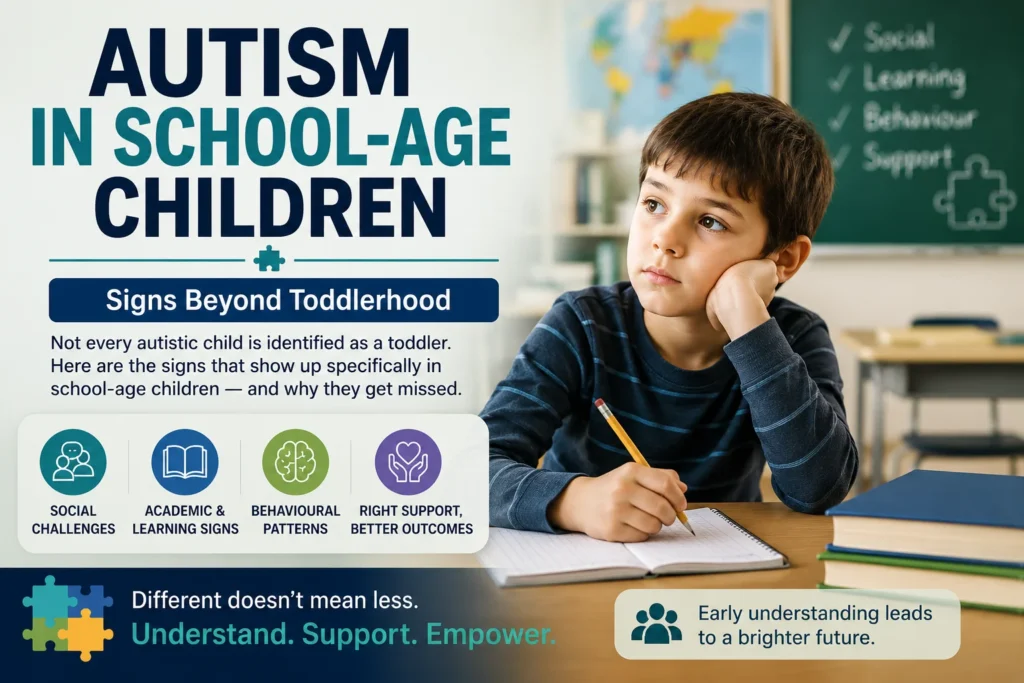
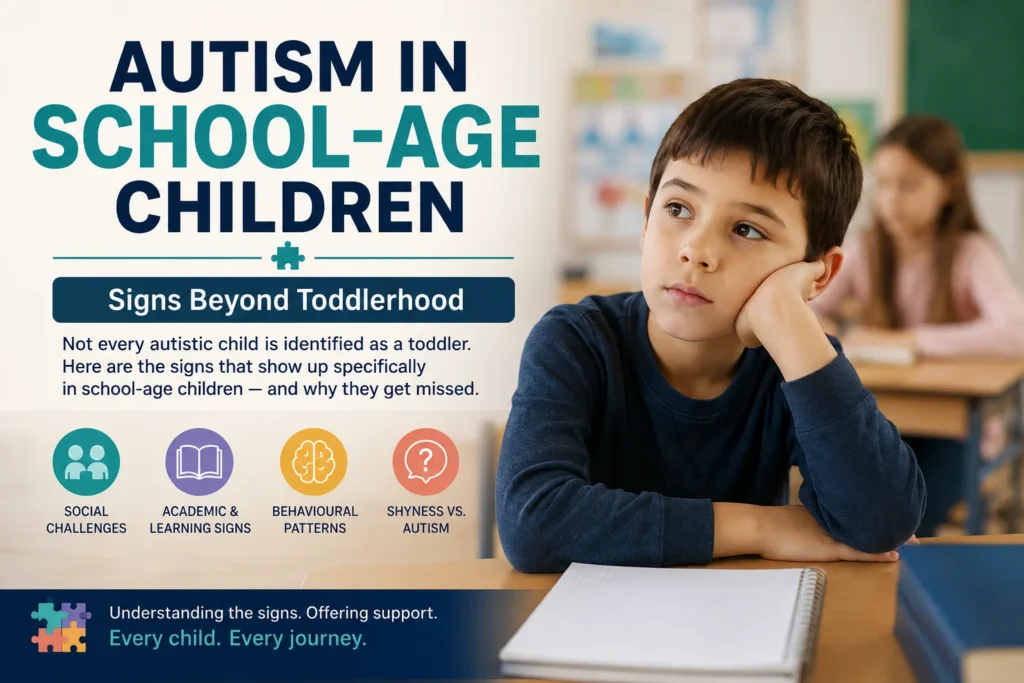
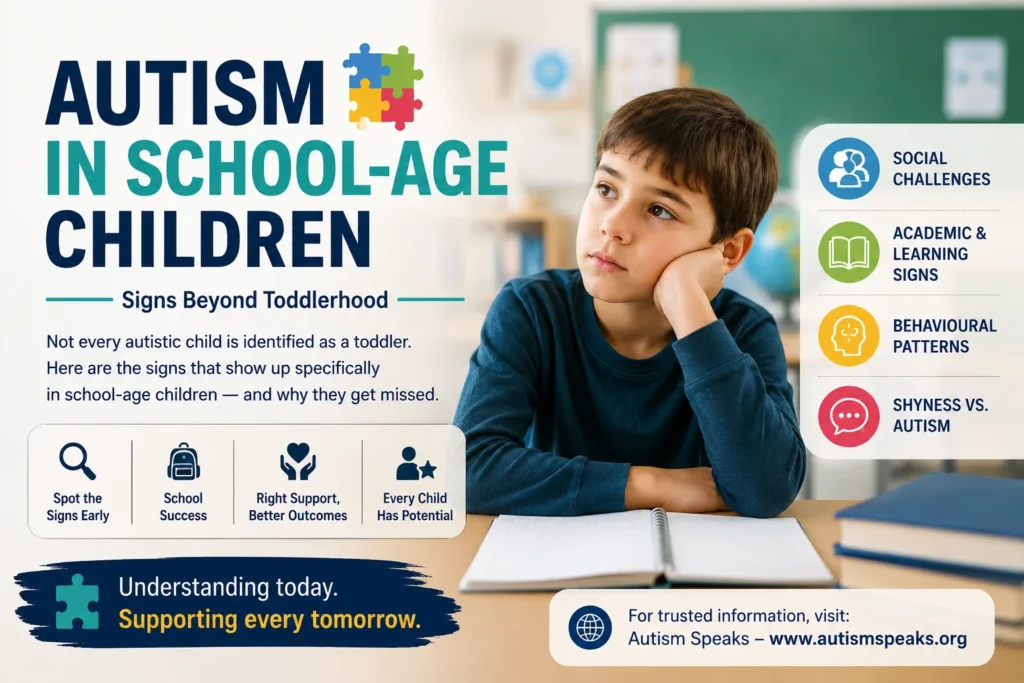
Not every autistic child is identified as a toddler. Here are the signs that show up specifically autism in school age children and why they get missed.
Most public conversation about autism signs focuses heavily on toddlers the classic image of a two-year-old not yet talking or pointing to share interest. But a significant number of children aren’t actually identified until they’re already well into school, sometimes years into their education, when a considerably different, more academically and socially demanding environment reveals differences that simply weren’t as visible back at home. This guide focuses specifically on what autism can look like in school-age children, roughly ages six through twelve, and why this later pattern of recognition happens so often.
Why Do Some Autistic Children Go Unnoticed Until School Age?
A few genuine, well-documented reasons come up repeatedly in clinical practice. Some children have milder or more subtle presentations that don’t create obvious difficulty within a flexible, familiar home environment, but become far more apparent once faced with a structured classroom, larger peer groups, and considerably more complex, unstructured social expectations than home ever required.
Others have developed strong compensatory strategies over their early years closely copying peers, relying heavily on routine and memorisation that work reasonably well during the earliest years of school but become progressively harder to sustain as social and academic demands steadily increase with each passing grade. And for some children, particularly girls (our dedicated guide on autism in girls covers this specific pattern in full), genuinely effective masking simply delays recognition even further, sometimes for years.
What Are the Social Signs to Watch for in Autism in School Age Children?
Watch for difficulty navigating unstructured social time specifically recess, lunch, informal group work considerably more than structured, adult-led classroom activities. One or two intense friendships rather than broader peer ease is another common pattern, sometimes accompanied by significant distress if that one specific friendship changes or ends entirely.
Difficulty understanding sarcasm, idioms, or indirect language is common too, sometimes leading a child to take things very literally in a way peers find confusing or, occasionally, amusing at the child’s expense. Missing subtler social cues not noticing when a peer seems bored or clearly wants to change the current activity, continuing to talk about a preferred topic well past when others have lost interest rounds out this cluster, alongside a general preference for playing or working alone even when genuine opportunities for group interaction are readily available.
What Academic and Learning Signs Might Point to Autism?
Strong performance in specific subjects alongside genuine, significant difficulty in others, sometimes considerably more pronounced than typical variation between subjects, is a pattern worth noting. Difficulty with open-ended or creative tasks specifically, alongside genuine strength in tasks with clear, well-defined structure and rules, is another common pattern. Extremely detailed knowledge on one specific narrow topic, well beyond what’s typical for the child’s age, often appears alongside these other signs. And difficulty adapting when a usual routine or format changes, even for something relatively minor like a substitute teacher or a rearranged timetable, can point toward the same underlying pattern.
What Behavioural Signs Show Up More at School Age Than in Toddlerhood?
Meltdowns or complete shutdowns specifically after school, even when the school day itself seemed to go reasonably well on the surface, are a pattern worth paying close attention to (our guide on autism in girls covers this specific pattern in more depth, though it genuinely appears in boys too, just somewhat less commonly discussed). Strong, sometimes disproportionate distress around specific transitions the start of a new school term, a change in classroom seating, a new teacher arriving mid-year is another common sign at this age.
And repetitive behaviours that may have become considerably more subtle or “internalised” compared to toddlerhood quieter self-soothing movements, or intense focus on specific objects or fixed routines rather than more overt toddler-era behaviours round out this behavioural cluster.
Could This Just Be Shyness or Introversion Instead?
This is a fair, genuinely common question, and the honest answer is that shyness and autism can look quite similar on the surface while differing considerably underneath. A shy child generally wants social connection and finds it anxiety-provoking to actually initiate, but still understands the underlying social “rules” being navigated by everyone around them. An autistic child may find the underlying social rules themselves genuinely confusing or effortful to track and apply, regardless of how much anxiety is or isn’t present alongside that difficulty. This precise distinction is exactly the kind of thing a proper assessment is specifically designed to clarify, rather than something reliably distinguishable through casual observation alone, however attentive a parent or teacher might be.
Why Might a Teacher Notice Signs Before a Parent Does?
Teachers see your child within a specific, genuinely comparative context surrounded by same-age peers, in structured group settings, across a consistent daily routine repeated many times that parents simply don’t have the same vantage point on at home. A teacher raising a concern isn’t necessarily a judgment of your parenting; it often reflects genuinely useful information gathered from an environment where certain specific patterns are simply easier to notice than they would be in the more flexible, less comparative setting of home life.
What Should I Do If My Child’s School Raises a Concern?
Take it seriously as one valuable, specific source of information, without either dismissing it defensively or assuming it’s automatically and entirely correct on its own. A school’s observation is a genuinely good reason to seek a proper professional evaluation it isn’t, by itself, a diagnosis, and a thorough assessment carefully considers the school’s specific input alongside your own observations and a structured, direct evaluation of your child.
Does a School-Age Diagnosis Mean Early Intervention Opportunities Were Missed?
Not in any way that should be treated as a closed door or a source of ongoing guilt. While earlier intervention is generally associated with certain genuine advantages, meaningful, effective support remains genuinely available and valuable at school age and well beyond it this isn’t a narrow window that simply closes at a fixed point in early childhood, and a diagnosis arriving now still opens real, useful, and effective doors for support going forward from here.
How Is an Assessment Different for a School-Age Child Compared to a Toddler?
The overall process remains broadly similar developmental history, structured observation, and a full clinical picture built carefully over multiple sessions but a school-age autism assessment typically incorporates considerably more direct conversation with the child themselves, more emphasis on academic and social functioning specifically at school, sometimes including formal teacher input or questionnaires, and observation tools appropriately matched to the child’s actual verbal and cognitive level rather than the toddler-focused play materials used for much younger children.
What Support Typically Follows a School-Age Diagnosis?
This varies considerably by individual child, but often includes some combination of school-based accommodations (our dedicated guide on autism and school in Pakistan covers this specific process in depth), social skills-focused support, and, depending on the specific profile identified, ABA therapy ,speech therapy, or occupational therapy, each addressing particular areas of need highlighted through the assessment itself.
How Do Friendships Typically Change for an Autistic Child as They Move Through Primary School?
Early primary school friendships often form more naturally around shared, structured activities a specific game, a seat assignment, a shared interest and can feel reasonably manageable for an autistic child during these years. As children move through the later primary years, friendships increasingly depend on more unstructured, unspoken social navigation group dynamics, subtle inclusion and exclusion, evolving shared interests which can become considerably more difficult to track and participate in, sometimes making a previously manageable social picture noticeably harder around ages nine or ten.
What Should I Say to My Child About the Process?
For a school-age child old enough to notice something is happening around them, honest, simple, age-appropriate framing that you’re working together with a professional to understand how their brain works and how to help both school and things at home go more smoothly for everyone tends to work considerably better than either avoiding the topic entirely or over-explaining clinical detail they’re not yet ready to fully process.
How Do Report Cards and Teacher Comments Sometimes Hint at Undiagnosed Autism?
Looking back through several years of report cards can sometimes reveal a pattern that wasn’t obvious in any single year on its own repeated comments about a child being “in their own world,” struggling with group work despite strong individual academic performance, or difficulty with transitions between activities, appearing consistently across different teachers and different years. This retrospective pattern, when parents notice it, is worth bringing directly to a clinician as part of the developmental history, since it can add genuinely useful context beyond what’s remembered from casual conversation alone.
What About Children Who Are Identified Through a Sibling’s Diagnosis?
It’s common for a school-age child’s own autism to be identified only after a younger or older sibling is assessed first, with parents suddenly recognising strikingly familiar patterns in their other child that hadn’t previously registered as anything more than personality. This is a completely legitimate, common pathway to diagnosis, not a less valid one, and it’s worth pursuing a proper evaluation for the older or previously unassessed sibling directly, rather than assuming the family “already knows” based on the first child’s experience.
Does a School-Age Diagnosis Change How Teachers and Peers Already Perceive My Child?
This is a genuine, practical concern worth thinking through. In practice, a diagnosis usually doesn’t change how a child is perceived so much as it gives everyone around them teachers especially a more accurate framework for understanding behaviour they’d already been noticing and, in many cases, already responding to with some confusion or frustration. Sharing the diagnosis thoughtfully with relevant staff, as covered in our guide on autism and school in Pakistan, often shifts existing perceptions in a more understanding direction rather than introducing an entirely new judgment that wasn’t already forming.
How Common Is a School-Age Diagnosis Compared to Toddler-Age Diagnosis?
While earlier identification has become more common as awareness has grown, a meaningful proportion of autistic children figures vary across different studies and populations, but it’s consistently far from rare are still first identified during the primary school years rather than in toddlerhood. This is worth knowing simply to counter the sometimes-implicit assumption that a “real” or straightforward case of autism is always caught early, which can otherwise make a school-age diagnosis feel unusual or somehow suspect when it genuinely isn’t.
The Bottom Line
Autism doesn’t always announce itself clearly in toddlerhood, and a school-age diagnosis is neither rare nor a sign that anything was missed through carelessness or inattention. If your school-age child is showing a genuine, persistent pattern across social, academic, or behavioural domains even without the more classically recognised toddler-era signs you may have read about elsewhere that pattern is genuinely worth a proper, thorough evaluation.