
Online Psychology Services for Pakistani and Indian Families in the USA
Raising children in the United States while holding on to the language, values and family ties of home is something many Pakistani and Indian parents manage every day. Most of the time it works well. But when a child is struggling (with attention at school, with worries, with behaviour, with development, or with growing up between two cultures), parents often find it hard to get support from someone who understands the whole picture.
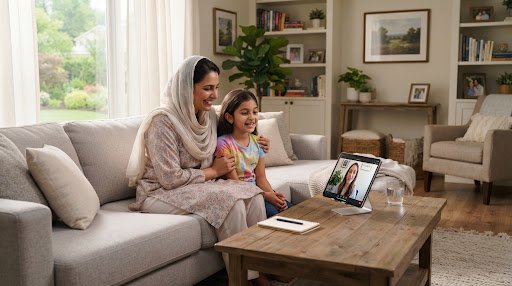
Umme Habiba is a clinical psychologist based in Lahore, Pakistan, who works with children, adolescents and their parents. Through online sessions on Google Meet, she offers parent guidance, counselling and therapy to Pakistani and Indian families living in the USA. Sessions are in Urdu and English.These are online services provided from Pakistan. There is no clinic in the USA. Umme Habiba’s only clinic is at House 397-B, Faisal Town, Lahore.
- No Waitlists
- Urdu & English
- HIPAA-Compliant
5.0 Rating
Trusted by 200+ families in USA.
Bilingual Excellence
EST, CST, PST evening & weekend slots
Bilingual Sessions
Fluent in Urdu and English
100% HIPAA-Compliant
Encrypted high-definition portal
School Accommodations
Clinical notes for 504 & IEP context
Who this service is for
This service is for parents and caregivers of children and adolescents living in the United States, including:
The practice doesn’t work with adults as individual clients. Parents are seen in their role as parents, in relation to their child’s needs.
Concerns US-based families often bring
Every family is different, but some themes come up again and again for South Asian families raising children in America.
School concerns in a system that works differently
Many parents went to school in Pakistan or India, where expectations, teaching styles and the relationship between parents and teachers were very different. When a US teacher raises a concern about attention, reading, behaviour or social skills, parents may not know how seriously to take it, what the school is suggesting, or what their child is entitled to. A conversation in your own language, with someone who understands both education systems in broad terms, can help you work out what's happening and what to ask.
Attention, focus and organisation
Parents often describe a bright child who can't finish homework, forgets assignments, loses things, or seems not to listen. These difficulties can have many causes: attention difficulties, anxiety, learning difficulties, sleep, or stress. Parent guidance can help you understand the pattern and support your child at home, while deciding whether a formal assessment would be useful.
Anxiety and pressure
Academic expectations in many South Asian families are high, and American schools add their own pressures: competitive programmes, advanced courses, extracurricular activities and college admissions. Some children respond with worry, perfectionism, stomach aches before school, or avoidance. Others become irritable or shut down. Therapy can help a child or teenager learn to manage worry, and help parents respond in ways that reduce anxiety rather than accidentally increase it.
Behaviour and big emotions
Meltdowns, anger, defiance and daily battles over screens, homework and bedtime are common reasons families get in touch. Umme Habiba works with parents on practical, consistent responses and, where appropriate, with the child directly on emotional regulation skills.
Growing up between two cultures
Children of immigrant families often live with two sets of expectations: at home and at school, in the family and with friends. Questions about language, religion, food, dating, friendships and independence can create tension, especially in adolescence. Many parents worry that their child is drifting away. Many teenagers feel their parents don't understand their world. Counselling offers a space where both sides can be heard without anyone being told they are wrong.
Grandparents and extended family
When grandparents live with the family or visit for months at a time, they often have strong views on discipline, food, sleep, education and whether a child "needs" psychological help at all. Differences between generations are not a problem to be fixed. They are part of family life. But they can leave a child with mixed messages. Sessions can help families agree on a shared approach.
Developmental differences and new diagnoses
Some families contact us after a US professional has raised the possibility of autism, ADHD or a learning difficulty, or after a diagnosis has been given. Parents may want help understanding what it means, explaining it to relatives, or deciding what support to prioritise. Guidance in Urdu or English can make an unfamiliar process feel more manageable.
Stigma and privacy
In many South Asian communities, seeking psychological help for a child still carries stigma. Families sometimes delay because they worry about what relatives or the community will think. Sessions are confidential, and the first conversation is simply about understanding your concern. It commits you to nothing.
What online support can include
Depending on your child’s needs, online sessions may include:
Parent counselling
practical guidance for parents on behaviour, routines, homework, screens, sibling conflict, and parenting a child with additional needs. Parents can join from different locations if needed.
Interactive Digital Tools
Child anxiety counselling
for children and teenagers dealing with worry, school stress, separation anxiety or exam pressure.
Child-Led Gentle Exposure
Emotional regulation
skills for children and teenagers who struggle with anger, meltdowns or overwhelming feelings, alongside co-regulation coaching for parents. For some adolescents, this may draw on DBT-informed skills.
Standardized Clinical Tools
Child behavioural therapy
much of this is delivered through parent coaching, which works well online.
Urdu & English Consults
Family therapy
sessions that bring family members together to improve communication and reduce conflict. Relatives in different cities or countries can join the same session.
Urdu & English Consults
Guidance after a diagnosis
understanding a report you've received in the US, and deciding how to support your child at home.
Urdu & English Consults
ABA parent coaching
guidance for parents of autistic children on using ABA-informed strategies at home.
Urdu & English Consults
Not every service suits every child online. Very young children, for example, often benefit more from sessions where much of the work is done with parents. This will be discussed at the first consultation.
Most counselling, parent guidance and many therapy sessions can take place over video.Some formal assessments can’t be completed online. Standardised observations used in autism assessment, such as the ADOS-2, and cognitive tests such as the WISC or WPPSI, are designed to be carried out face to face with the child. These parts of an assessment take place in person at the clinic in Lahore. Parent interviews, review of earlier reports and feedback can often be done online counselling.
What can and can't be done online
Planning an assessment during a visit to Pakistan
Many Pakistani families in the US travel to Pakistan during school holidays. If an in-person assessment would help your child, it may be possible to plan it around a visit:
1
Before you travel
An online consultation to discuss your concerns and decide whether an assessment is appropriate; a parent interview online; and sharing school reports and any US evaluations.
2
During your visit
the in-person parts of the assessment at the clinic in Faisal Town, Lahore.
3
After you return
a feedback session online and a written report.
Language, culture and family
Sessions are in Urdu and English, and families can move between the two as they naturally would at home. Families from India are very welcome. If you’d prefer a language other than Urdu or English, please mention it when you get in touch, so we can tell you honestly whether sessions will work for you.
Culture is treated as part of the child’s life, not as an obstacle. Family values, religion, respect for elders, the role of grandparents and expectations about education are taken seriously. At the same time, the child’s experience of growing up in America is taken seriously too. The aim isn’t to choose one world over the other. It’s to help the child and family find a way that works for them.
Important information about online services from abroad
Umme Habiba practises as a clinical psychologist in Pakistan. She doesn’t hold a professional licence in any US state. In the United States, the rules on who may provide psychological services to someone located in a particular state are set at state level, and they may affect whether and how online services from abroad can be provided. Before booking, we’ll ask which state you live in and what kind of support you’re looking for, so you can make an informed decision about whether this service is appropriate for you. If a US-based service would be more suitable, we’ll tell you.
Privacy and online sessions
Online sessions take place on Google Meet. To keep sessions private:
- Join from a quiet room where you won’t be overheard
- Use headphones if other family members are nearby
- Make sure younger siblings are occupied elsewhere
- For sessions with a teenager, give them a private space so they can speak freely
What you share is confidential, within the limits described in the Privacy Policy. With your written consent, information can be shared with your child’s school or another professional.
How online sessions work
1
Get in touch
Send a WhatsApp message or email describing your concern, your child's age and the US state where you live
2
Initial conversation
A short call to understand what you're looking for, explain what can be offered online, and discuss whether this service is appropriate for your situation.
3
First consultation
An online session via Google Meet with one or both parents. Umme Habiba will ask about your child's development, health, schooling, family and the current concern
4
An agreed plan
Together you decide what would help: parent sessions, sessions with your child or teenager, family sessions, or a combination.
5
Regular review
Progress is reviewed as you go, and the plan changes if it isn't helping.
Scheduling from the USA
Sessions are arranged within clinic hours in Pakistan, 9:00 AM – 8:00 PM Pakistan time. Pakistan does not change its clocks, but the US does, so the equivalent US times shift twice a year.
Virtual Consultation
$65 USD / session
Equiv. approx PKR 18,000 • Billed transparently
- 100% HIPAA-compliant secure encrypted video link
- International Visa, MasterCard & Stripe accepted
- Post-session action plan & parent guidance notes
- Bilingual support (Urdu for elders / English for youth)
Transparent Care
Clinical Availability
- Dedicated slots aligned with US school and work days
Slots Open
Eastern Time (EST)
New York, Washington DC, Florida
12:00 AM – 11:00 PM
& 11:00 PM – 10:00 PM
Pacific Time (PST)
California, Seattle, Pacific Coast
11:00 AM – 10:00 AM
& 10:00 PM – 9:00 PM
Weekend Coverage
Saturday & Sunday Mornings
By Appointment
Dedicated family slots
- For most US families, this means early-morning sessions before school or work, or late-evening sessions. Parent sessions are usually easier to fit in than sessions with children. Let us know your time zone and your preferred times, and we'll tell you honestly what's possible.
- Confidential • High Definition • No Special App Required
Working alongside services in the USA
Online sessions with a psychologist in Pakistan don’t replace services in the United States. For many families, the most useful approach combines the two: local services for formal evaluations, school support and medical care, and culturally informed guidance to help the family understand and use them.
Schools
Public schools in the US have their own processes for identifying and supporting children with disabilities or learning needs, including evaluations and plans such as an IEP (Individualized Education Program) or a Section 504 plan. Parents can usually request a school evaluation in writing. If a report from outside the school district is shared, the school decides how to use it and may carry out its own evaluation. A report written in Pakistan should not be relied on as a substitute for your child's school evaluation. Please speak to your child's school about their process.
Health care and medication
Umme Habiba doesn't prescribe medication. If medication might be worth considering, for example for ADHD, your child would need to see a US-licensed physician such as a paediatrician or child psychiatrist. With your written consent, relevant information can be shared with them.
Insurance
Health insurance plans in the US generally have their own rules about which providers they cover. Don't assume online sessions from Pakistan will be covered. Check with your insurer if this matters to you.
Local therapists
If your child needs frequent in-person therapy, or support that must be delivered locally, you may be advised to find a US-based provider. Umme Habiba can continue to support you as a parent alongside that care where appropriate.
“Finding a child psychologist in Texas who truly understands both my daughter’s American school anxiety and our Pakistani family dynamics was nearly impossible until we met Psychologist Umme Habiba. The difference in her confidence and our home peace has been remarkable.”
Ayesha & Tariq M. Parents of 9-year-old • Dallas, TX
Frequently Asked Questions
Everything US-based families need to know about our tele-psychology practice.
Is there a clinic in the USA?
No. All sessions for families in the USA are online. The only clinic is in Faisal Town, Lahore, Pakistan.
Is Umme Habiba licensed in the US?
No. She is a clinical psychologist practising in Pakistan and doesn’t hold a US state licence. Please read the important information section above before booking.
Which platform do you use?
Google Meet. You don’t need to install special software on a computer; on a phone, the Google Meet app is usually needed.
Can my child be assessed for ADHD or autism online?
Not fully. Parent interviews and reviewing earlier reports can take place online, but standardised observation and testing must happen in person at the clinic in Lahore. A report from Pakistan may not be accepted by US schools or health providers.
Our child already has an IEP. Can you help?
Yes, as support for you as parents. That might mean helping you understand the plan, think through what to ask at meetings, and support your child at home. The IEP itself is managed by your child’s school.
Can both parents join if one of us travels for work?
Yes. Each parent can join the same Google Meet session from a different location.
Can grandparents join?
Where it’s helpful and everyone agrees, yes. Grandparents who share caregiving can sometimes make a real difference to how well a plan works at home.
My teenager doesn't want to talk to anyone. What can we do?
Many teenagers are reluctant at first. It often helps to start with parent sessions, and to offer the teenager a choice about joining later. When a young person does take part, they usually have a private part of the session.
What times are sessions?
Between 9:00 AM and 6:00 PM Pakistan time, which is usually late night or early morning in the US. See the scheduling table above.
Do you work with adults?
No. The service is for children and adolescents, and for parents in relation to their child’s needs.
How much does it cost?
Fees are discussed during the booking process
Explore Other International Care Locations:
Start with a conversation
You don’t need to know exactly what kind of help your child needs. Tell us what you’ve noticed, and we’ll talk through whether online sessions are a good fit.