
Honest, respectful answers to the autism myths that come up most often in Pakistani families from vaccines to “bad parenting” to spirit-related beliefs.
Few topics in child development attract as much conflicting, often well-meaning but inaccurate information as autism and within Pakistani families specifically, a particular set of myths tends to come up again and again, sometimes from genuine concern, sometimes from cultural or religious framing, and sometimes simply from outdated information passed down through generations. This article addresses the most common ones directly and respectfully, without mocking anyone for having heard them or believed them at some point.
Myth 1: “Autism Is Caused by Bad Parenting or Not Enough Discipline”
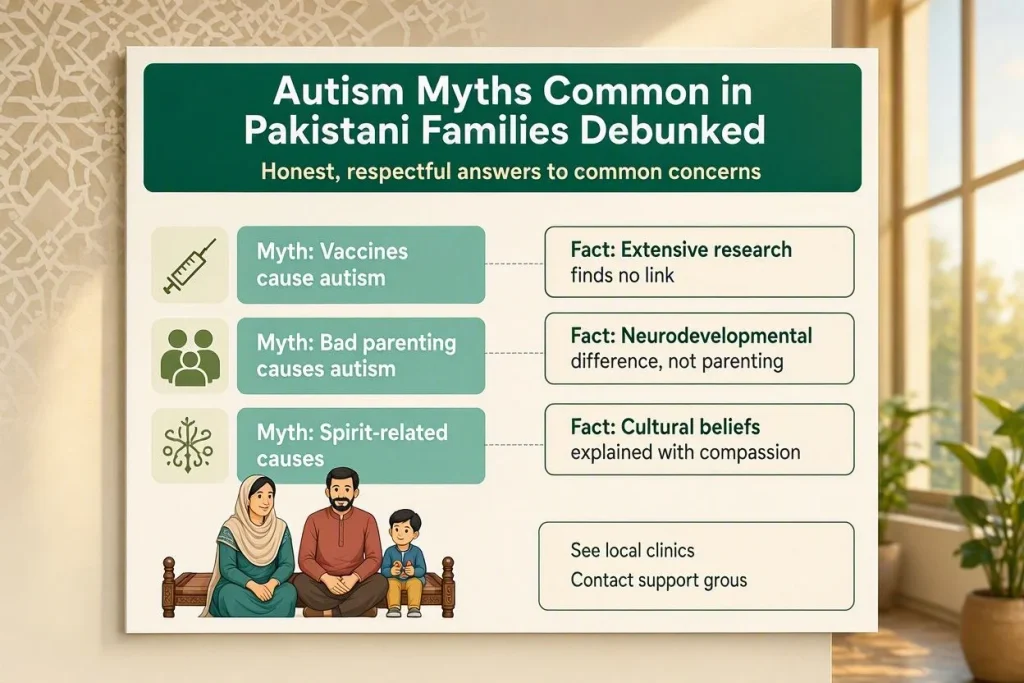
This is one of the oldest and most genuinely damaging autism myths, dating back to a thoroughly discredited mid-20th-century theory that was later proven entirely without scientific merit. Autism is a neurodevelopmental difference related specifically to how the brain develops and processes information not a result of parenting style, the amount of discipline applied, or how much attention a child received growing up. Parents hearing this claim from relatives deserve to know clearly and without hedging: nothing you did caused this, and nothing you could have done differently would have prevented it from occurring.
Myth 2: “Vaccines Cause Autism”
This claim originated from a single, now-retracted study that has since been thoroughly discredited and directly contradicted by an extensive body of subsequent research involving millions of children studied across many different countries. There is no credible scientific evidence linking vaccines to autism in any way. This particular myth has caused real, measurable harm globally by discouraging vaccination in some communities, without any corresponding benefit whatsoever it’s worth being firm and clear about this specific point when it comes up.
Myth 3: “It’s a Spiritual Issue Spirit Possession, the Evil Eye, or a Test From God”
This belief still appears in parts of Pakistani society, sometimes leading families to seek treatment primarily at shrines or through spiritual healers instead of, or significantly delaying, a proper clinical evaluation. This is worth addressing with genuine sensitivity rather than any dismissiveness: many families hold sincere, deeply-held religious or spiritual beliefs, and this isn’t about disrespecting faith in any way. Autism is a recognised neurodevelopmental condition with a clear clinical, evidence-based basis, and seeking a proper assessment and appropriate support doesn’t conflict with also holding personal spiritual beliefs the two are not mutually exclusive, and delaying clinical support entirely in favour of spiritual treatment alone can genuinely mean a child misses an important early window for effective help.
Myth 4: “He’ll Grow Out of It” or “She’s Just a Late Talker, Don’t Worry”
While some developmental delays genuinely do resolve entirely on their own over time, this reassurance often well-intentioned, coming from grandparents or other relatives shouldn’t replace a proper professional evaluation when a parent has a genuine, persistent concern that isn’t going away. An evaluation costs relatively little in time and effort, and provides either genuine reassurance backed by evidence or an early start on meaningful support; simply waiting and hoping provides neither of these outcomes.
Myth 5: “Autism Only Affects Boys”
Autism affects girls too, though it’s diagnosed considerably later and less often, largely due to genuine differences in how it tends to present and a stronger tendency toward masking. (Our dedicated guide on autism in girls provides a full explanation of this specific pattern.) Assuming a daughter can’t possibly be autistic simply because “it’s a boys’ condition” can significantly delay an evaluation she genuinely needs.
Myth 6: “A Child With Autism Can’t Love or Bond With Their Family”
This particular myth causes real, entirely unnecessary heartbreak for families. Autistic children absolutely do form genuine attachments and love their families deeply autism affects social communication and interaction in particular, specific ways, but it does not mean any absence of love, connection, or attachment. A child may express affection somewhat differently than expected perhaps more through action than through eye contact and physical cuddling without that expression being any less genuine or heartfelt.
Myth 7: “If My Child Makes Eye Contact, Is Affectionate, or Has Friends, They Can’t Be Autistic”
Autism exists on a genuine spectrum, and presentation varies enormously between individual children. Many autistic children make some eye contact, remain affectionately bonded with family, and maintain one or more genuine friendships, while still showing the broader overall pattern of differences that only a proper assessment is designed to identify accurately. A single reassuring observation doesn’t reliably rule autism in or out on its own, however comforting it might feel in the moment.
Myth 8: “Autism Can Be Cured With the Right Diet, Supplement, or Treatment”
Autism is a lifelong neurodevelopmental difference, not an illness with a cure to be found. Be genuinely cautious of any provider or product promising to “cure” or “reverse” autism entirely this framing isn’t supported by credible scientific evidence and can lead families toward expensive, sometimes genuinely harmful interventions instead of pursuing genuinely helpful, evidence based support. What actually does help proper assessment, appropriate therapy, and consistent, informed support focuses on building real skills and improving quality of life, not on eliminating autism itself as though it were a disease.
Myth 9: “Getting a Diagnosis Will Label My Child and Limit Their Future”
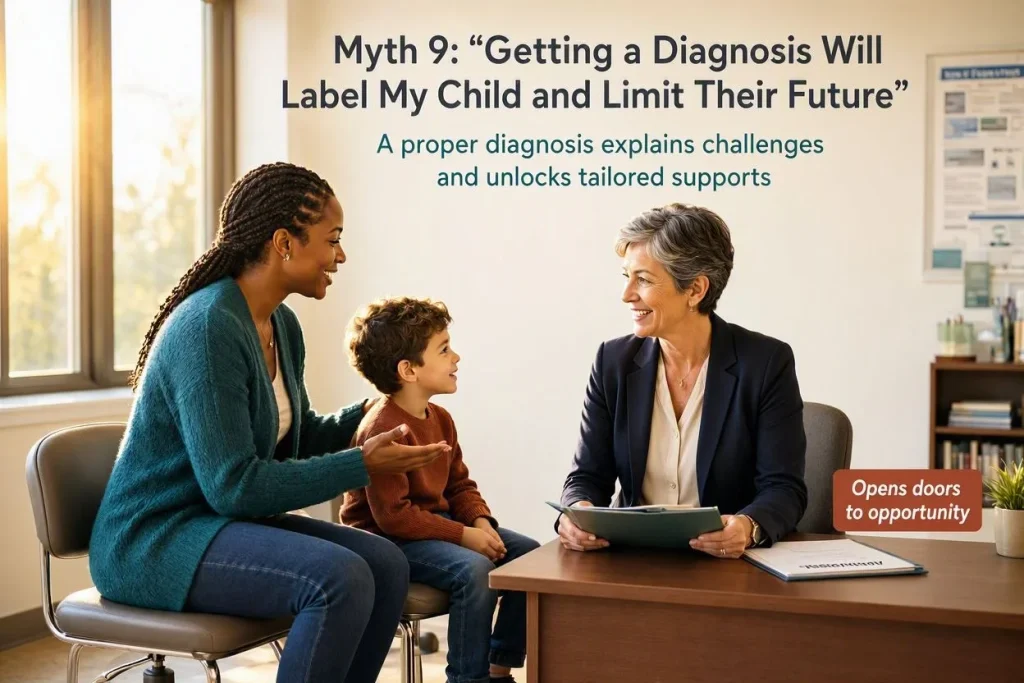
In practice, the opposite is usually genuinely true. A proper diagnosis doesn’t create limitations that weren’t already there it explains ones that already existed and opens the door to support specifically matched to your child’s actual needs, which tends to expand a child’s real opportunities and available support over time, not restrict them in any way. Avoiding a diagnosis entirely out of fear of “labelling” typically means a child simply goes without support that could genuinely help them, rather than protecting them from anything meaningful.
Myth 10: “Only Severely Affected Children Have ‘Real’ Autism”
Autism presents across a genuinely very wide range, from children who need significant, ongoing support with daily functioning to those who are highly verbal, academically capable, and need more targeted support only in specific areas like social communication or sensory regulation. All of these presentations reflect genuine, entirely valid autism there isn’t a “real” version somehow limited only to more visibly significant presentations.
Myth 11: “ABA Therapy and Other Interventions Are Just Western Concepts That Don’t Apply to Us”
While specific cultural context genuinely matters considerably in how support is actually delivered and a genuinely good clinician adapts their approach accordingly the underlying neurodevelopmental reality of autism, and the evidence behind effective approaches like ABA therapy, aren’t culturally specific to any single country or region. What matters most is finding a provider who understands both the clinical evidence and your family’s specific cultural context together, not dismissing evidence-based support outright as inherently foreign or somehow inapplicable to Pakistani families.
Myth 12: “Talking About It Openly Will Bring Shame on the Family”
This belief, while genuinely understandable given real social pressures present in some communities, tends to isolate families precisely when connection and support matter most for everyone involved. Increasingly, more Pakistani families are choosing to speak openly about autism, and doing so tends to reduce isolation considerably, connect families with genuinely useful resources and community, and gradually, over time shift the broader stigma this particular myth is itself rooted in.
Myth 13: “A Child Who Talks Well Can’t Be Autistic”
Verbal fluency and autism are not mutually exclusive, and this specific myth causes real confusion when a highly articulate child is dismissed as “definitely not autistic” based on their vocabulary alone. Many autistic children and adults are highly verbal, sometimes even precociously so, while still experiencing significant difficulty with the social and pragmatic use of language understanding sarcasm, reading a listener’s interest, navigating back-and-forth conversation naturally regardless of how extensive their vocabulary happens to be.
Myth 14: “Autism Is Becoming More Common Because of Something New in the Environment”
Rates of autism diagnosis have indeed risen substantially over recent decades, which understandably fuels concern about a new environmental cause. The most well-supported explanation for this rise, according to the current body of research, is a combination of broader diagnostic criteria, greater awareness among both professionals and the public, and improved access to assessment meaning more autistic children and adults are being accurately identified today, rather than autism itself becoming fundamentally more common as a condition. This doesn’t rule out all environmental factors as worthy of ongoing research, but the dramatic rise in diagnosis rates is well explained by these factors without requiring an unproven environmental cause.
Myth 15: “Once You Have One Autistic Child, Every Future Child Will Definitely Be Autistic Too”
There is a genuine, documented increased likelihood of autism in younger siblings once one child in a family has been diagnosed, which is a real, useful piece of information worth knowing for early monitoring purposes but it is far from a certainty, and most siblings of an autistic child are not themselves autistic. This distinction matters for family planning conversations, where the accurate picture is “somewhat increased likelihood worth being aware of,” not “guaranteed outcome” as this myth sometimes implies.
Myth 16: “An Autistic Child Will Never Be Able to Live Independently or Marry”
This sweeping prediction, sometimes offered by relatives as a concern about a child’s entire future based on very limited information, isn’t supported by the genuine diversity of outcomes seen across the autism spectrum. Long-term outcomes vary enormously depending on an individual’s specific profile, the support received throughout childhood, and countless other factors the same as they do for any child, autistic or not. Making sweeping, negative predictions about a young child’s entire adult future, based on a diagnosis alone, isn’t grounded in what’s actually known about the genuine range of autistic adult lives.
Why Do These Myths Persist So Strongly Despite Being Inaccurate?
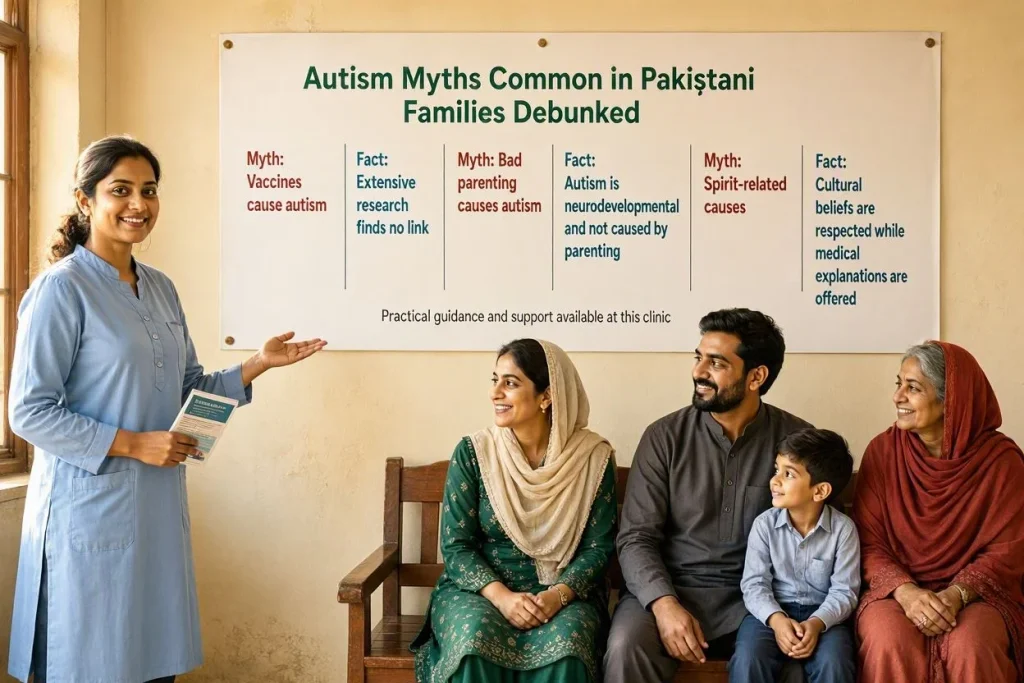
Many of these myths persist not from any real malice, but from a genuine lack of accessible, culturally-relevant information, combined with real social and religious context that shapes how individual families come to interpret unfamiliar experiences within their own lives. Addressing them with genuine respect, rather than dismissively, tends to be considerably more effective at actually shifting a relative’s understanding over time than simply insisting outright that they’re wrong.
What Should I Do When a Relative Repeats One of These Myths Directly to Me?
You genuinely don’t need to win every argument in the moment it comes up. A brief, calm, factual response “we’ve had him properly assessed by a qualified psychologist, and this is what’s actually going on with him” tends to be considerably more effective over repeated, patient exposure than a single heated debate, and you’re entirely allowed to simply end a conversation that clearly isn’t heading anywhere productive.
How Can I Prepare Myself Emotionally for Encountering These Myths Repeatedly?
It genuinely helps to accept in advance that you’ll likely encounter versions of these myths more than once, sometimes from the same relative repeatedly, and that this doesn’t reflect a failure on your part to explain things clearly enough the first time. Deciding beforehand which battles feel worth engaging with in the moment, and which are better met with a brief, calm response before moving the conversation along, can genuinely help preserve your own energy for the parts of this journey that matter most.