
ABA Therapy for Toilet Training: A child with developmental delays or autism can take longer and need a different approach. Here’s how ABA-based toilet training actually works.
ABA Therapy for Toilet Training is one of the most practically demanding milestones for any family, and for children with autism, developmental delays, or significant sensory sensitivities, it can take considerably longer and require a more structured, patient approach than typical toilet training advice accounts for. This guide walks through how ABA-based toilet training works, what makes it different, and what to realistically expect.
Why Typical ABA Therapy for Toilet Training Advice Often Doesn’t Work
Standard toilet training guidance usually assumes a child can reliably recognise their body’s signals, communicate the need to use the toilet, tolerate the sensory experience of the process, and understand and follow a multi-step sequence of instructions. For a child with developmental delays, autism, or significant sensory sensitivities, one or more of these assumptions may not currently hold which is exactly why generic advice (“just try three days of intensive training”) often fails, and can leave parents feeling like they or their child have failed, when really the approach simply wasn’t matched to the child’s actual starting point.
Readiness: What to Check Before Starting
Before beginning a structured toilet training program, it’s worth honestly assessing a few readiness indicators, ideally with input from your child’s ABA therapist:
- Can your child stay dry for a reasonable stretch of time (roughly 1.5 to 2 hours), suggesting some bladder control?
- Does your child show any awareness of being wet or soiled discomfort, pulling at a nappy, or communicating in some way?
- Can your child follow simple, familiar instructions?
- Can your child sit for a short period of time?
- Is your child generally in a stable period, without a major upcoming transition (a house move, a new sibling, starting school) that might make this a harder time to start?
If several of these aren’t yet in place, that’s genuinely useful information it may mean focusing on some foundational skills first (sitting tolerance, following simple instructions, communicating discomfort) before a full toilet training program, rather than starting the full process prematurely.
The ABA Approach: Structure, Data, and Consistency
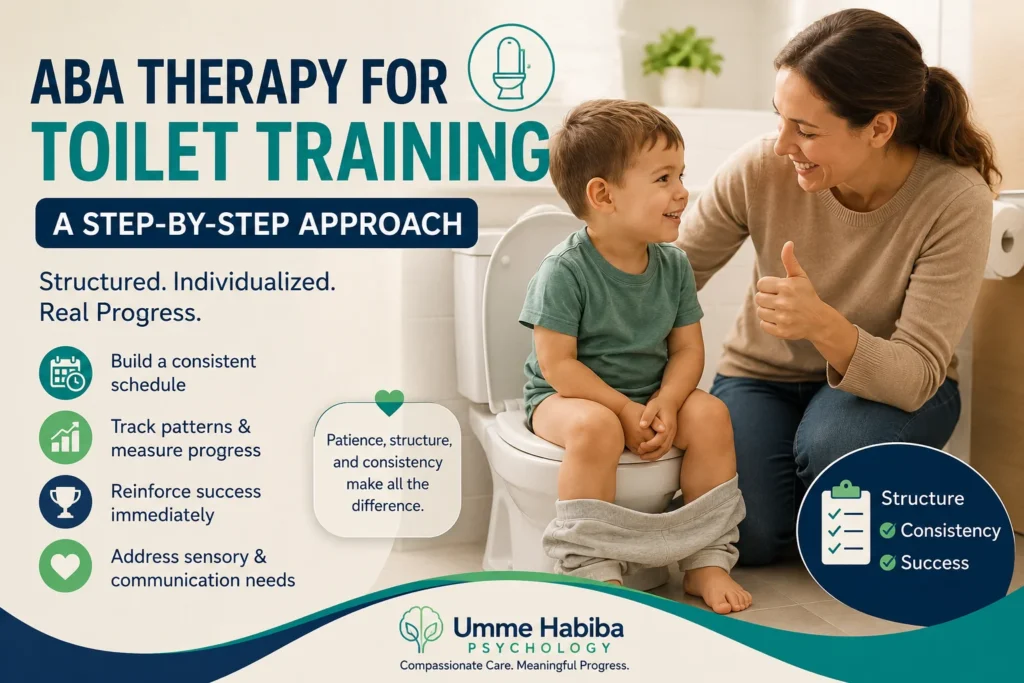
1. Build a consistent schedule. Rather than waiting for your child to spontaneously indicate a need, a structured program typically starts with scheduled sitting bringing your child to the toilet at regular intervals (for example, every 30 to 60 minutes initially, adjusted based on your child’s actual pattern) rather than relying on communication that hasn’t developed yet.
2. Track patterns before intervening. Many programs start with a short baseline period tracking when your child actually urinates or has a bowel movement, whether in a nappy or otherwise to identify their natural pattern, which makes the scheduled sitting far more effective once it starts, since you’re working with your child’s actual rhythm rather than a generic timetable.
3. Reinforce success immediately and specifically. When your child successfully uses the toilet, immediate, genuine, specific praise (and often a small preferred reward, chosen based on what motivates your specific child) helps build the association between the behaviour and a positive outcome.
4. Use consistent, simple language. A short, consistent phrase used every single time (“toilet time,” or your family’s chosen term) helps your child recognise the routine and, eventually, the sensation itself.
5. Address sensory barriers directly. For some children, the toilet itself is a genuine sensory challenge the sound of flushing, the sensation of sitting on a cold or unfamiliar surface, the echo in a bathroom. Identifying and addressing these specific barriers (a padded toilet seat insert, flushing after your child has left the room initially, noise-reducing strategies) can remove obstacles that have nothing to do with “readiness” in the traditional sense.
6. Teach the full sequence, not just “going.” Depending on your child’s current skills, this may include pulling clothing down and up, wiping, flushing, and handwashing each of which can be broken into smaller, teachable steps if needed, rather than assumed to happen automatically once the core skill is in place.
Communicating the Need
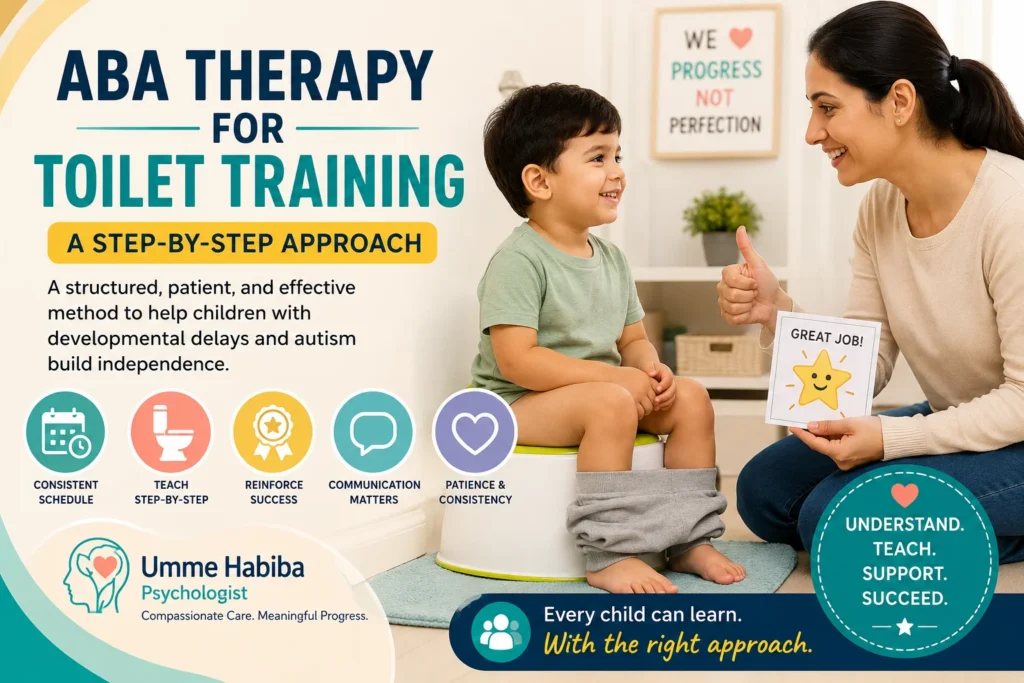
For children with limited verbal communication, toilet training often needs to be paired with a specific way to communicate the need a picture card, a specific gesture, a single word or sign taught deliberately alongside the physical process itself, so your child has an actual way to signal the need over time, not just an expectation that they eventually will.
Common Setbacks and How to Handle Them
Regression during illness or major transitions. This is common and doesn’t mean progress has been lost permanently usually a brief return to more frequent scheduled sitting and consistent reinforcement gets things back on track once the disruption passes.
Success at home but not at school or in public settings. This is a generalisation issue, much like other ABA targeted skills the routine and cues may need to be deliberately practiced and reinforced across different settings, not assumed to transfer automatically.
Bowel movements lagging behind urination progress, which is extremely common many children achieve daytime urination success considerably before bowel movement consistency, and this gap is a well-recognised, normal pattern, not a sign that something is going wrong.
Resistance or distress around the process itself. If your child shows genuine distress rather than simple reluctance, it’s worth pausing and revisiting readiness and sensory factors with your therapist, rather than pushing through distress, which tends to build negative associations that make future attempts harder.
Why Consistency Between Home and Therapy Matters Enormously Here
Toilet training is one of the clearest examples of why a single, consistent approach across every setting matters so much. If a scheduled sitting routine happens consistently with an ABA therapist but inconsistently at home or vice versa progress typically slows considerably, because the routine and reinforcement pattern that’s actually building the skill isn’t happening reliably enough anywhere to take hold. This is a goal where close coordination between your child’s therapist and your daily routine at home is especially worth prioritising.
Setting Realistic Expectations
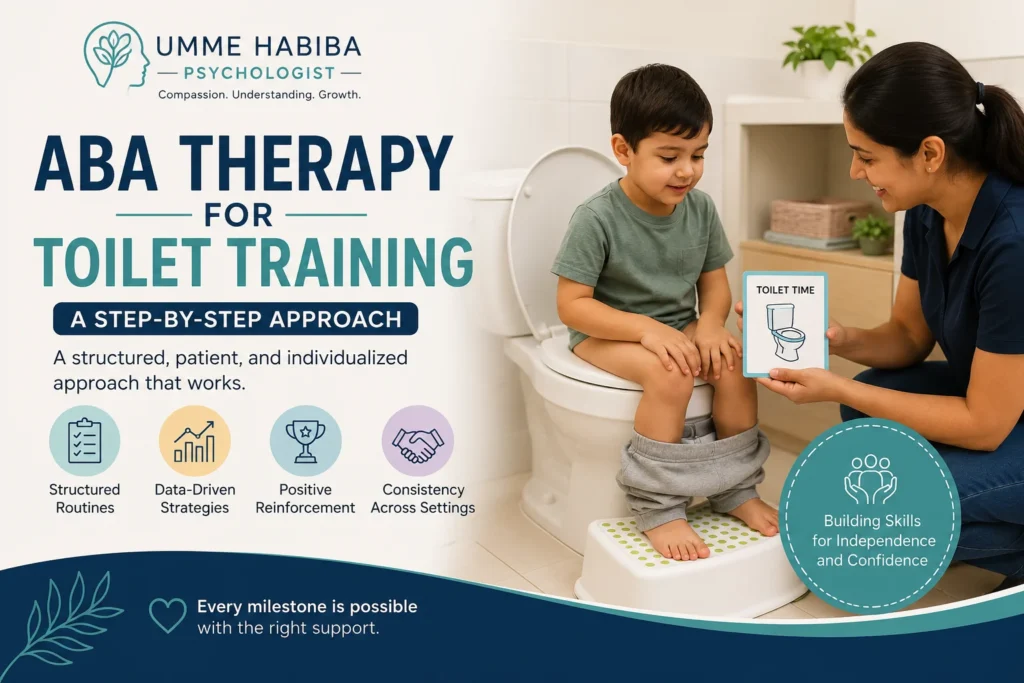
Toilet training a child with developmental delays or significant sensory sensitivities commonly takes considerably longer than typical toilet training timelines sometimes several months of consistent, structured effort rather than a matter of days or weeks. This isn’t a reflection of anything going wrong; it reflects a genuinely different starting point and a process that, done well, is more gradual and more individualised than generic advice assumes.
The Bottom Line
ABA-based toilet training works by replacing guesswork with structure: understanding your child’s actual patterns, addressing real barriers (sensory, communicative, or skill-based) directly, and reinforcing success consistently across every setting. It typically takes patience and time, but it’s one of the areas where a structured, individualised approach makes a genuine, practical difference to daily family life.