
What is the ADOS-2, and what does it actually measure? A plain-language explanation for Pakistani parents preparing for their child’s autism assessment.
If you’ve started researching autism assessments, you’ve probably run into the term “ADOS-2” and wondered what it actually means beyond a string of letters and a number appearing repeatedly in reports and provider websites. It’s one of the most widely used, most extensively researched tools in autism assessment worldwide, and understanding what it actually is and just as importantly, what it isn’t can make the entire assessment process feel considerably less mysterious and less intimidating.
What Does ADOS-2 Stand For?
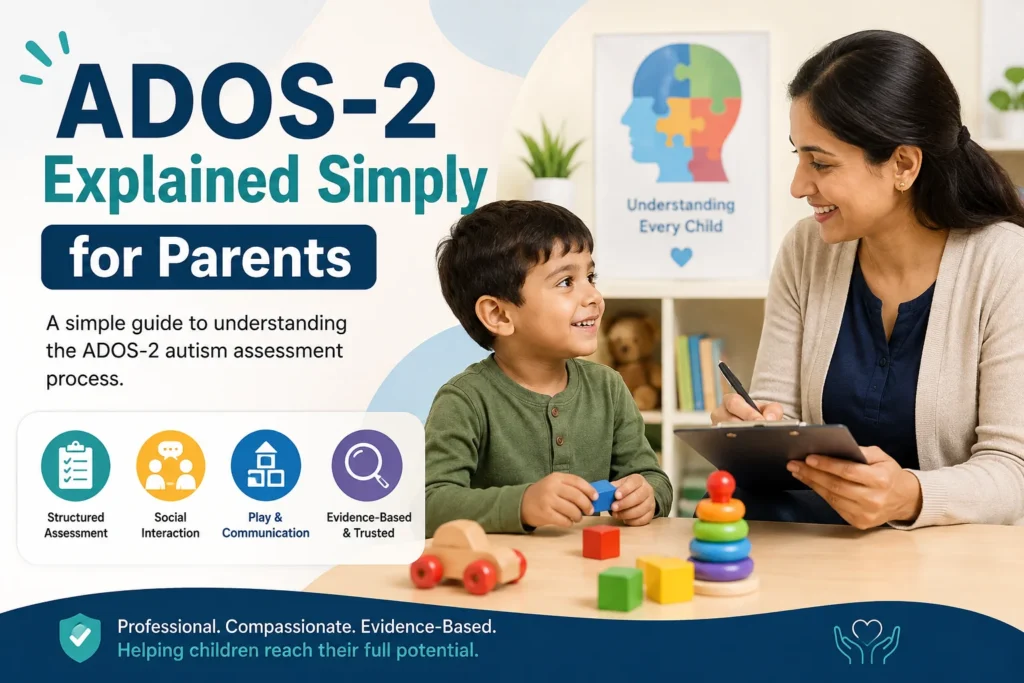
ADOS-2 stands for the Autism Diagnostic Observation Schedule, Second Edition. It’s a structured, standardised observational assessment tool not a questionnaire, not a blood test, and not a quick informal checklist specifically designed to observe social communication and behaviour patterns relevant to autism, in a consistent, carefully researched way that can be meaningfully compared against a large, well-established body of prior research.
Why Is the ADOS-2 So Widely Trusted in Autism Assessment?
The ADOS-2 is one of the most extensively studied and internationally recognised tools currently used in autism assessment, which means clinicians trained in its use are working from a well-validated, consistent method, rather than a purely individual, subjective impression formed on the day. This matters considerably in practice, because it substantially reduces the risk of a diagnosis or equally, a “no autism” conclusion resting entirely on one clinician’s personal judgment during a single interaction. The structured framework itself provides a replicable, evidence-based method that holds up across different clinicians and different settings.
The Different Modules of the ADOS-2
The ADOS-2 is organised into separate “modules,” each one selected based on a child’s age and current language level, rather than a single fixed format used identically for every child. There’s a toddler module designed for children not yet using much spoken language, modules for young children at different points along the language development spectrum, and modules designed for verbally fluent older children, adolescents, and adults. Selecting the correct module matters enormously for accurate results, and it’s a decision made by the trained examiner based on your child’s actual current functioning, not simply their age in years alone.
What Actually Happens During an ADOS-2 Session?
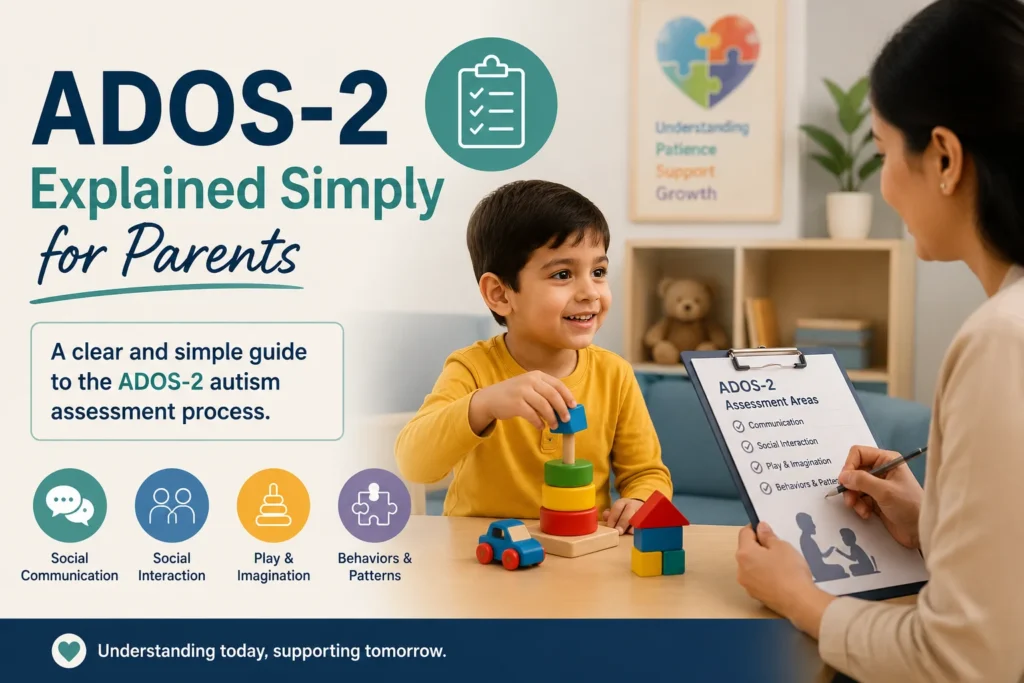
During the session, the examiner engages your child in a series of carefully planned social and play-based activities, chosen according to the selected module. These typically include structured play with specific toys and materials, a simple joint activity carried out together with the examiner, a picture description or storytelling task for children with sufficient language, and social conversation or small talk for more verbally fluent modules. Each activity is deliberately designed to create natural, low-pressure opportunities for particular social communication behaviours to emerge, so the examiner can observe them directly as they happen, rather than relying solely on secondhand parent description.
What Is the Examiner Actually Looking For?
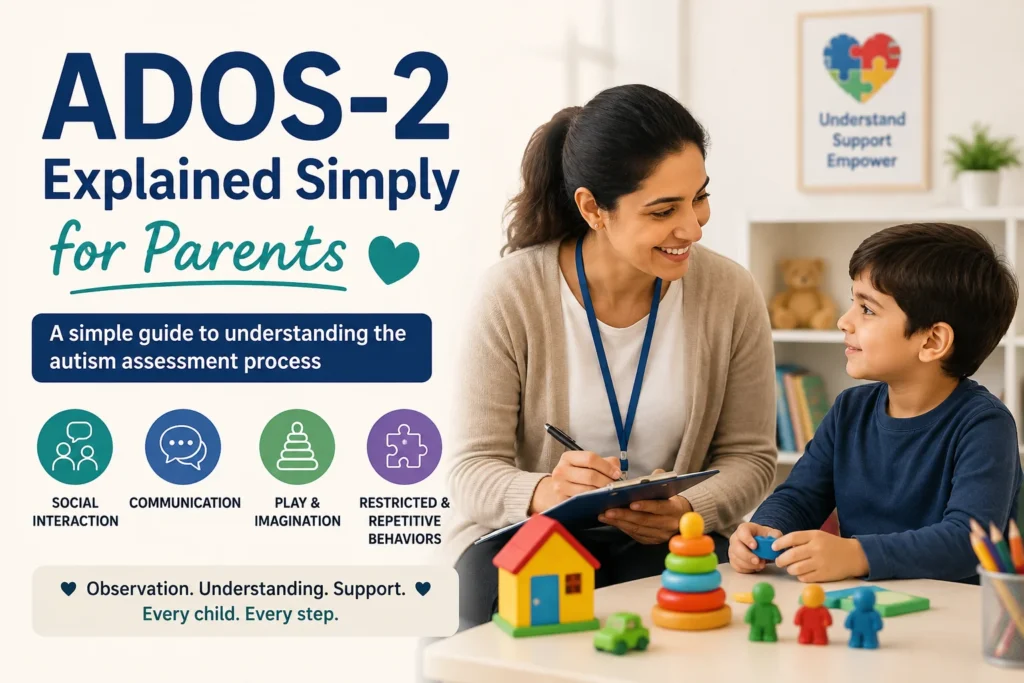
Broadly, the ADOS-2 examines patterns across several connected areas: Communication how the child uses language, gesture, and other means to communicate their intentions; reciprocal social interaction how the child engages back-and-forth with the examiner, including eye contact, shared enjoyment, and responsiveness to social bids; play and imagination for younger children specifically, whether play is functional and creative or more repetitive and narrowly focused; and restricted and repetitive behaviours unusual movements, intensely narrow interests, or rigid adherence to particular routines, where relevant to observe within the session’s timeframe.
Does the ADOS-2 Give an Automatic Yes-or-No Answer?
No, and this is a genuinely important point that many parents don’t fully realise going in. The ADOS-2 produces a structured score, based on the specific behaviours observed during that session, which falls along a scale indicating the level of autism-related behaviours present during that particular sitting. This is one significant, well-researched piece of evidence not a standalone diagnostic verdict delivered automatically on its own. A responsible clinician always combines the ADOS-2 result with the full developmental history, parent interview, and any additional observations before reaching an overall conclusion. Any provider offering a diagnosis based purely on an ADOS-2 score, without this fuller surrounding context, isn’t following proper, responsible clinical practice.
Can a Child “Fail” the ADOS-2?
There’s genuinely no passing or failing involved it isn’t that kind of tool at all. A child’s resulting score reflects the specific pattern of behaviours observed during that session relative to well-researched benchmarks, which the clinician then uses as part of a broader, considered clinical judgment not a test your child can succeed or fail at in the way they might approach a school exam.
How Long Does an ADOS-2 Assessment Session Take?
A single ADOS-2 session typically takes somewhere between 40 minutes and an hour, depending on the specific module used and how the child engages on the day. The broader assessment process surrounding it history-taking, questionnaires, and the eventual feedback session extends well beyond that single session, as covered in complete detail in our separate guide on what actually happens during a full autism assessment.
Who Is Qualified to Administer the ADOS-2?
This matters more than many parents initially appreciate. Administering and scoring the ADOS-2 reliably requires specific formal training and, ideally, ongoing regular practice it isn’t a tool any general clinician can simply pick up without proper preparation and certification. When choosing a provider, it’s entirely reasonable to ask directly whether the specific person administering your child’s assessment has genuine, current ADOS-2 training, since inconsistent or informal use of the tool meaningfully undermines its whole clinical value.
What If My Child Doesn’t Cooperate During the ADOS-2?
Experienced examiners are thoroughly used to working with toddlers and young children who are shy, distracted, or simply having an off day, and the tool itself is designed with a degree of built-in flexibility to accommodate this reality. If a session turns out to be genuinely too disrupted to yield useful, reliable information, a good clinician will straightforwardly schedule another session rather than drawing firm conclusions from an unrepresentative sitting.
How Does the ADOS-2 Fit Into the Rest of a Full Assessment?
It’s useful to think of the ADOS-2 as one especially well-researched lens among several used together. A thorough autism assessment typically also includes a detailed developmental history (sometimes gathered using a structured interview like the ADI-R), parent and, where relevant, teacher questionnaires, and general clinical observation carried out across all the sessions involved. The ADOS-2’s particular strength lies in creating a consistent, comparable window into social communication and play behaviour in the moment which is precisely why it’s used alongside the fuller developmental history, never as a substitute for it.
Should I Prepare My Child for the ADOS-2 Specifically?
You don’t need to prepare your child for the ADOS-2 the way you might prepare them for a school exam there’s genuinely nothing to study or rehearse, and attempting to coach specific responses beforehand would actually work directly against the tool’s entire purpose, which is to observe natural, unprompted behaviour. General preparation for the assessment day as a whole adequate rest, familiar comfort items, a calm, unhurried morning is far more useful than anything specific to the ADOS-2 itself. (Our dedicated guide on preparing your child for assessment day covers this fully.)
What Should I Ask For When Reviewing My Child’s Results?
It’s entirely reasonable to ask your clinician to walk you through the specific behaviours observed during the ADOS-2 session and explain how those observations fit into the overall clinical picture, rather than simply being handed a score or a single-word conclusion without further explanation. A good clinician will genuinely welcome this conversation and explain it in plain, specific language tied directly to your own child’s actual presentation.
The Bottom Line on the ADOS-2
The ADOS-2 is a genuinely valuable, extensively researched tool among the most trusted internationally within the field but it remains one part of a larger, careful, multi-step process, not a shortcut to an instant answer. Understanding what it actually measures, and precisely how it fits alongside everything else in a proper assessment, should make the whole overall process feel considerably less intimidating before you go in.
How Is the ADOS-2 Scored, in More Detail?
Each activity within the module produces specific behavioural codes, which the examiner records based on precisely what they observe not a general impression, but coded ratings across defined categories like communication, reciprocal social interaction, and repetitive behaviours. These individual codes are then combined into an overall algorithm score, which falls along a defined range indicating the level of autism-related behaviours observed during that specific session. Understanding that this is a coded, structured process rather than a clinician’s informal, unstructured impression is part of why the tool carries the weight and consistency it does across different examiners and different clinics.
How Does the ADOS-2 Compare to Other Tools Used in Autism Assessment?
The ADOS-2 is often used alongside, rather than instead of, other established tools. The ADI-R (Autism Diagnostic InterviewRevised), for instance, is a structured interview conducted with parents that gathers detailed developmental history, complementing the ADOS-2’s direct observation of the child. Some assessments also incorporate cognitive testing or adaptive behaviour questionnaires. Each tool captures a different, specific angle on a child’s overall profile, and a thorough assessment typically draws on more than one, rather than relying on any single tool in isolation, however well-researched that individual tool may be.
Is There a Newer Version Beyond the ADOS-2?
As of current, widely-used clinical practice, the ADOS-2 remains the standard, most current edition of this specific tool internationally, having refined and updated the original ADOS through additional research and improved scoring algorithms. Assessment tools in this field are periodically reviewed and revised based on ongoing research, so it’s reasonable to ask a provider whether they’re using current editions and current scoring norms, though the ADOS-2 itself has remained the established standard for a considerable period.
What Training Does an Examiner Actually Need?
Formal ADOS-2 training typically involves a structured course covering the tool’s administration and scoring, followed by supervised practice sessions and ongoing reliability checks to ensure consistent, accurate use over time. This isn’t a one-time certification that, once obtained, requires no further attention reputable practitioners maintain their skills through regular use and, in many training frameworks, periodic reliability re-checks. This is precisely why asking a potential provider about both their initial training and their ongoing experience with the tool is a genuinely reasonable, useful question, not an excessive level of scrutiny.
Does the ADOS-2 Account for Cultural Differences?
This is a fair, important question, and worth addressing honestly. The ADOS-2 was developed and validated primarily using research from Western populations, and an experienced clinician working with Pakistani families should be thoughtful about interpreting certain behaviours for instance, norms around eye contact with adults, or culturally-specific social expectations within the appropriate cultural context, rather than applying Western behavioural norms without adjustment. This is one of the genuine, practical reasons that choosing a clinician who understands your specific cultural context matters, alongside their formal ADOS-2 training itself.
What Happens to the ADOS-2 Results If My Child Is Reassessed Later?
Some children are reassessed years after an initial evaluation sometimes to review progress, sometimes because the original assessment happened at a very young age and a clearer picture is needed as the child develops further. A later ADOS-2 session uses the module appropriate to the child’s current age and language level at that time, which may well be a different module than was used originally, and the results are interpreted as a fresh, current picture rather than simply compared point-by-point against the earlier score.
Why Does Understanding the ADOS-2 Actually Help You as a Parent?
Beyond simple curiosity, understanding what the ADOS-2 measures and how it fits into the broader process genuinely changes how you experience the assessment day itself knowing that a certain amount of your child’s behaviour during the session is expected and accounted for, that there’s no “correct performance” to worry about, and that the resulting score is one part of a much fuller picture, tends to reduce the anxiety many parents carry into assessment day considerably.
Is the ADOS-2 Used for Anything Besides Diagnosis?
Beyond its central diagnostic role, ADOS-2 observations sometimes provide genuinely useful practical information for early planning the specific communication and social patterns noted during the session can inform initial goals for therapy, giving a new provider like an ABA therapist or speech therapist a documented, detailed starting picture of your child’s current presentation, rather than starting entirely from scratch.