
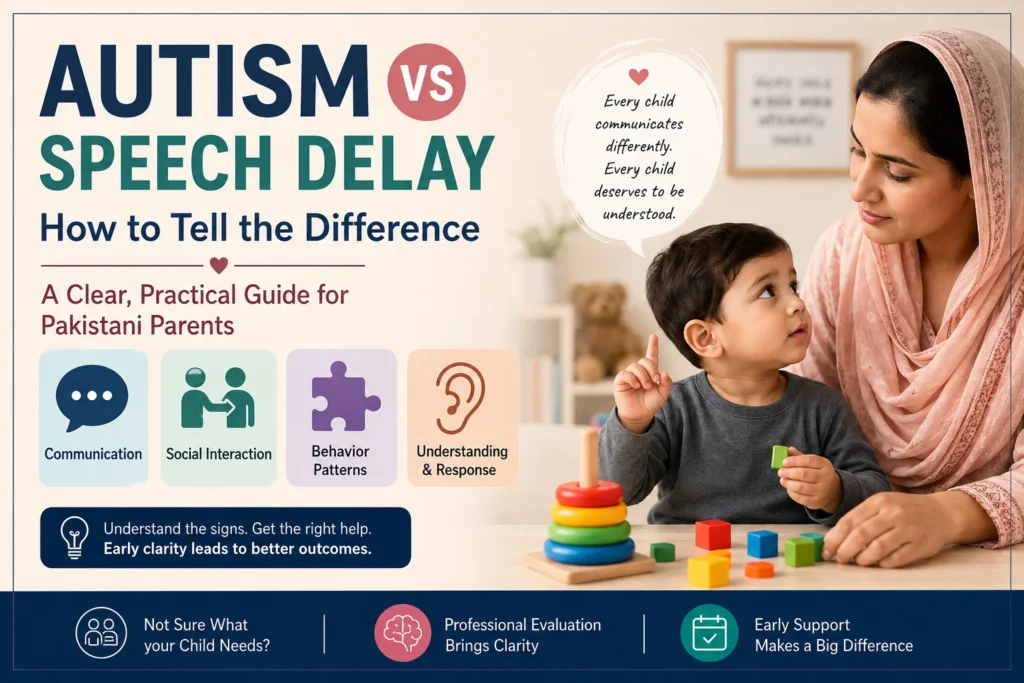
Is it autism vs speech delay? A clear, practical comparison for Pakistani parents trying to understand why their toddler isn’t talking yet.
Your toddler isn’t talking as much as other children their age, and now you’re caught between two very different explanations that relatives, neighbours, and even well-meaning friends keep offering: “he just has a speech delay, it’ll sort itself out” on one side, and the quieter, harder-to-voice worry that it might be something broader, like autism, on the other. This is one of the most common points of genuine confusion for parents in Lahore and across Pakistan, and it deserves a clear, specific answer rather than reassurance pulled in either direction.
What Is a Speech or Language Delay, Specifically?
A speech or language delay means a child’s communication skills vocabulary size, sentence structure, clarity of pronunciation, or understanding of spoken language are developing more slowly than expected for their age, while the underlying social use of communication remains intact.
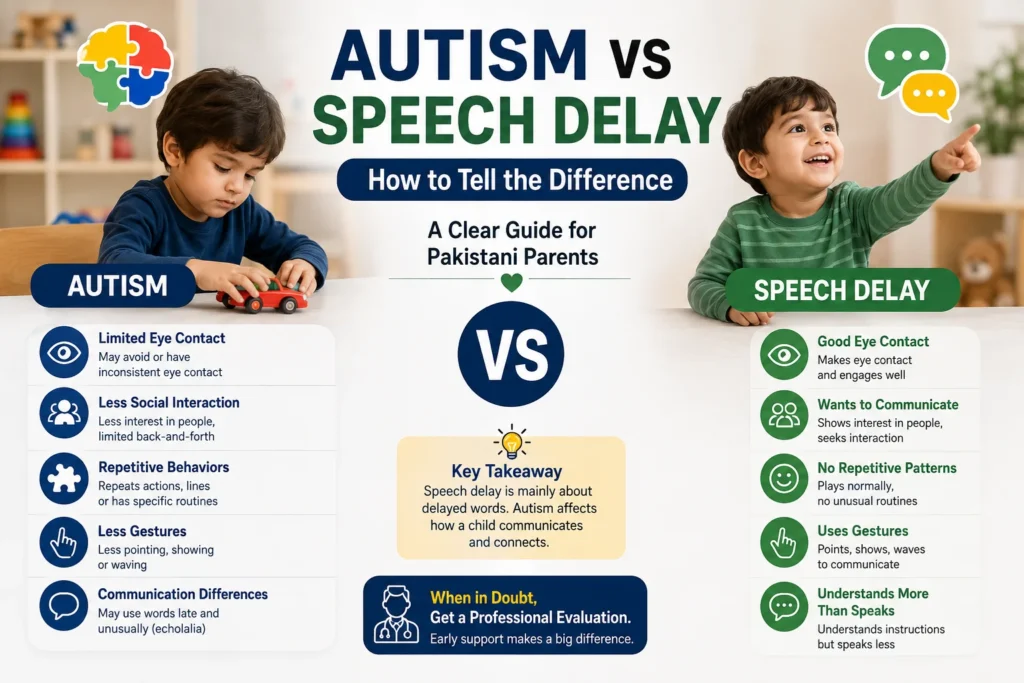
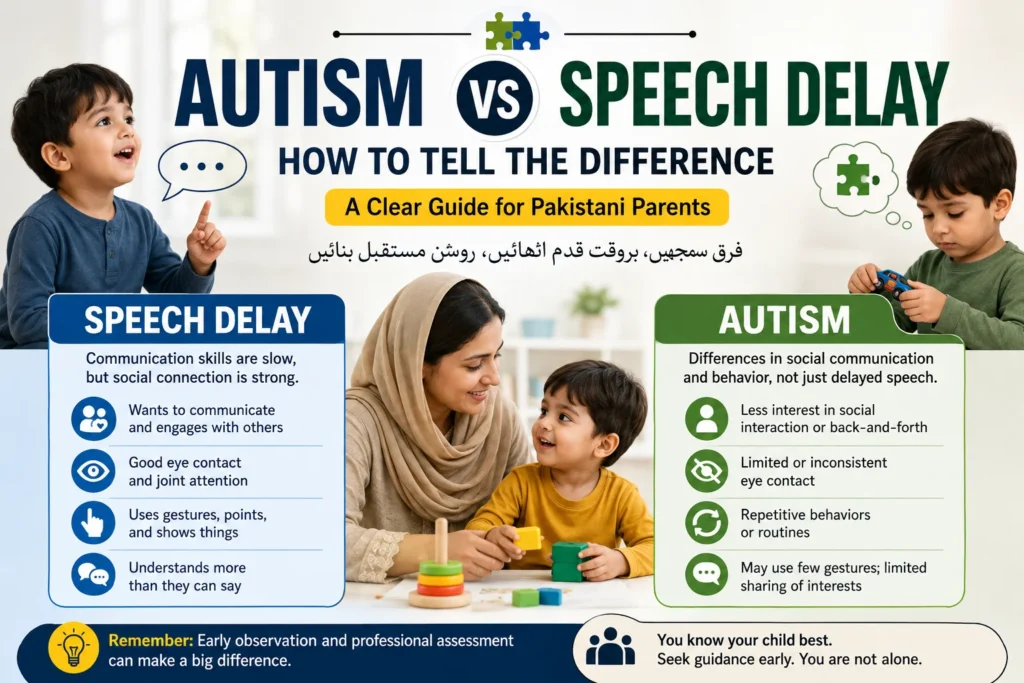
A toddler with a straightforward speech delay generally still wants to communicate with the people around them, uses gesture and eye contact readily to connect, understands social back-and-forth even when their own words are limited, and shows clear, consistent interest in the people in their life. Speech delays are relatively common, well understood, and with the right support often respond very well to speech and language therapy.
How Autism Affects Communication Differently
Autism affects the social and communicative function of language, not simply its mechanics. A toddler with autism-related communication differences may well have delayed speech, but the surrounding pattern usually includes broader differences in how whatever communication they do have is actually used reduced eye contact during interaction, less frequent or less varied gesture use (pointing to share interest, waving, reaching to be picked up), reduced drive toward social back-and-forth even in play, and sometimes distinctive features like repeating phrases from cartoons or overheard conversations (echolalia) without a clear functional purpose, rather than a straightforward, even if delayed, path toward typical spontaneous language.
Is My Child Trying to Communicate, Just Without Many Words Yet?
This is one of the single most useful questions a parent can ask themselves directly, and it’s worth sitting with rather than rushing past. A toddler with a pure speech delay will often work visibly hard to communicate through other means pulling you firmly by the hand to show you something specific, pointing insistently and checking whether you’re looking, using elaborate, improvised gestures, making steady eye contact while trying to get a point across, or even inventing consistent personal “words” for particular things.
A toddler on the autism spectrum may show noticeably less of this compensatory effort not because they lack needs to express, but because the underlying drive toward shared, reciprocal social communication itself tends to work differently.
Does My Child Understand More Than They Can Say?
This is worth watching closely, because the pattern here is genuinely informative. A child with an isolated speech delay typically understands language well above their own ability to produce it they’ll follow simple, familiar instructions reliably, respond appropriately when their name is called, and clearly track conversations happening around them, even while saying relatively little themselves.
When both understanding (what clinicians call receptive language) and the broader social use of communication are affected together, that combined pattern points more specifically toward something autism-related than toward a delay isolated purely to speech production.
What About Eye Contact and Joint Attention?
Joint attention the ability to share focus on something with another person, such as looking where someone points, or bringing an object over purely to share a moment of enjoyment rather than to request help is one of the clearest early differentiators available, and it’s specifically what clinicians look for during a proper assessment.
Children with isolated speech delays generally have intact joint attention; they simply can’t yet put their intentions into words. Reduced or inconsistent joint attention, alongside limited or unusual eye contact patterns, is more specifically and consistently associated with autism spectrum differences than with a pure language delay on its own.
Can a Child Have Both Autism vs Speech Delay at the Same Time?
Yes, and this happens often enough that it’s worth stating clearly autism and speech or language delay frequently co-occur, and the presence of one doesn’t rule out or fully explain away the other. This matters practically, because a child might genuinely have autism *and* benefit significantly from dedicated speech therapy running alongside broader support, rather than either condition being treated as the single, complete explanation for everything being observed. Recognising both, where both are present, tends to produce a far more complete and genuinely useful support plan than assuming one diagnosis accounts for the whole picture.
Why Guessing at Home Rarely Settles This Question Clearly
Even attentive, observant parents and often even paediatricians without specific developmental training can find it genuinely difficult to reliably distinguish a pure speech delay from autism-related communication differences through conversation and casual observation alone. This isn’t a reflection of anyone’s competence or attentiveness; it reflects the fact that the distinction depends on structured, careful observation across several domains at once social behaviour, play patterns, communicative intent, and sensory responses, not vocabulary size in isolation which is precisely what a formal developmental assessment is specifically designed to evaluate properly.
What Does a Proper Assessment Actually Check For?
A thorough evaluation looks well beyond simply counting the words a toddler currently has. It typically examines the quantity and quality of gestures used across different situations, joint attention and eye contact patterns during genuinely interactive moments, a child’s overall interest in and approach to social interaction more broadly, play skills distinguishing functional and pretend play from more repetitive or narrowly focused play sensory responses, and the developmental trajectory over time, considered alongside language specifically rather than instead of it.
This breadth is exactly why an assessment carried out by a clinical psychologist experienced in early childhood development, rather than a single conversation or a passing opinion, is the route to genuine clarity here.
What If It Turns Out to Be “Just” a Speech Delay?
This is a completely legitimate, common, and very manageable outcome, and it’s worth being said plainly: speech and language therapy is genuinely effective for a great many children with isolated speech delays, and many catch up substantially sometimes fully with appropriately targeted support. Getting a clear, proper evaluation doesn’t only rule things in; ruling autism out with confidence, based on an actual structured assessment rather than a guess or a hope, is valuable, reassuring information in its own right, and lets you direct your energy toward the right kind of support without the underlying uncertainty continuing to sit in the background.
What If It Does Turn Out to Involve Autism?
An autism-related communication difference doesn’t make speech therapy irrelevant quite the opposite. It often becomes one part of a broader, deliberately coordinated plan that might also include ABA therapy or other developmental support, specifically shaped around how your child’s communication and social development actually work together, rather than a generic, speech-delay-focused approach that doesn’t address the fuller underlying picture.
What Role Does Bilingualism Play in This Question?
Many Pakistani households raise children across two or more languages from birth Urdu and English, or a regional language alongside Urdu and it’s worth addressing a specific worry directly: raising a child bilingually does not cause speech delays, and it does not cause autism.
Research consistently shows that bilingual children may sometimes show a temporarily smaller vocabulary in each individual language compared to monolingual peers, while their total vocabulary across both languages is typically comparable or even larger. If your toddler is being raised bilingually and showing signs of concern, bilingualism itself is very unlikely to be the actual explanation the same evaluation process described above remains the right route to genuine clarity, rather than assuming the household’s language environment is responsible.
What About Hearing Difficulties as an Alternative Explanation?
Before any broader developmental evaluation, it’s worth ruling out a hearing difficulty specifically, since reduced hearing can produce a pattern that superficially resembles both a speech delay and, less commonly, some autism-related signs inconsistent response to sounds or to being called, limited babbling, and delayed language development can all stem from an unaddressed hearing issue rather than a neurodevelopmental difference.
A basic hearing screening is a quick, low-cost step many clinicians will recommend early in the process specifically to rule this out, since a hearing-related explanation, where present, changes the appropriate next steps considerably.
How Do Paediatricians Typically Approach This Question?
Many families’ first stop is a paediatrician rather than a clinical psychologist directly, and it’s worth understanding what that conversation can and can’t realistically offer. A paediatrician can screen for obvious red flags, rule out certain medical explanations, and make an appropriate referral but most paediatricians, without specific developmental training, aren’t equipped to reliably distinguish a speech delay from autism-related communication differences through a routine appointment alone.
A referral to a clinical psychologist or developmental specialist for a proper structured evaluation isn’t a sign your paediatrician has failed you; it reflects the genuine specialisation this specific question requires.
How Should I Talk to Family Members While I Wait for Clarity?
It’s entirely reasonable to simply explain that you’re pursuing a proper professional evaluation to understand what your child specifically needs you don’t owe anyone a defence of that decision, and you certainly don’t need to have already settled the “autism or speech delay” question yourself before seeking appropriate help.
Working out that exact distinction is precisely what the evaluation itself is for, not something you’re expected to determine on your own beforehand.
What About Children Who Are Late Talkers With a Strong Family History of Late Talking?
A family history of late talking a father or uncle who “didn’t speak until age four and turned out fine is genuinely relevant information and worth mentioning to your clinician, since some late-talking patterns do run in families without any broader developmental concern.
That said, a family history of late talking is a piece of context to factor into a proper evaluation, not a substitute for one plenty of family stories about a relative who “just talked late” were never actually formally evaluated at the time, and the same reassurance that felt accurate for one family member doesn’t automatically transfer to your own child without being checked.
Does the Setting Matter Home, Clinic, or Daycare Behaviour Differing?
It’s common for a toddler to communicate quite differently across settings more expressive and vocal at home in a familiar routine, noticeably quieter or less engaged in a daycare or clinic environment.
This difference is worth mentioning to whoever is evaluating your child rather than assuming it’s not relevant, since a consistent pattern across settings versus a pattern that’s highly setting-dependent can itself be informative. A thorough evaluation will usually ask directly about this variation as part of the history-taking process.
What If My Child Was Talking Well and Then Seemed to Regress?
A toddler who had a small but genuine vocabulary that then disappeared rather than simply staying flat or progressing slowly is a distinct pattern worth flagging clearly and promptly to a clinician, regardless of whether you suspect autism, a speech delay, or something else entirely. Loss of previously acquired language, unlike a delay in acquiring it in the first place, is a pattern that consistently warrants a prompt, thorough evaluation rather than a wait-and-see approach.
What Role Does Play Have in Distinguishing the Two?
Play patterns often reveal as much as language does, and they’re worth paying attention to directly. A toddler with a pure speech delay typically still engages in varied functional and pretend play feeding a doll, pushing a car and making an engine sound, stacking blocks to build something even without narrating it verbally.
A toddler with broader autism-related differences may show more repetitive or narrowly focused play, such as lining up objects consistently or fixating on one particular feature of a toy, alongside the language differences described earlier. This is exactly why a proper assessment observes play directly rather than relying on a parent’s verbal description of vocabulary alone.
Does Gender Change How This Distinction Should Be Approached?
There’s some evidence that girls, in particular, may be more likely to be assumed to simply “have a speech delay” when a broader autism-related pattern is actually present, partly because girls on average show somewhat different, sometimes subtler, social presentation than the pattern most commonly recognised in boys (our dedicated guide on autism in girls covers this in full).
This is worth keeping in mind if your toddler is a girl showing language delay alongside any of the broader social signs described above the same thorough evaluation process applies regardless of gender, even though the assumption of “just a speech delay” sometimes gets applied more readily to girls by default.
The Most Useful Next Step
If you’re genuinely unsure whether you’re looking at a straightforward speech delay or something broader, the answer isn’t to keep quietly watching, comparing, and guessing for months longer it’s a proper developmental and psychological evaluation that considers the whole picture together: language, social communication, play, and sensory patterns, rather than vocabulary counted in isolation from everything else.