
Discrete Trial Training is one of the most widely used ABA techniques. Here’s what it actually looks like in a session, why it works, and what to expect.If you’ve ever peeked into an ABA therapy session and seen a therapist sitting across a small table from your child, presenting one instruction at a time, followed by a reward for a correct response you’ve watched Discrete Trial Training, usually shortened to DTT. It’s one of the oldest and most researched teaching methods within ABA, and understanding how it works can help you make sense of what’s actually happening in your child’s sessions.
What “Discrete Trial training” Actually Means
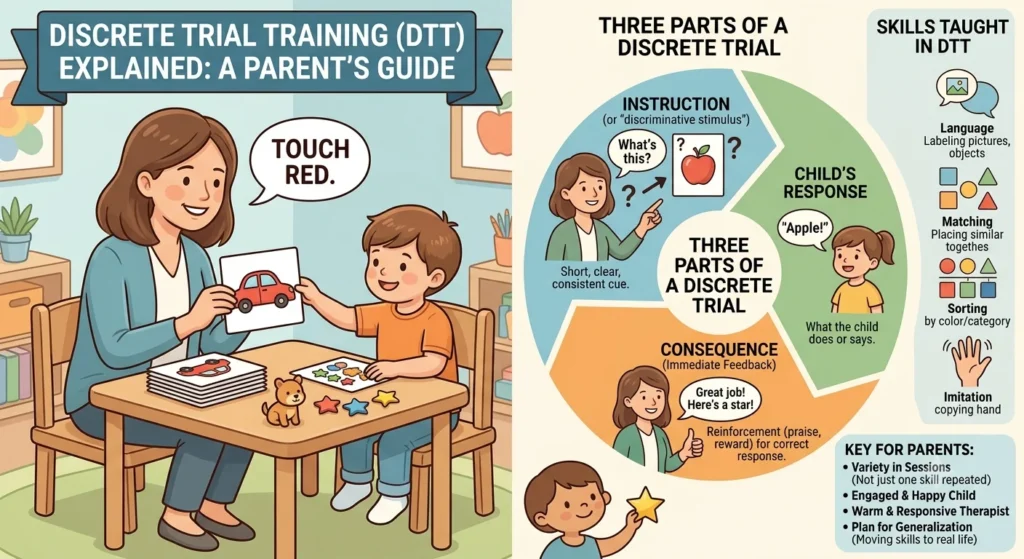
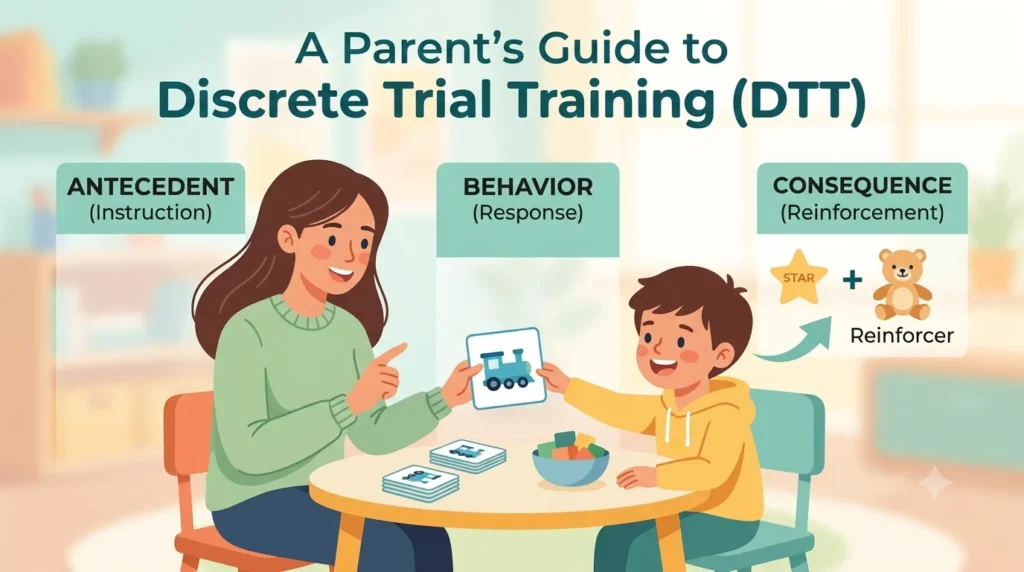
The word “discrete” here means separate and distinct each teaching opportunity, or “trial,” is a clearly defined, self-contained unit with a clear beginning and end. Each trial has three parts, deliberately structured and repeated:
- The instruction (or “discriminative stimulus”). A short, clear, consistent cue for example, “touch red,” or “what’s this?” while holding up a picture card.
- The child’s response. What the child does or says in reply to the instruction.
- The consequence. Immediate feedback reinforcement (praise, a small reward, access to a preferred item) for a correct or effortful response, or a neutral correction procedure if the response was incorrect.
After the consequence, there’s a brief pause, and then the next trial begins. A single session might include dozens of trials across a handful of different skills, each one short often just a few seconds but repeated many times.
Why Repetition Is the Point, Not a Flaw
To an outside observer, DTT can look repetitive, even a little strange. But that repetition is deliberate and purposeful. Learning a new skill especially for a child who processes information differently often requires far more repeated practice than we assume. DTT is built to provide that practice in a structured, predictable, low-distraction format, which makes it easier for many children to focus and succeed, especially early in learning a new skill.
Once a skill is solid in this structured format, a good ABA program moves it into more natural settings this is called generalisation, and it’s a critical next step (a program that only ever teaches in DTT format, without moving skills into daily life, isn’t doing its job fully).
What Skills Is DTT Typically Used For?
DTT tends to work particularly well for skills that can be broken into clear, teachable steps, such as:
- Receptive language following instructions, identifying objects or pictures when named
- Expressive language labelling objects, answering simple questions
- Matching and sorting matching identical items, sorting by colour or category
- Imitation copying simple motor actions, an important building block for later learning
- Early academic skills identifying letters, numbers, shapes, and colours
- Pre-requisite attending skills sitting, making eye contact briefly, waiting
A Real Example of a DTT Trial
Instruction: The therapist places three picture cards on the table a ball, a cup, and a shoe and says, “Touch ball.” Response: The child touches the correct card. Consequence: The therapist immediately praises (“Yes! That’s the ball!”) and may offer a small preferred reinforcer, like a few seconds of a favourite toy or a bite of a preferred snack, depending on what motivates that specific child.
If the response had been incorrect, the therapist would use a neutral, non-punishing correction procedure for example, modelling the correct answer and giving the child another opportunity rather than any form of scolding or negative reaction.
Why Reinforcement Matters So Much in DTT
The reinforcement used in DTT is chosen specifically for each child, based on what genuinely motivates them which might be praise, a favourite toy, a specific snack, or even a brief tickle or physical play, depending on the child. This is one of the most misunderstood parts of ABA by people unfamiliar with it: reinforcement isn’t about bribery, it’s about identifying what makes learning genuinely rewarding for that particular child, and using it consistently and immediately enough that the connection between effort and reward is clear.
Over time, as a skill becomes more established, reinforcement is gradually thinned meaning the child doesn’t need a reward after every single correct response anymore, moving toward more natural, intermittent reinforcement, similar to how learning works in everyday life.
Common Concerns About DTT
“It looks so rigid is that healthy for my child?” The structure is intentional and time-limited to specific teaching goals, not the entirety of a session or program. A well run program balances structured teaching like DTT with more natural, play-based teaching (see our guide on Natural Environment Teaching), rather than relying on DTT exclusively for everything.
“Will my child just memorise answers without really understanding them?” This is a legitimate concern, and it’s exactly why generalisation is such a critical, deliberate part of a good program testing and practicing the skill across different materials, different people, and different settings, not just with the same cards and the same therapist at the same table.
“Is this the only technique used in ABA?” No. DTT is one tool among several, typically used alongside more naturalistic approaches, depending on the specific skill being taught and how the individual child learns best.
What to Look For as a Parent
If your child’s program uses DTT, a few signs indicate it’s being done well:
- Sessions include variety different skills, different materials not the same handful of trials repeated indefinitely without progression
- Your child appears engaged, even eager for their turn, rather than distressed or shut down
- The therapist is warm and responsive, adjusting pace and reinforcement based on your child’s mood and energy that day
- There’s a clear plan to move mastered skills out of the structured table setting and into daily life
How This Fits Into the Bigger Picture
DTT is best understood as one well-researched tool within a much larger toolkit. For a child just starting to build foundational skills like imitation, following instructions, or early language DTT’s clear structure often provides exactly the kind of predictable, low-distraction environment that helps skills take hold quickly. As those skills solidify, a good program shifts more of the teaching into naturalistic, play-based formats, gradually reducing reliance on the structured table format as the child’s skills and flexibility grow.