
A realistic, honest timeline for ABA therapy progress what to expect in the first weeks, months, and beyond, and what actually influences the pace.
This is one of the most common questions parents ask right before starting ABA therapy prog, and one of the hardest to answer honestly, because the truthful response is: it depends on several specific, identifiable factors not a fixed universal timeline. This guide walks through what genuinely influences the pace of progress, what a realistic timeline actually looks like, and how to evaluate progress along the way without either losing patience too early or ignoring a program that genuinely isn’t working.

What Actually Determines the Timeline
The specific goal being targeted. Some skills like tolerating a new food on the plate, or waiting a few extra seconds before a request is met can show measurable progress within a couple of weeks. Others like developing spontaneous, flexible conversational language are inherently longer, multi-stage processes that unfold over many months or longer.
The child’s starting point. A child with some existing language who needs support expanding it will typically progress differently than a child who is not yet using any functional communication. This isn’t a reflection of effort or potential it simply reflects a different starting point requiring a different amount of foundational work.
Intensity and consistency of the program. A child receiving 20 hours a week of consistent, well-structured therapy will generally show measurable change faster than a child receiving 4 hours a week though both intensities can be appropriate depending on the child’s needs; more hours isn’t automatically “better” for every situation, but it does generally correlate with pace of progress.
Consistency between therapy and home. As covered in our guide on using ABA techniques at home, a child whose family reinforces the same strategies consistently outside of sessions tends to progress faster than one where therapy and home operate on very different rules.
Co-occurring factors. Sleep difficulties, significant sensory sensitivities, or other unaddressed medical or developmental factors can all affect how quickly a child is able to engage with and benefit from therapy.
A Realistic General Timeline
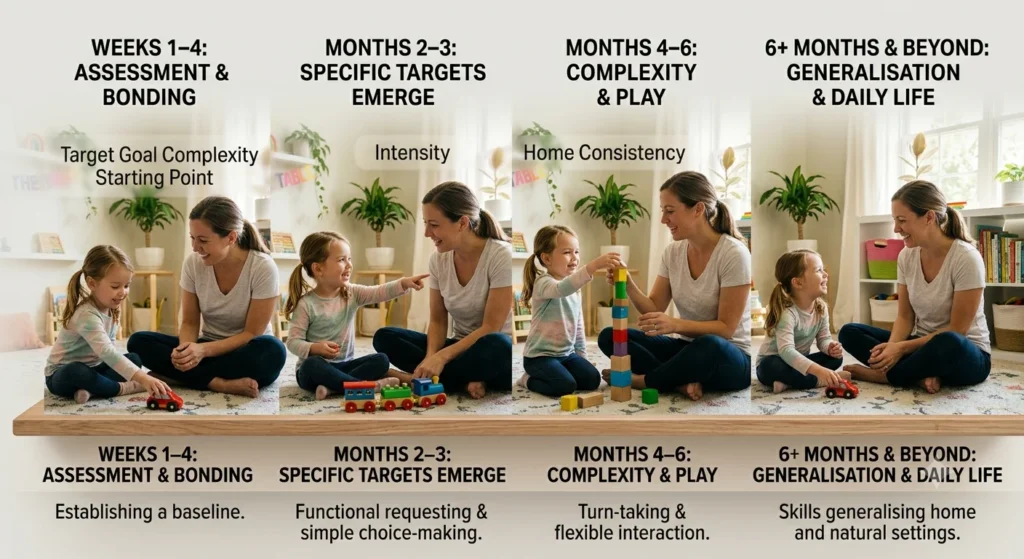
While every child is different, here’s a general pattern many families experience with a well-structured program:
Weeks 1–4: This period is largely about assessment, relationship-building, and establishing a baseline. The therapist is learning what motivates your child, testing initial strategies, and beginning to collect the data that will guide the rest of the program. Visible, dramatic change is uncommon this early and that’s expected, not a sign of failure.
Months 2–3: Early, specific, well-targeted goals often start showing measurable movement for example, an increase in spontaneous requesting, a reduction in the frequency of a specific challenging behaviour, or improved tolerance for a previously difficult transition. This is usually the point where parents start noticing real, if modest, differences in daily life.

Months 4–6: More complex or broader goals like expanding conversational language, more flexible play with peers, or generalising a skill across multiple settings often begin to show clearer, more consistent progress during this window, assuming consistent program delivery.
6 months and beyond: This is typically when families see the most meaningful, cumulative change skills building on each other, generalising across settings, and becoming a more natural part of the child’s everyday functioning, rather than something that only appears in a therapy session.
This timeline is a general pattern, not a guarantee some children progress faster, some need more time, and some goals are simply longer-term by nature.
Why ABA Therapy Progress Isn’t Always a Straight Line
It’s genuinely common and not a sign of a failing program for progress to include plateaus, or even brief regressions, particularly:
- Around major transitions, like starting school, a change in routine, or a house move
- During illness, or periods of poor sleep
- When a skill is being generalised to a new setting, which can temporarily look like “starting over” even though it’s actually an important, necessary part of the learning process
- Right after starting to address a challenging behaviour, where a temporary increase in that behaviour (an extinction burst) is a well-documented, expected part of the process before improvement
A good therapist should proactively explain these patterns to you in advance, rather than leaving you to wonder if something has gone wrong.
How to Evaluate aba therapy Progress Along the Way
Rather than a vague sense of “is this working,” ask your child’s therapist for concrete, specific information at each review:
- What specific goals were targeted this review period, and what does the data show?
- Which goals are progressing as expected, which are slower than expected, and why?
- Are mastered skills being seen outside of therapy sessions at home, at school, with family?
- What’s the plan for the next review period, and what would indicate we should adjust the approach?
If a provider can’t answer these clearly with actual data, that’s a legitimate concern worth raising directly, regardless of how much time has passed.
When It’s Reasonable to Be Concerned
While patience and realistic expectations matter, it’s also fair to raise concerns if, after a genuinely reasonable period (commonly around 3 months of consistent, sufficient-intensity therapy):
- There is no measurable progress on any targeted goal, based on actual data, not just impression
- The provider can’t clearly explain what’s being targeted or why
- Your child seems more distressed or withdrawn rather than more engaged over time
- Skills are not generalising at all outside of the therapy setting, even for simple, well-established goals
A good provider will welcome this conversation and adjust the plan accordingly, rather than being defensive about it.
Setting Realistic Expectations From the Start
One of the most useful things you can do before starting is ask your child’s clinician, at the very first assessment, what a realistic timeline looks like for your child’s specific goals not a generic answer, but one grounded in your child’s actual assessment results. This gives you a genuine benchmark to measure against, rather than comparing your child’s pace to another family’s very different situation, which is rarely a fair or useful comparison.
The Bottom Line
There is no single universal timeline for ABA therapy results, because “results” depends entirely on which specific skill is being targeted, your child’s starting point, and how consistently the program is delivered both in sessions and at home. What you can reasonably expect from a well-run program is regular, data-backed updates on specific goals giving you a clear, honest picture of progress at every stage, rather than vague reassurance either way.
Frequently Asked Questions
How soon should I expect to see my child talking more after starting ABA therapy progress?
This depends heavily on your child’s starting point and the specific language goals being targeted. Some children show early gains in functional requesting within weeks; broader, more flexible language development is typically a longer, multi-month process.
Is it normal for a behaviour to get worse before it gets better in ABA therapy progress?
Yes, this can happen and is a well-documented pattern called an extinction burst, particularly when addressing a behaviour that has previously “worked” for the child. A good therapist should explain this possibility in advance.
What if my child hasn’t made any progress after 3 months of therapy?
This is worth raising directly with your child’s clinician. Ask to see the actual data on targeted goals and discuss whether the current approach, intensity, or specific goals need adjustment.
Does more therapy hours always mean faster aba therapy progress?
Generally, higher intensity correlates with faster measurable progress, but the right number of hours depends on the individual child’s needs, tolerance, and the family’s capacity to support consistency more isn’t automatically better for every child.
Will my child eventually “graduate” from ABA therapy completely?
Many children do reduce and eventually discontinue formal ABA therapy as they meet goals and skills become well-established and generalised into daily life, though the timeline for this varies enormously by child.
How often should progress be formally reviewed?
Most well-structured programs review data and update treatment plans every few weeks, with a broader reassessment typically every few months to check overall progress against original goals.