
A practical, honest guide to ABA therapy cost in Lahore what affects the price, what to budget for, and questions to ask before you commit. Cost is one of the first questions almost every parent has about ABA therapy, and it’s often one of the hardest to get a straight answer to, because the honest answer is: it depends on several specific factors, not a single fixed number. This guide walks through exactly what shapes ABA therapy pricing in Lahore, so you can budget realistically and ask providers the right questions.
Why There’s No Single “Standard Price”
Unlike a single consultation fee, ABA therapy cost is driven by the total number of hours delivered, since it’s an ongoing, intensive service rather than a one-time appointment. Two families with children who have very different needs can end up with very different monthly costs, even at the exact same clinic, simply because their recommended hours differ.

What Actually Drives the Cost
1. Recommended weekly hours. This is the single biggest factor. A child recommended for 10 hours a week will cost roughly half of a child recommended for 20 hours a week, all else being equal. Weekly hours are determined by the initial assessment, based on your child’s specific needs not a fixed package everyone receives.
2. Who’s delivering the session. Sessions run by a Registered Behaviour Technician under supervision are typically priced differently than sessions run directly by a senior clinician or BCBA-level professional. Some programs blend both a technician for most sessions, with periodic direct sessions or reviews from the supervising clinician.
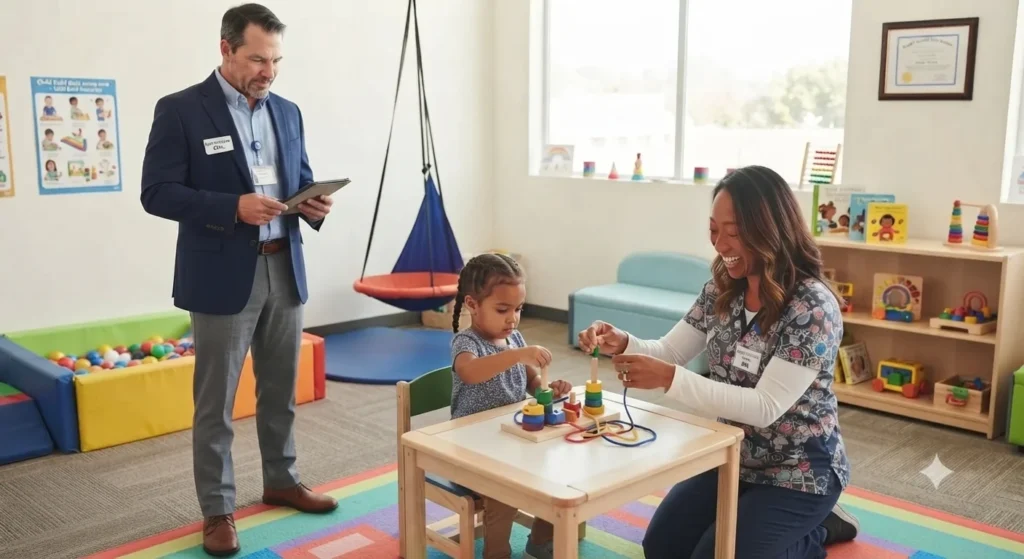
3. In-clinic versus home-based versus online. In-clinic sessions are often more cost-effective per hour because a provider can serve multiple families from one location without travel time. Home-based sessions, which include a therapist travelling to your house, often carry a premium for that convenience. Online sessions, delivered via video for consultation, parent training, and certain teaching goals, are typically the most cost-effective option, though they’re not a full substitute for hands-on, in-person work with a young child in the early stages of a program.
4. Assessment fees. The initial functional behaviour assessment is usually billed separately from ongoing therapy sessions, since it involves dedicated clinical time to observe your child, gather history, and write a detailed report and treatment plan.
5. Supervision and plan review. Ongoing clinical oversight the BCBA or senior clinician reviewing data and updating the plan regularly is sometimes billed as a separate periodic fee, and sometimes built into the per-session rate. Ask your provider directly which model they use.
A Realistic Way to Think About Monthly Cost
Rather than asking “how much does ABA therapy cost in Lahore” as a single number, it’s more useful to think in this structure:
(Per-session or per-hour rate) × (recommended weekly hours) × (roughly 4.3 weeks per month) = estimated monthly cost
For example, a child recommended for 10 hours a week will have a very different monthly total than a child recommended for 25 hours a week, even if the per-hour rate is identical. This is why the assessment which determines recommended hours is such an important first step, both clinically and financially.
Questions to Ask Before Committing
- What is the per-session or per-hour rate, and does it differ based on who delivers the session (RBT versus senior clinician)?
- How many hours per week are being recommended for my child specifically, and why?
- Is the initial assessment fee separate from ongoing therapy fees?
- Is clinical supervision and plan review billed separately, or included in the session rate?
- Are there package rates for committing to a certain number of sessions or months?
- What happens financially if we need to pause or reduce sessions temporarily?
- Is there a difference in cost between in-clinic, home-based, and online sessions?
A transparent provider should be able to answer all of these clearly, in writing, before you commit.
Is Less Expensive Always Worse, or More Expensive Always Better?
Not necessarily either way. Price differences often reflect real differences in who’s delivering the session, the level of clinical supervision behind the plan, and the provider’s overall infrastructure but a higher price doesn’t automatically guarantee better outcomes, and a lower price doesn’t automatically mean lower quality. The better questions are the ones above: who’s involved, how are they supervised, how is progress tracked, and how transparent is the provider about all of it.

Budgeting for the Full Picture, Not Just the Session Rate
A few costs families sometimes overlook when budgeting:
- Travel time and cost, if sessions are home-based or require regular clinic visits
- Materials, which some programs include and others bill separately
- Periodic reassessment, since goals and recommended hours are typically reviewed and adjusted every few months as your child progresses
- Complementary therapies, such as speech therapy or occupational therapy, if recommended alongside ABA as part of a coordinated plan
Making ABA Therapy More Financially Sustainable
A few practical approaches families use:
- Starting with a realistic, sustainable number of hours rather than the maximum recommended intensity, if the maximum isn’t financially sustainable long-term some structured support delivered consistently is generally more valuable than intensive support that gets interrupted due to cost
- Combining in-clinic sessions with parent-delivered strategies at home, guided by the therapist, to extend the value of each paid session
- Discussing a phased approach directly with your provider for example, starting more intensively and gradually reducing hours as your child meets goals, rather than assuming the initial hours are fixed indefinitely
What This Means for Overseas Pakistani Families
Families based in the UK, USA, Canada, UAE, Saudi Arabia, or Australia often find that ABA therapy costs in Lahore, delivered either during a visit or via structured online consultation and parent coaching, are considerably more accessible than equivalent services in their country of residence while still working with a clinician who understands the child’s cultural and linguistic context. It’s still worth asking the same cost-transparency questions above, adjusted for how sessions will actually be delivered across a distance.
The Bottom Line
ABA therapy cost in Lahore depends primarily on recommended weekly hours, who delivers the sessions, and the format (in-clinic, home, or online) not a single flat number you can compare across providers without more context. The most useful thing you can do as a parent is ask direct, specific questions about how pricing is structured before starting, so there are no surprises once your child’s program is underway.