
Practical, realistic fixes for common sensory sensitivities in autistic children at home from noise and clothing to haircuts and meltdown-prone moments.
Sensory sensitivities are one of the most misunderstood parts of autism from the outside looking in, and one of the most quietly exhausting to manage from inside your own home day after day. A child who seems entirely fine one moment can be completely overwhelmed the next by something that appears, to everyone else in the room, entirely unremarkable a bit of background noise, a clothing tag, a slightly brighter light than usual. This guide focuses specifically on practical, realistic fixes you can start using at home this week, organised by the specific sensory challenge you’re facing.
What Is a Sensory Sensitivities, Really?
Sensory sensitivities refer to genuine differences in how the brain processes information arriving through the senses sound, touch, sight, smell, taste, movement, and internal body awareness. For many autistic children, this means certain sensory input feels considerably more intense, or in some cases considerably less noticeable, than it does for most people around them. A sound that seems entirely mild to you might feel physically uncomfortable, even painful, to your child; a texture that seems completely unremarkable might feel genuinely unbearable against their skin, in a way that has nothing to do with stubbornness or drama.
Why Does My Child Seem Fine With Sensory Input One Day and Overwhelmed the Next?
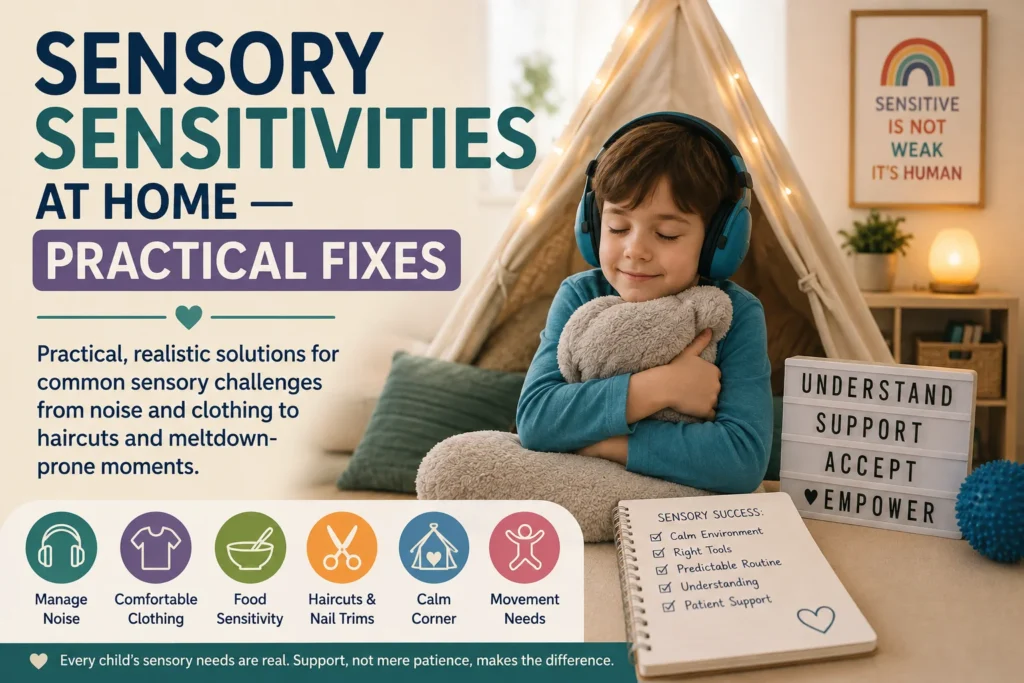
Sensory tolerance genuinely isn’t fixed from day to day it fluctuates based on tiredness, accumulated stress, hunger, illness, and how much sensory “load” has already built up earlier in the same day. A child who handled a noisy classroom perfectly fine in the morning might completely melt down at a relatively quiet dinner table that same evening, not because the dinner table is somehow objectively worse, but because their overall capacity for sensory input has already been substantially used up across the preceding hours. Thinking of sensory tolerance as something closer to a battery that genuinely drains and needs recharging, rather than a fixed personal trait, tends to help parents respond with considerably more patience in the moment.
What Are the Most Common Sound Sensitivities, and What Actually Helps?
Many children are particularly sensitive to sudden, unpredictable, or high-pitched sounds a blender starting unexpectedly, a doorbell ringing, a crowded family gathering with multiple overlapping conversations happening at once. Practical fixes include warning your child clearly before a loud sound is about to happen wherever this is possible, such as with a blender or a vacuum cleaner; using noise-reducing headphones or simple earplugs during genuinely loud or unpredictable events like weddings or large family gatherings; and creating a quiet retreat space at home that your child can go to whenever things feel like too much offered as a genuinely available option, not framed as a punishment or a place they’re sent when they’ve misbehaved.
How Do I Handle Clothing and Texture Sensitivities?
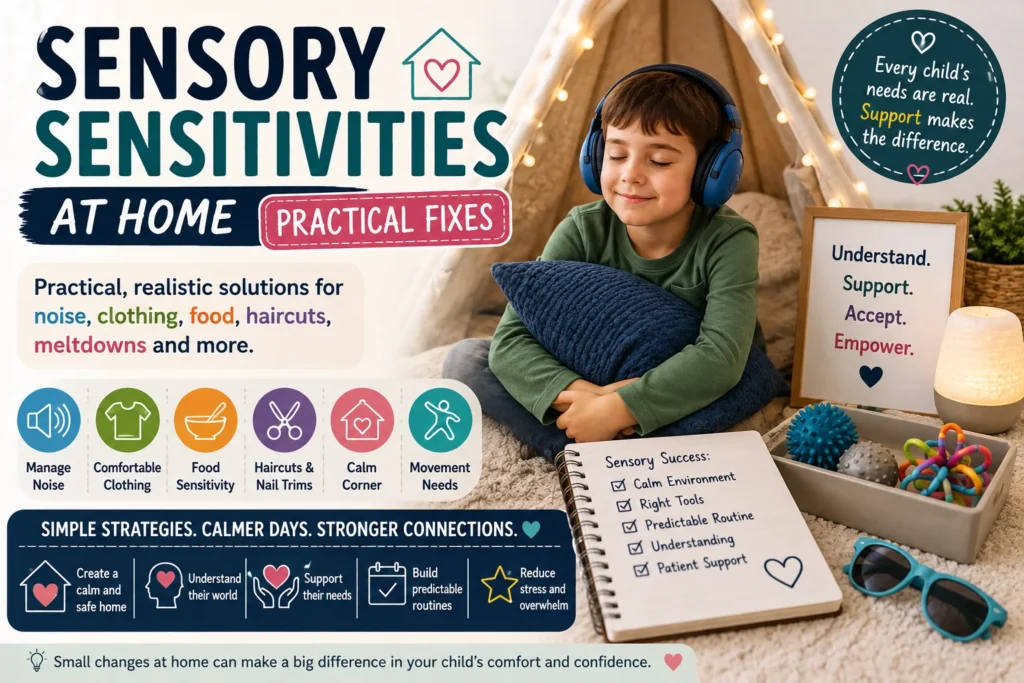
Texture sensitivities around clothing are extremely common among autistic children, and they are not your child being deliberately dramatic or difficult. Practical approaches include removing clothing tags before your child ever wears something new, choosing softer fabrics and looser fits where reasonably possible even if they’re not your own first aesthetic preference, washing new clothes multiple times before your child wears them to soften the fabric considerably, and involving your child directly in choosing their own clothes whenever feasible, since their own sensory experience of a specific item is far more reliable, useful information than how it happens to look on a hanger in a shop.
What About Food Sensitivities and Extreme Pickiness?
Sensory-based food selectivity in autistic children often goes well beyond typical picky eating it can involve strong, genuine reactions to specific textures, temperatures, or even the way different foods happen to touch each other on a single plate. Rather than pushing hard for immediate variety, practical approaches include respecting genuinely sensory-based refusals rather than treating them as simple defiance, introducing new foods very gradually and entirely without pressure sometimes just having a new food sitting nearby on the table without requiring your child to actually eat it, repeated patiently across many separate exposures over time and working with a professional if selectivity becomes severe enough to raise genuine nutritional concerns, rather than attempting to manage it entirely alone indefinitely.
How Can I Make Haircuts, Nail Trims, and Similar Tasks Less Distressing?
These specific everyday tasks combine several sensory triggers at once unfamiliar touch, unexpected sounds, unusual physical sensations which is exactly why they’re so often disproportionately difficult compared to other activities. Practical fixes include choosing quieter times of day when your child is generally more regulated, using tools your child has had a genuine chance to see and touch beforehand rather than being surprised by them in the moment, breaking the task into smaller sessions spread across multiple days rather than insisting on completing everything at once, and allowing your child to hold a comfort item or wear noise-reducing headphones throughout the entire process.
What Can I Do About Sensitivity to Light?
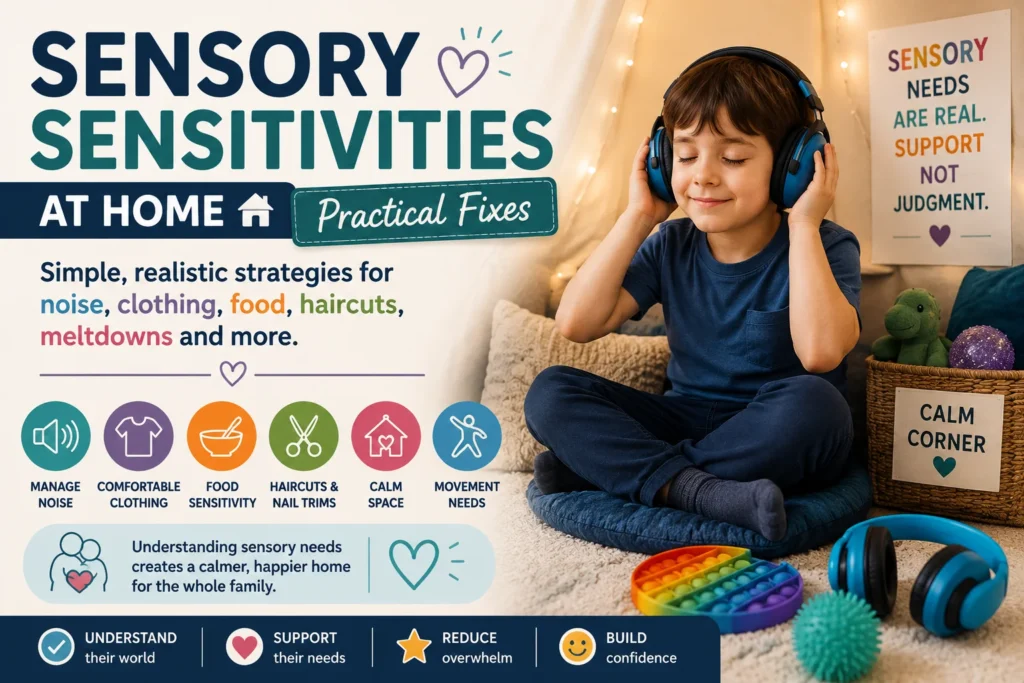
Bright, flickering, or fluorescent lighting can be genuinely uncomfortable for some children, sometimes contributing to headaches or general irritability that isn’t always obviously connected to the lighting itself at first glance. Practical fixes include using warmer, dimmer lighting at home wherever reasonably possible, allowing sunglasses or a cap to be worn in brightly lit outdoor settings even if it looks somewhat unusual to others around you, and being genuinely aware that a meltdown happening in a brightly-lit shopping mall might well be sensory-driven at its root, not purely behavioural in the way it might first appear.
My Child Seeks Out Intense Sensory Input Spinning, Crashing, Jumping. Is That a Problem?
Sensory-seeking behaviour spinning repeatedly, crashing into cushions, jumping over and over, seeking out deep pressure is just as real and just as common as sensory avoidance, and it’s generally not something that needs to be suppressed outright. Instead, it’s usually far more helpful to provide safe, appropriate outlets for this genuine need: a trampoline or a crash pad set up at home, weighted blankets specifically for deep pressure input, or scheduled “sensory breaks” deliberately built into the day, particularly before activities that require sitting still or sustained focus.
Building a Calm Corner at Home Does It Actually Help?
A dedicated, predictable space your child can retreat to whenever they feel overwhelmed even a small corner with a few soft cushions, dim lighting, and a couple of genuinely calming items helps many children regulate considerably, precisely because it’s available and already familiar before a meltdown even starts, rather than being introduced only as damage control after distress has already escalated. (Our separate, more detailed guide on building a calm corner at home walks through exactly how to set one up.)
How Do I Handle Sensory Overload When We’re Out in Public?
Preparation matters considerably more than reaction in the moment here. Before a potentially overwhelming outing a wedding, a crowded market, an Eid gathering with many relatives plan a clear, specific exit strategy in advance, bring familiar sensory tools with you such as headphones or a comfort item, and identify a genuinely quiet space at the venue beforehand if that’s at all possible. When overload does happen despite reasonable preparation, prioritise reducing sensory input immediately by moving to a quieter space, over attempting to reason with or verbally calm your child in the middle of the overwhelming environment itself.
How Do I Explain Sensory Needs to Relatives Who See Them as “Spoiled” Behaviour?
A brief, calm, factual explanation something like “loud sounds are physically uncomfortable for him, this genuinely isn’t him being difficult on purpose” tends to work considerably better over repeated, patient exposure than a single emotional defence delivered in the heat of the moment, even if it doesn’t shift everyone’s view immediately the first time. You’re not obligated to justify your child’s needs extensively to every relative present, but a short, consistent explanation, repeated calmly and without apology, often does gradually shift understanding over time.
What Role Does Occupational Therapy Play in Addressing Sensory Needs?
While many sensory strategies can genuinely be implemented at home, an occupational therapist brings specific, specialised training in sensory processing that can meaningfully deepen your approach, particularly for more significant sensory challenges. An occupational therapy assessment can identify your child’s specific sensory profile in detail which senses are under-responsive, which are over-responsive, and which specific strategies are likely to help most giving you a far more targeted plan than general home strategies alone can provide.
How Do Sensory Needs Typically Change as a Child Gets Older?
Sensory sensitivities often do shift over time, sometimes becoming less pronounced in certain areas as a child develops additional coping strategies and greater self-awareness, and sometimes becoming more noticeable in new areas as life demands change school uniforms, exam halls, and eventually workplace environments each bring their own sensory challenges. This is part of why sensory strategies benefit from being revisited periodically rather than treated as a single, fixed plan set once and never adjusted again.
How Do Sensory Needs Show Up Differently at Home Versus at School?
A child’s sensory environment at home is often, at least to some degree, within a parent’s control lighting, noise, textures can all be adjusted. A classroom, by contrast, is a considerably less controllable sensory environment, with fluorescent lighting, the noise of many children, and unpredictable sounds from corridors or nearby classes. It’s worth discussing with your child’s teacher what reasonable accommodations might help at school specifically permission to wear headphones during independent work, a seat away from the loudest part of the room, or a quiet space available during particularly overwhelming moments like assemblies. (Our dedicated guide on autism and school in Pakistan covers this specific conversation in more depth.)
What Sensory Tools Are Genuinely Worth Investing In?
Beyond the specific fixes already covered, a few general categories of sensory tools tend to be worth the investment for many families: a good pair of noise-reducing headphones for genuinely unpredictable or loud environments, a weighted blanket or lap pad for children who respond well to deep pressure, simple fidget tools for children who benefit from having something to do with their hands during moments requiring focus or waiting, and a small, portable comfort item that can travel with your child to reduce the unpredictability of new environments. Not every child benefits from every tool introducing them gradually and observing your own child’s specific response works better than assuming a tool that helped another family’s child will automatically help yours.
How Do I Balance Accommodating Sensory Needs With Building Tolerance Over Time?
This is a genuinely reasonable tension worth thinking through directly rather than assuming one approach is always correct. Accommodating a genuine sensory need removing a clothing tag, allowing headphones in a loud environment isn’t the same as avoiding all sensory challenge indefinitely. Gradual, carefully paced exposure to mildly challenging sensory experiences, introduced without pressure and with your child’s own pace respected throughout, can genuinely help build tolerance over time for some sensitivities, while other sensitivities may remain lifelong and are better accommodated consistently rather than pushed against. A good occupational therapist can help you understand which approach fits which specific sensitivity for your own child.
When Should Sensory Sensitivities Be Discussed With a Professional?
If sensory sensitivities are significantly limiting your child’s daily functioning affecting nutrition, sleep, school attendance, or participation in ordinary family activities it’s genuinely worth raising this directly with your child’s psychologist or an occupational therapist, since targeted, professional strategies can meaningfully help well beyond what general home adjustments alone are able to achieve.