
The ABC model (Antecedent-Behaviour-Consequence) is the foundation of every ABA therapy program. Here’s how it works, explained with real examples from everyday parenting.If you’ve started ABA therapy for your child, you’ll hear the letters “ABC” constantly in session notes, in progress reports, in conversations with your child’s therapist. It sounds technical, but the idea behind it is something every parent already does instinctively, just without the formal language for it. Understanding the ABC model is the single most useful thing you can learn as a parent supporting a child through ABA therapy, because once you see it, you start noticing it everywhere including in your own home, every single day.
What Does ABC Actually Stand For?
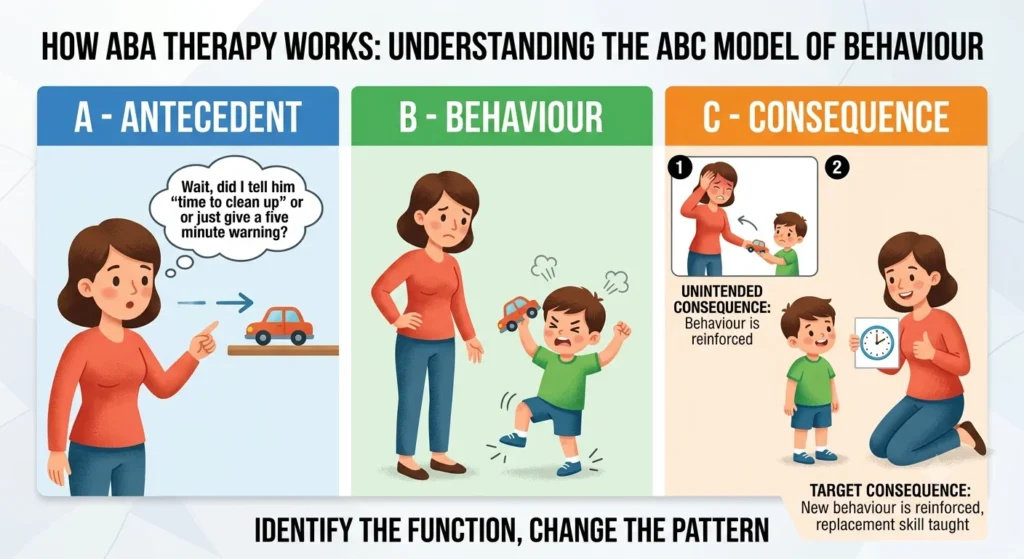
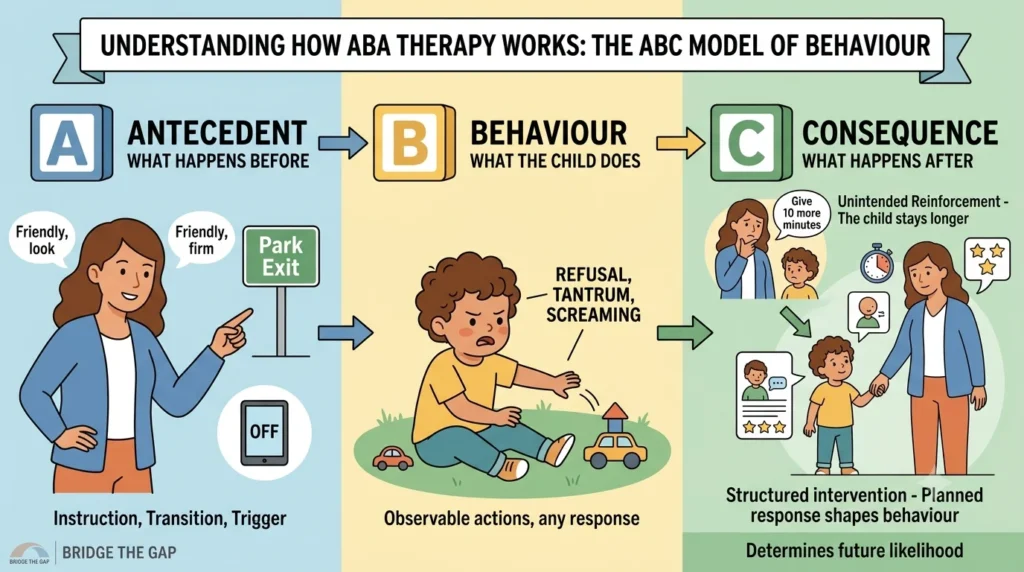
- A — Antecedent: What happens right before a behaviour. This could be an instruction (“time to turn off the tablet”), a change in environment (walking into a noisy shop), a sensory trigger (a loud sound), or simply being asked to do something the child finds difficult.
- B — Behaviour: What the child actually does in response. This might be a tantrum, hitting, running away, following the instruction calmly, or asking for help.
- C — Consequence: What happens immediately after the behaviour and this is the part most parents underestimate. A consequence isn’t necessarily a punishment. It’s simply whatever happens next, and it’s often the thing that determines whether that behaviour is more or less likely to happen again.
Why This Matters More Than “Good” or “Bad” Behaviour
Most parenting advice focuses on the behaviour itself how to stop a tantrum, how to get a child to listen. ABA therapy takes a step back and asks a different question: what is this behaviour actually doing for the child? Every behaviour, even a difficult one, is communicating something or achieving something for the child, whether that’s getting attention, escaping a demand, accessing something they want, or self-soothing from sensory overload.
This is why an ABA therapist spends so much time observing before intervening. Two children can have the exact same behaviour say, throwing toys for completely different reasons. One might be throwing toys to get a parent’s attention. Another might be throwing toys to escape a task they find overwhelming. The behaviour looks identical, but the function is different, and effective therapy depends entirely on identifying that function correctly.
A Real-World Example
Let’s walk through an everyday scenario using the ABC model.
Antecedent: A parent tells their child it’s time to leave the park. Behaviour: The child screams, drops to the ground, and refuses to move. Consequence: The parent, embarrassed and wanting the screaming to stop, lets the child stay 10 more minutes.
From the outside, this looks like a small, understandable parenting moment. But from an ABA lens, something important just happened: the child learned that screaming works to delay an unwanted transition. The consequence getting 10 more minutes made the screaming more likely to happen again next time, even though that wasn’t the parent’s intention at all.
This isn’t about blaming parents. It’s about showing how consequences shape behaviour whether we plan them or not and how understanding this pattern gives parents a genuinely different, more effective way to respond.
How ABA Therapists Use the ABC Model to Build a Plan
Once an ABA therapist identifies the pattern behind a specific behaviour, the intervention usually works on more than one part of the ABC chain at once:
- Changing the antecedent. For example, giving a 5-minute warning before leaving the park, using a visual timer, or offering a choice (“do you want to leave now or after one more slide?”) small changes that reduce the likelihood of the behaviour happening at all.
- Teaching a replacement behaviour. Instead of just trying to eliminate the tantrum, the child is explicitly taught a more effective way to communicate the same need for example, asking for “5 more minutes” using words, a picture card, or a gesture.
- Adjusting the consequence. This is often the hardest part for parents, but the most important. If screaming used to result in extra time at the park, and now it consistently doesn’t while asking calmly does result in a reasonable compromise the child gradually learns which strategy actually works.
Why This Approach Works Better Than “Just Be More Strict” or “Just Be More Patient”
Many parents try one of two default strategies before starting therapy: becoming stricter (more consequences, more punishment) or becoming more permissive (giving in to avoid meltdowns). Both can work in the short term and both tend to break down over time, because neither one actually addresses why the behaviour is happening. The ABC model works because it treats behaviour as information, not just as something to be controlled. Once you know the function of a behaviour, you can actually change the pattern rather than just managing the same crisis differently each day.
How This Shows Up Across Different Skills
The ABC model isn’t only used for reducing difficult behaviours it’s also how ABA therapists build new skills.
- Teaching a child to request a snack: Antecedent (snack is visible but out of reach) → Behaviour (child points, or says “snack”) → Consequence (child receives the snack). Over repeated, consistent trials, requesting becomes a reliable, functional skill.
- Teaching a child to greet others: Antecedent (someone says “hello”) → Behaviour (child waves or says “hi”) → Consequence (warm, genuine social response from the other person).
- Teaching a child to tolerate waiting: Antecedent (child is told “wait a moment”) → Behaviour (child waits calmly, even briefly) → Consequence (praise, and the item or activity they were waiting for).
What Parents Can Actually Do With This
You don’t need to become a behaviour analyst to use this yourself. A few practical starting points:
- Notice the pattern before reacting. When a difficult behaviour happens, pause and ask: what happened right before this, and what is my child getting (or avoiding) because of it?
- Be consistent with consequences. If a behaviour sometimes “works” and sometimes doesn’t, children learn to persist longer, not less because inconsistent reinforcement is actually one of the strongest ways to make a behaviour more resistant to change.
- Reinforce the behaviour you want to see, deliberately and immediately. If your child asks calmly instead of screaming, respond warmly and promptly the timing matters as much as the response itself.
- Talk to your child’s ABA therapist about the “why,” not just the “what.” Understanding the function behind a specific behaviour will help you respond consistently at home, which is one of the biggest predictors of how quickly a child’s progress in therapy carries over into daily life.
Bringing This Into Your Child’s Therapy Plan
If your child is receiving ABA therapy in Lahore or online, ask your therapist to walk you through the ABC data specific to your child’s target behaviours most programs collect this data anyway, and seeing it explained in plain language, tied to your own child’s actual patterns, makes the whole approach far less abstract and far more useful day to day.