
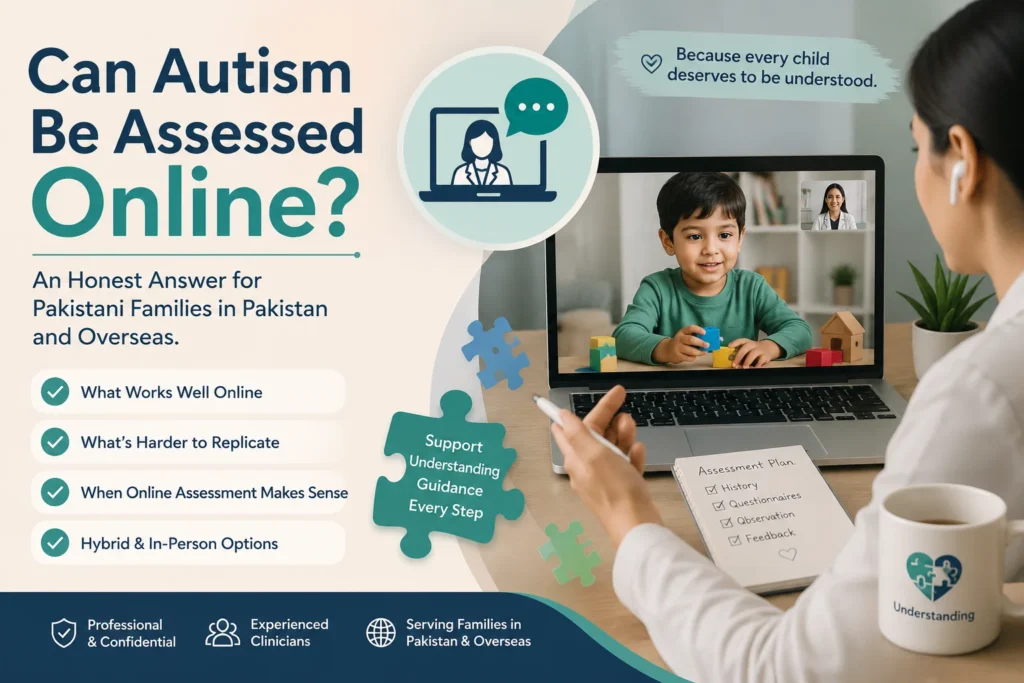
Can autism genuinely be assessed through an online consultation? An honest, balanced answer for Pakistani families in Pakistan and overseas.
This question comes up constantly, and it deserves a straight, specific answer rather than either blanket reassurance or blanket dismissal. Online autism assessment has become far more common in recent years, especially for families outside major cities or living abroad but “can it genuinely be done” and “is it always the ideal option for every child” aren’t quite the same question, and conflating them tends to leave parents either unfairly dismissive of a genuinely valid option or unrealistically confident about a process that varies considerably in quality between providers.
What Parts of an Autism Assessment Online?
Several core components of a proper autism assessment online translate genuinely well to a video-call format. The detailed developmental history interview with parents doesn’t depend on physical presence at all, and in practice often works just as well over video sometimes better, since parents can speak from a comfortable, familiar environment rather than a formal clinical waiting room, which can itself reduce some of the anxiety that colours an in-person visit.
Structured questionnaires work identically whether completed on paper in a clinic or through a secure online form. Review of prior reports and any home videos you provide is unaffected by format entirely. And the feedback session, where results are explained to you directly, translates to video just as effectively as it would in person, arguably with the added benefit of you being in a comfortable space to process what’s being discussed.
What Part Is Genuinely Harder to Replicate Online?
The direct structured observation of the child particularly tools like the ADOS-2, which were traditionally designed around in-person interaction, including physical play materials, close observation of subtle physical and social behaviours, and hands-on joint activities is the part where online delivery faces genuine, honest limitations, especially for younger children. This isn’t a reason to dismiss online assessment outright, but it’s the specific, honest place where format matters most, and pretending otherwise would be misleading.
Does That Mean Online Assessment Isn’t Genuinely Valid?
Not necessarily it means the how matters considerably more than usual when the format is online. Experienced clinicians can meaningfully adapt structured observation for video delivery, using screen-shared or mailed-ahead materials, careful camera positioning, and parent-guided interaction directed by the clinician in real time.
There’s a growing, genuine body of clinical practice supporting adapted online autism assessment, particularly when conducted by clinicians who specifically know how to run it well. The honest caveat worth stating plainly: not every online assessment is run this carefully, and quality varies considerably between providers which is exactly why asking specific, direct questions about a provider’s particular approach matters far more than assuming “online” automatically means either lower quality or equally reliable quality.
When Does Online Assessment Make the Most Sense?
Online assessment is often a genuinely strong, sensible option when you’re based outside Lahore or another major city with no local specialist access nearby; when you’re an overseas Pakistani family and travel to Pakistan isn’t immediately practical; when your child is somewhat older and more verbally engaged, making structured conversation-based observation more naturally adaptable to a video format; or when you need to start the process now, rather than waiting months for an in-person appointment slot, with a genuine plan to supplement with an in-person visit later if that turns out to be needed.
When Might In-Person Be Meaningfully Better?
In-person assessment tends to have a real, honest edge specifically for very young toddlers, where subtle physical behaviours, fine motor patterns, and hands-on play observation are genuinely harder to capture fully through a screen than they are sitting in the same room. It can also matter in situations where a child’s behaviour is significantly affected by the novelty of a camera or screen itself, which can occasionally distort what’s actually observed compared to how the child would behave in person. None of this means online is unusable for toddlers specifically it means the particular tradeoffs are worth discussing directly and honestly with your clinician for your own child’s specific situation.
Is a Hybrid Approach an Option Worth Considering?
Yes, and for many families particularly those outside Lahore this is often the most practical answer available. A hybrid model, combining online developmental history-taking, questionnaires, and an initial consultation with a single in-person visit for the direct structured observation portion specifically, genuinely captures much of the benefit of both formats at once. This is worth asking about directly rather than assuming the choice is strictly all-or-nothing between fully online and fully in-person.
Will an Online Assessment Be Taken Seriously by Schools or Other Professionals?
This depends significantly on the credentials and thoroughness of the specific clinician conducting the assessment, not simply the format itself. A properly conducted assessment with a genuinely thorough developmental history, appropriately adapted observation, and a detailed, well-documented written report carries real, substantive weight regardless of delivery method, though it’s worth checking directly with your specific school or professional body if formal acceptance is a concern, particularly for overseas families needing a report recognised by a school system abroad (our dedicated guide for overseas Pakistani families addresses this specific question in full).
What Should I Ask a Provider Before Booking an Online Assessment?
Before committing, it’s worth asking directly: how is the direct observation portion specifically adapted for video delivery, and what materials or preparation will be needed at home beforehand; what is your specific, genuine experience with online-adapted autism assessment, not simply online consultation more generally; will the assessment include the same depth of developmental history and multiple sessions as a thorough in-person process, or is it condensed and shortened; and under what specific circumstances would you recommend an in-person visit instead, or as a meaningful follow-up. A transparent, confident provider will answer each of these clearly rather than deflecting the question or treating it as unwelcome scrutiny.
What Does a Well Run Online Assessment Actually Look Like in Practice?
A properly run online assessment typically involves multiple sessions, not a single rushed call a thorough parent interview conducted with real care, guided observation activities where the clinician directs age-appropriate play or interaction, sometimes with a parent’s hands-on involvement guided by the clinician step by step in real time, careful review of home videos capturing more natural behaviour than a single formal video call ever could, and a full, detailed written report exactly matching what a strong in-person process would produce, just delivered through a different medium.
What Are the Genuine Advantages of Online Assessment Beyond Simple Convenience?
Beyond simply removing the burden of travel, online assessment allows genuine access to a specific clinician’s particular expertise regardless of geography which matters enormously for families in Faisalabad, Multan, Gujranwala, or other cities without a local specialist, and for overseas Pakistani families who specifically want an assessment from someone who understands Pakistani cultural and family context deeply, not simply a generic local provider unfamiliar with that background. It can also mean starting the entire process considerably sooner, rather than waiting months for a local in-person slot to become available.
How Should I Weigh Cost Differences Between Online and In-Person Options?
Online assessment is sometimes, though not always, somewhat less expensive than in-person options, partly reflecting reduced overhead and eliminated travel costs on both sides. That said, cost shouldn’t be the primary or sole deciding factor a properly conducted online assessment by an experienced provider is a genuinely sound clinical choice on its own merits for many families, not simply a lower-cost compromise chosen reluctantly in place of something better.
What Technology Do I Actually Need for an Online Assessment?
A stable internet connection, a device with a working camera and microphone, and a reasonably quiet, well-lit space are the practical basics. Beyond that, some providers may ask you to have specific simple materials on hand in advance everyday household items or particular toys the clinician will direct you or your child to use during a guided observation activity with clear instructions sent ahead of time rather than assuming you already have specialised equipment.
How Does an Online Assessment Handle a Child Who’s Reluctant to Engage With a Screen?
Some children, particularly younger ones, are naturally more resistant to sustained screen-based interaction than they would be to an in-person visitor. Experienced online assessors build in flexibility for this shorter sessions, breaks, activities that draw the child’s attention through a parent’s guided involvement rather than direct screen engagement, and, where genuinely needed, a recommendation to shift toward an in-person component if screen-based engagement remains a persistent barrier despite reasonable adaptation.
What Should I Do to Set Up My Home for an Online Session?
Choosing a space with minimal distractions fewer toys scattered within reach, a door that can be closed to reduce interruptions from other family members, and lighting that lets the clinician see your child’s face and reactions clearly genuinely helps the observation portion run more smoothly. This isn’t about creating an artificial environment; it’s about reducing incidental noise so the clinician can focus on what actually matters.
Does Online Assessment Work Differently for Toddlers Compared to Older Children?
Yes, meaningfully. For toddlers, online assessment leans heavily on parent-guided interaction, with the clinician directing specific play activities for the parent to carry out while observing closely over video, since a toddler generally engages far more naturally with a parent physically present than with an unfamiliar adult appearing only on a screen. For older, more verbally fluent children, direct conversation between the clinician and child over video becomes considerably more feasible and often works close to as well as an in-person conversation would.
What If the Internet Connection Is Unreliable During a Session?
This is a genuine practical concern worth planning for honestly, particularly for families in areas with less consistent connectivity. It’s worth discussing directly with your provider beforehand what happens if a session is interrupted most experienced online providers have a straightforward approach, such as resuming from where the disruption occurred or rescheduling the affected portion, rather than treating a technical interruption as invalidating the whole session.
How Do I Know If the Provider I’m Considering Actually Has Genuine Online Assessment Experience?
Ask directly how many online assessments they’ve conducted, whether they can describe their specific adapted process for the observation portion in concrete detail rather than vague reassurance, and whether they can share (without breaching confidentiality) a general sense of how the process has worked for other families in similar situations. A provider newly attempting online assessment without a clearly thought-through adapted process is a different, more uncertain proposition than one with genuine, established experience specifically in this format.
Can an Online Assessment Be Combined With Input From Local Professionals Already Involved With My Child?
Yes, and this is worth raising directly if your child already sees a paediatrician, speech therapist, or teacher who has relevant observations. A thorough online assessment can incorporate written input or a brief conversation with these existing professionals, adding valuable additional context to the developmental history gathered directly from you, and giving the assessing clinician a fuller picture than parent report alone would provide.
The Honest Bottom Line
Online autism assessment is genuinely valid and, for a great many families, a practical and even preferable option but its quality depends heavily on the specific clinician’s experience with properly adapting the process, not simply on the format itself. The right question isn’t “is online assessment real” it clearly and demonstrably can be it’s “is this specific provider running a properly adapted, genuinely thorough process,” which is worth asking about directly and specifically before you book anything.