
Confused about whether your child needs ABA therapy vs speech therapy, occupational therapy, or a combination? Here’s a clear, practical breakdown of each.
After an assessment, many parents are handed a report recommending a combination of therapies and left unsure what each one actually does, how they’re different, and how they’re supposed to work together. This guide breaks down ABA therapy, speech and language therapy, and occupational therapy clearly, so you understand exactly what each one is targeting and why a child might need one, two, or all three.
The Short Version
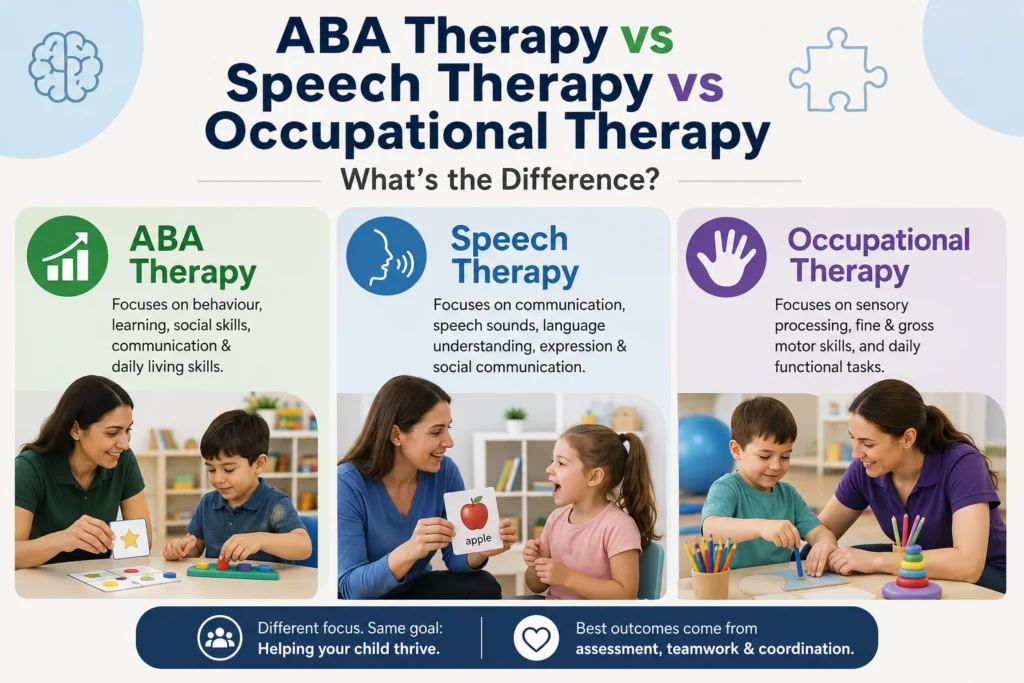
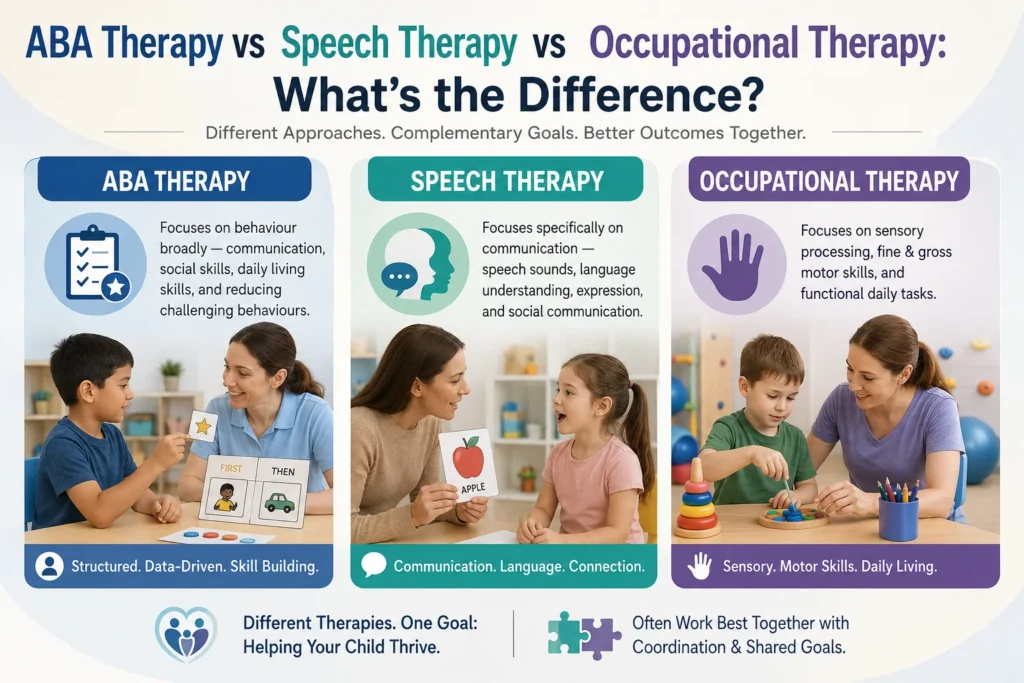
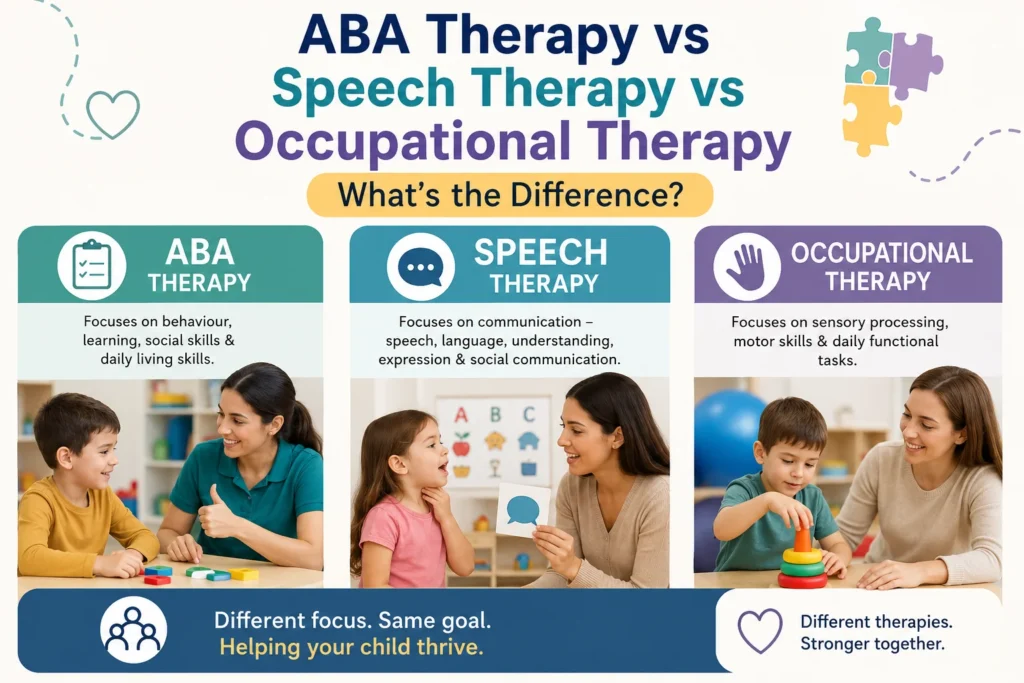
- ABA (Applied Behaviour Analysis) therapy addresses behaviour broadly communication, social skills, daily living skills, and reducing challenging behaviours using structured teaching and reinforcement principles.
- Speech and language therapy addresses communication specifically articulation, understanding language, expressive language, and sometimes social communication (pragmatics).
- Occupational therapy addresses sensory processing, fine and gross motor skills, and functional daily tasks like handwriting, dressing, and using utensils.
They frequently overlap for example, all three might touch on communication or daily living skills but each approaches the child from a different professional lens and with different core methods.
ABA Therapy vs Speech Therapy in More Depth
ABA therapy is grounded in the science of learning and behaviour. It looks at a child’s environment, what triggers specific behaviours, and what reinforces them, then builds a structured, individualised plan to teach new skills and reduce behaviours that get in the way of learning, safety, or connection. It’s delivered by RBTs under BCBA or senior clinician supervision, typically across many hours a week, using methods like Discrete Trial Training and Natural Environment Teaching.
ABA is often the right primary intervention when: a child has significant behavioural challenges (aggression, self-injury, extreme non-compliance), broad developmental delays across multiple areas, or needs a highly structured, data-driven approach to building foundational skills.
Speech and Language Therapy, in More Depth
A speech-language pathologist (or speech therapist) specialises specifically in communication. This includes:
- Articulation how clearly speech sounds are produced
- Receptive language understanding what’s said or asked
- Expressive language using words, phrases, and sentences to communicate
- Pragmatics the social use of language, like taking turns in conversation, understanding tone, and reading context
- Alternative communication, for children who are non-verbal or minimally verbal, including picture-based systems or communication devices
Speech therapy is often the right primary or complementary intervention when: a child’s main challenge is specifically communication for example, a significant speech delay without broader behavioural or developmental concerns, or a need for specialised support building an alternative communication system.
Occupational Therapy, in More Depth
An occupational therapist focuses on a child’s ability to function in their daily physical environment. This includes:
- Sensory processing how a child responds to sounds, textures, movement, and other sensory input, and strategies to help regulate sensory sensitivities or seeking behaviours
- Fine motor skills handwriting, using scissors, buttoning clothes, using utensils
- Gross motor skills balance, coordination, physical play skills
- Daily functional tasks dressing, feeding, self-care routines
Occupational therapy is often the right primary or complementary intervention when: a child has significant sensory sensitivities affecting daily life, notable delays in fine or gross motor development, or specific difficulty with functional daily tasks like handwriting or dressing.
Why Children Often Need More Than One
Developmental needs rarely fall cleanly into a single category. A child with autism, for example, might have:
- Significant behavioural challenges and delayed functional communication (pointing toward ABA and speech therapy)
- Sensory sensitivities that make transitions and certain environments difficult (pointing toward occupational therapy)
- Fine motor delays affecting handwriting readiness for school (pointing toward occupational therapy)
In this kind of case, a coordinated program combining ABA, speech therapy, and occupational therapy with the different professionals communicating and aligning their goals often produces better outcomes than any single therapy delivered in isolation.
How These Therapies Can Work Together, Not in Competition
A well-coordinated team typically:
- Shares assessment findings and goals across professionals, rather than each working from a completely separate plan
- Uses consistent language and strategies where goals overlap for example, if ABA and speech therapy are both targeting requesting skills, using the same cueing language in both settings speeds up progress
- Communicates regularly about a child’s overall progress, not just progress within each individual discipline
- Adjusts the balance of therapies over time for example, reducing ABA hours as behavioural goals are met while increasing focus on speech therapy for a child whose communication needs become the primary remaining focus
How to Know Which Combination Your Child Needs
This should come from a thorough initial assessment, not a generic assumption based on diagnosis alone. A good assessment will specifically identify:
- Which areas represent the most significant, functionally impactful challenges for your child right now
- Which professional discipline is best suited to address each specific area
- How therapies should be sequenced or combined, and at what intensity
If your child has only been assessed by one type of professional, and you have concerns spanning multiple areas (behaviour, communication, sensory, motor skills), it’s worth asking directly whether a broader, multi-disciplinary assessment would give a more complete picture.
A Common Point of Confusion: “Which One Is ‘Better’?”
This is genuinely the wrong question. These aren’t competing options ranked by effectiveness in the abstract they’re different tools addressing different aspects of a child’s development. Asking “should I choose ABA or speech therapy” is a bit like asking whether a cardiologist or an orthopaedist is the “better” doctor the right answer depends entirely on what specifically needs addressing, not a general ranking.
The Bottom Line
ABA therapy, speech therapy, and occupational therapy each address a genuinely different piece of a child’s development, and many children benefit from a coordinated combination rather than any single therapy alone. The right starting point is always a thorough assessment that identifies your child’s specific profile not a generic assumption based on a single diagnosis or what worked for another family’s child.