
ABA therapy at home works best when it doesn’t stay confined to therapy sessions. The families who see the fastest, most durable progress are almost always the ones where parents role actively reinforce the same strategies at home, in the moments therapy sessions simply can’t cover. You don’t need formal training to start you need consistency, and a clear understanding of a handful of core techniques. Here are ten you can begin using this week.

1. Use Clear, Consistent Language
Children learning new communication and behavioural expectations do best with simple, predictable phrasing. Instead of varying your instructions (“Can you please put that down,” “Stop that,” “Don’t touch”), pick one consistent phrase for a given situation (“Hands down”) and use it every time. Consistency helps a child recognise and respond to the instruction faster.
2. Give Instructions Once, Then Wait
It’s common instinct to repeat an instruction multiple times, increasingly urgently, when a child doesn’t respond immediately. This can accidentally teach a child that the first (or second, or third) request doesn’t really need a response. Instead, give the instruction clearly once, then pause for a few seconds to give your child genuine processing time before repeating or prompting.
3. Reinforce Immediately
The timing of reinforcement matters enormously. Praise, attention, or a reward that arrives even 30 seconds after the desired behaviour is far less effective than one that arrives within a second or two. If your child follows an instruction, communicates a need appropriately, or manages a difficult moment well, respond right away even a simple, specific, enthusiastic “yes, you did it!” makes a real difference.
4. Be Specific With Praise
“Good job” is vague and easy to tune out. “You asked so nicely for the toy, that was great communicating!” tells your child exactly what they did right, making it far more likely they’ll repeat that specific behaviour.
5. Use First-Then Statements
Instead of a long negotiation, use a simple, visual structure: “First homework, then tablet.” This gives your child a clear, predictable sequence, reduces the sense of an open-ended demand, and works especially well for children who struggle with transitions.
6. Offer Structured Choices
Rather than open-ended questions (“what do you want to do?”), which can be overwhelming, offer two clear, acceptable options: “Do you want to brush teeth first or put on pyjamas first?” This gives your child a genuine sense of control within a structure you’re comfortable with.
7. Prepare for Transitions in Advance
Many meltdowns happen around transitions leaving somewhere fun, switching activities, ending screen time. A warning system (a 5-minute warning, then a 2-minute warning, ideally paired with a visual timer) gives your child time to mentally prepare, rather than being interrupted abruptly.
8. Ignore (Don’t Engage With) Attention-Seeking Behaviour Deliberately

If a specific behaviour is clearly aimed at getting a reaction and isn’t unsafe calmly withholding attention (while still keeping your child safe) can reduce it over time, especially when paired with actively reinforcing a more appropriate way to get your attention. This is a nuanced strategy, and it’s worth discussing your child’s specific behaviours with your ABA therapist before applying it broadly, since not every behaviour is attention-driven.
9. Create Natural Opportunities to Communicate
Rather than anticipating every need before your child expresses it, build in small, natural moments where communication is required placing a favourite snack somewhere that needs to be asked for, pausing expectantly during a favourite activity before continuing. This mirrors Natural Environment Teaching and gives your child low-pressure daily practice using communication functionally.
10. Keep a Simple Behaviour Log
You don’t need formal data sheets, but jotting down a quick note when a significant behaviour happens what happened right before it, what your child did, and what happened right after can reveal patterns over a week or two that are hard to notice day to day. Bring this to your child’s next therapy session; it often gives the therapist genuinely useful information about what’s happening outside of sessions.
Why Consistency Between Home and ABA Therapy at Home
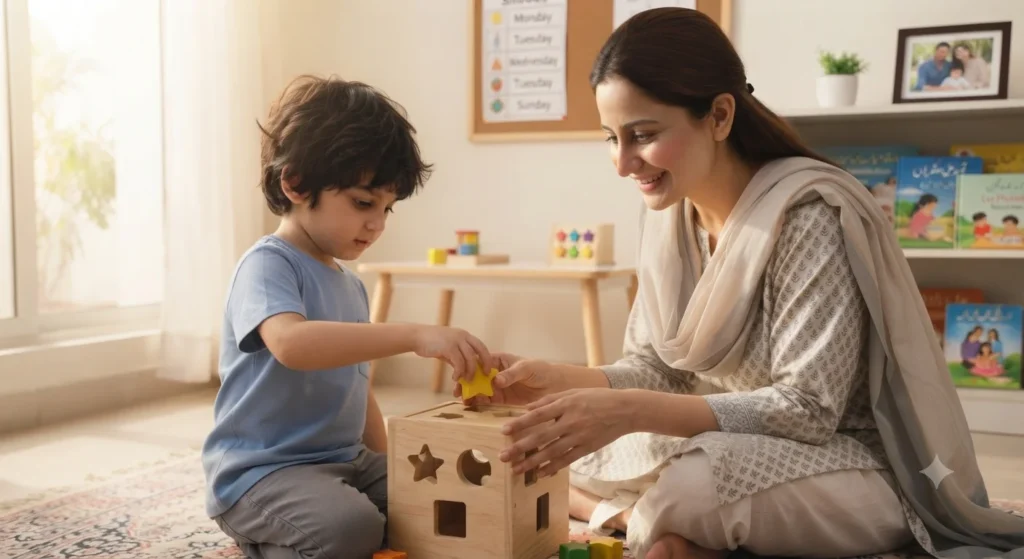
ABA therapy’s core strength is consistent, predictable teaching and reinforcement. When home responds very differently than therapy sessions do for example, if screaming reliably gets a child out of a task at home but not in therapy a child’s progress can stall, because they’re essentially receiving two different sets of rules. This isn’t about parents needing to become clinical therapists; it’s about aligning on a handful of key, agreed strategies, consistently, so your child gets one clear, coherent message rather than two conflicting ones.
What Not to Expect From Yourself
It’s worth being honest: even with all of this, you are your child’s parent, not their therapist, and that distinction matters. You’re not expected to run structured teaching sessions all day, track formal data on every behaviour, or get every interaction perfectly “textbook.” The goal is a handful of consistent, practical habits woven into your normal daily routine not a second full-time job. If something here doesn’t work for your family’s rhythm, that’s worth raising with your therapist rather than forcing it.
A Note on Extended Family
In many Pakistani households, grandparents, aunts, uncles, and household staff are all part of a child’s daily life and inconsistency across these different adults can genuinely undermine progress. Where possible, it’s worth having a simple, shared conversation about the two or three most important strategies (for example, the specific phrase used for transitions, or how to respond to a specific behaviour) so the whole household is working with the same basic approach, rather than your child receiving different responses depending on who’s in the room.
Bringing This Back to Your Child’s Program
The single best way to make these step-by-step techniques effective is to connect them directly to what your child’s ABA therapist is already working on. Ask specifically: what are this month’s top two or three goals, and what’s the one thing I can consistently do at home to support each of them? A focused, well-aligned effort on two or three things is far more effective than a scattered attempt at everything at once.