
A practical checklist for choosing an ABA therapy provider in Lahore what to ask, what to look for, and the warning signs worth taking seriously.Choosing who will spend hours a week working closely with your child is one of the most consequential decisions you’ll make as a parent and it’s a decision most families make without a clear framework for what actually distinguishes a strong provider from a weak one. This guide gives you a practical, specific checklist to use when evaluating ABA therapy providers in Lahore.
Start With the Assessment, Not the ABA Therapy Provider in Lahore

Before you even reach the question of “which provider,” the more foundational question is: has your child received a proper, individualised assessment? A trustworthy provider will insist on a thorough assessment before recommending any specific therapy program if a provider offers to start ABA therapy without a meaningful assessment process first, that’s a significant warning sign, regardless of how confident or reassuring they sound.
Questions to Ask About Qualifications and Supervision
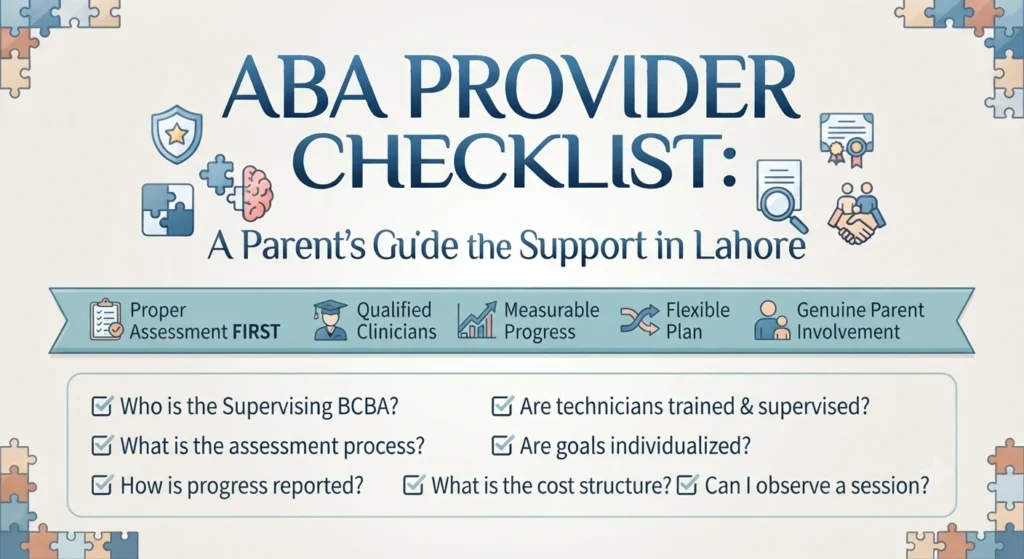
- Who is the senior clinician overseeing my child’s case, and what is their specific training in applied behaviour analysis (not just general child psychology)?
- Are day-to-day sessions delivered by trained technicians under regular, documented supervision, or by someone working largely independently?
- How often does the supervising clinician personally review my child’s data and progress?
- Will I have direct access to the supervising clinician, not only the technician delivering sessions?
(For more detail on these specific roles, see our guide on RBT versus BCBA responsibilities.)
Questions About the Treatment Approach
- What does the assessment process actually involve, and how long does it typically take?
- How are treatment goals decided, and will I be genuinely involved in setting them?
- What specific methods are used for example, do sessions combine structured teaching with naturalistic, play-based teaching, or rely on one approach exclusively?
- How is progress measured and reported to me, and how often?
- What happens if a specific goal isn’t progressing as expected?
- How is parent training and involvement built into the program, beyond just the child’s individual sessions?
Questions About Practical Logistics
- What are the available formats in-clinic, home-based, online and which is recommended for my child specifically, and why?
- What is the actual cost structure, including the assessment fee, ongoing session rates, and any periodic supervision or review fees? (See our full guide on ABA therapy costs in Lahore for a detailed breakdown of what to ask.)
- What is the provider’s policy on rescheduling, cancellations, or pausing sessions?
- How consistent is the staffing will my child generally see the same technician, or does the team rotate frequently?
Observing a Session (or Asking to)
Where possible, ask whether you can observe a session, either in person or through a brief trial, before committing to a longer-term program. A few things worth paying attention to:
- Does your child seem genuinely engaged, even if occasionally frustrated by a challenging task, rather than distressed or shut down?
- Is the therapist warm, responsive, and adjusting their approach based on your child’s mood and energy, rather than rigidly following a script regardless of how your child is responding?
- Is reinforcement used consistently and appropriately genuine, immediate, specific praise or rewards, not vague or infrequent?
- Does the session include variety, or does it feel repetitive and disengaged?
Red Flags Worth Taking Seriously
- A provider that starts therapy without a proper individualised assessment
- Vague or evasive answers about who is actually supervising your child’s case
- No clear system for tracking or sharing progress data with you
- A rigid, one-size-fits-all program that doesn’t seem to differ meaningfully from what other families describe
- Reluctance to explain the reasoning behind specific goals or techniques when you ask
- High staff turnover, with your child regularly seeing unfamiliar technicians without a smooth transition process
- A program that feels punitive, cold, or focused on compliance rather than genuine skill-building and your child’s wellbeing
Green Flags That Suggest a Strong Program
- A thorough, individualised assessment process before any therapy recommendation
- Clear, specific, measurable goals tied directly to your child’s assessment findings
- Regular, transparent progress updates, including actual data, not just general impressions
- Genuine parent involvement training, coaching, and being treated as an active partner rather than a bystander
- A team that coordinates with other professionals involved in your child’s care, such as speech or occupational therapists, and with your child’s school where relevant
- Willingness to adjust the plan when something isn’t working, without defensiveness
Trusting Your Own Observations, Not Just Credentials
Credentials and structure matter enormously, but so does your own observation of how your specific child responds. Two providers can both be well-qualified on paper, and your child may still respond noticeably better to one than the other perhaps due to a particular therapist’s temperament, communication style, or the way they build rapport. It’s worth giving real weight to this, alongside the more structural, checklist-style factors above.
What to Do If You’re Currently Unsatisfied With a Provider
If you’ve already started ABA therapy and have concerns, you don’t need to feel locked in. Reasonable first steps include:
- Directly raising specific concerns with the supervising clinician, in writing if that feels more comfortable, and giving them a genuine opportunity to respond
- Requesting to see actual progress data rather than relying on general updates
- Asking for a formal case review or reassessment if progress has genuinely stalled
- Seeking a second opinion from another qualified provider if concerns persist after raising them directly
Switching providers is a significant decision, and it’s reasonable to try resolving specific concerns first — but it’s also entirely reasonable to make a change if a program genuinely isn’t serving your child well, despite good-faith efforts to address it.
For Overseas Pakistani Families Choosing Remotely
If you’re evaluating a Lahore-based provider from the UK, USA, Canada, UAE, Saudi Arabia, or Australia whether for a child visiting Pakistan, planning to relocate, or receiving guidance remotely the same core questions apply, with additional focus on how consultation will actually be delivered across the distance, time zone coordination, and how progress will be communicated to you consistently despite not being physically present for sessions.
The Bottom Line
Choosing an ABA provider isn’t about finding the single “best” clinic in Lahore it’s about finding a provider whose qualifications, transparency, and approach genuinely match what your specific child needs, and who treats you as a genuine partner in the process rather than a passive recipient of updates. A provider confident in their own quality will welcome every question on this list, not resist them.