
If you’ve recently had your child assessed for autism, or you’ve been researching ways to support a child who struggles with communication, the ABC model of behaviour, or daily routines, you’ve probably come across the term “ABA therapy” more than once. It’s one of the most talked about and most misunderstood interventions in child psychology today. This guide explains what ABA therapy actually is, how it works, who it’s for, and what Pakistani parents specifically should know before starting.
What Does ABA Stand For?
ABA stands for Applied Behaviour Analysis. At its core, it’s the scientific study of how behaviour works, how it’s affected by the environment, and how learning happens. “Applied” simply means these principles are used in real, practical settings a home, a clinic, a classroom to help a person build skills that matter to their daily life and reduce behaviours that get in the way of learning, safety, or connection.
ABA is not a single technique. It’s a broad framework built on decades of research into how children (and adults) learn. Within that framework, a trained therapist uses specific, structured methods like Discrete Trial Training or Natural Environment Teaching chosen based on what a particular child needs.
What Does ABA Therapy Actually Look Like?
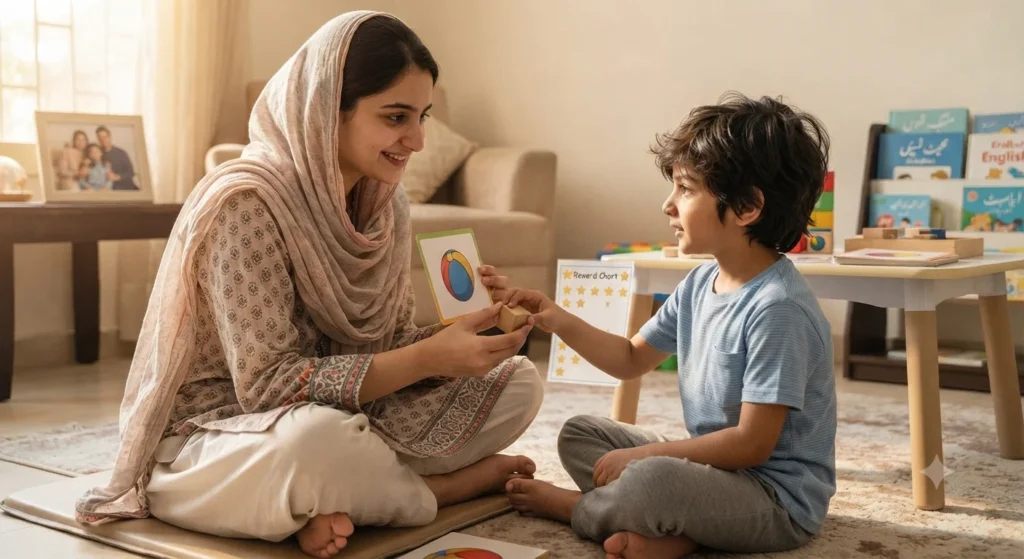
For a child in Lahore starting ABA therapy, a typical program usually includes:
- An initial assessment. Before any therapy begins, a Board Certified Behaviour Analyst (BCBA) or a clinician trained in ABA conducts a functional behaviour assessment observing the child, talking with parents, and identifying specific skills to build and specific behaviours (like aggression, self-injury, or extreme tantrums) to reduce.
- A written treatment plan. This isn’t a generic worksheet. It’s a document with measurable goals for example, “increase spontaneous requesting from 2 words to 4-word phrases” or “reduce instances of hitting during transitions from 8 times a day to 2 times a day within 8 weeks.”
- Structured sessions. These can happen in a clinic, at home, or in some cases at school, depending on the goals. Sessions are usually delivered by a Registered Behaviour Technician (RBT) working under the supervision of a BCBA or senior clinician.
- Ongoing data collection. ABA is unusual among therapies in how much it relies on data. Therapists record what happened in almost every teaching interaction not vague notes, but actual counts, percentages, and trends so progress (or lack of it) is visible, not just assumed.
- Regular review and adjustment. Every few weeks, the plan is reviewed against the data. If something isn’t working, it changes. This is one of ABA’s biggest strengths: it doesn’t rely on guesswork.
Who Is ABA Therapy For?
ABA therapy is most commonly associated with autism spectrum disorder, and the strongest evidence base is with autistic children, particularly when started early. But the underlying principles apply more broadly. In practice, ABA-based approaches are used to support children with:
- Autism spectrum disorder, across the full range of presentations
- Significant speech and language delays
- ADHD, particularly around impulse control and structured routines
- Intellectual and developmental disabilities
- Severe behavioural challenges (aggression, self-injury, extreme non-compliance) even without a formal autism diagnosis
It’s worth being clear: not every child needs ABA, and not every child who receives an autism diagnosis needs an intensive ABA program. The right recommendation depends entirely on the individual child’s assessment results, their specific challenges, and the family’s goals which is exactly why a proper diagnostic assessment should always come before a therapy recommendation, not after.
Why Early Intervention Matters
Research consistently points to early childhood particularly before age 6 as a period of especially rapid brain development, when new neural pathways form more readily. This is why ABA therapy started early, often between ages 2 and 5, tends to show the strongest outcomes in areas like language development, social engagement, and adaptive daily-living skills. That said, “early” doesn’t mean “only.” Older children and even teenagers can and do benefit from ABA-informed support, adapted to their age and goals the approach and the day-to-day activities just look different than they do for a 3 year old.
How Is ABA Different From Other Therapies?
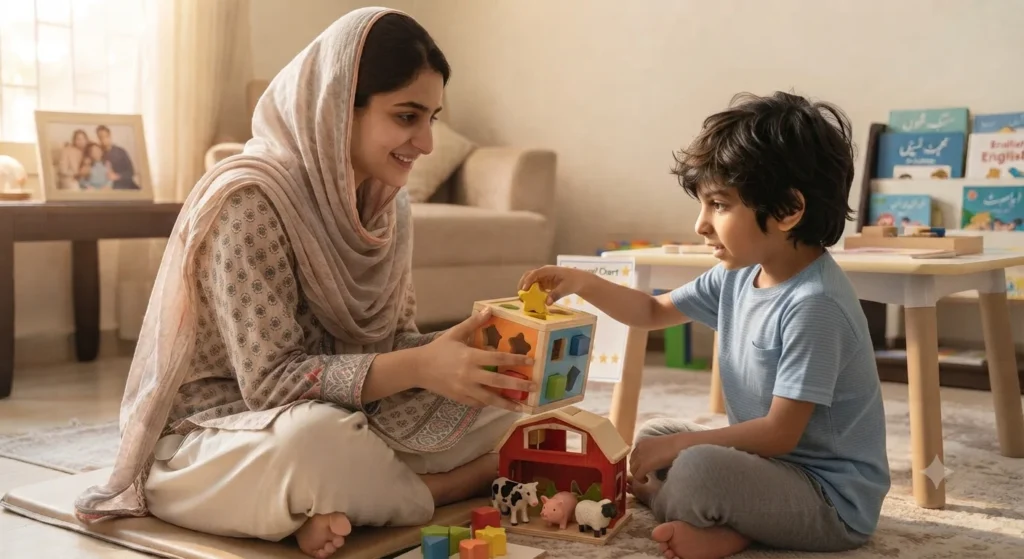
Parents often ask how ABA compares to speech therapy, occupational therapy, or general “play therapy.” The honest answer is: they’re not competitors, they’re complementary.
- Speech therapy focuses specifically on communication articulation, language comprehension, and expressive language.
- Occupational therapy focuses on sensory processing, fine motor skills, and daily functional tasks like dressing or handwriting.
- ABA therapy is broader it addresses behaviour, communication, social skills, and daily living skills together, using consistent teaching and reinforcement principles across all of them.
Many children benefit from a combination for example, ABA therapy alongside speech therapy, with the ABA therapist and speech therapist coordinating goals so the child isn’t getting conflicting approaches from different professionals.
Common Concerns Pakistani Parents Have About ABA Therapy
“Will this feel like training a child like an animal?” This is a genuine, common worry, usually based on outdated descriptions of ABA from decades ago. Modern, ethical ABA practice is built around positive reinforcement rewarding effort and progress not punishment. A well-run program should feel warm, playful, and responsive to the child, not rigid or robotic. If a program feels cold or mechanical, that’s a sign to ask questions or seek a second opinion, not a necessary feature of ABA itself.
“Is this going to change who my child is?” A well-designed ABA program targets specific, functional goals — communication, safety, independence, social connection not a child’s personality or the way they naturally experience the world. The goal is to reduce what genuinely gets in the way of a child’s quality of life, not to make a child “act typical” for its own sake. This is a legitimate, active debate within the field, and it’s worth discussing directly with your child’s clinician so you understand exactly what a specific program is targeting and why.
“Do we have to do this forever?” No. ABA therapy is typically intensive in the early stages and gradually reduces in hours and frequency as the child meets goals and skills generalise into daily life. Many children eventually graduate from formal ABA entirely.
What to Ask Before Starting ABA Therapy
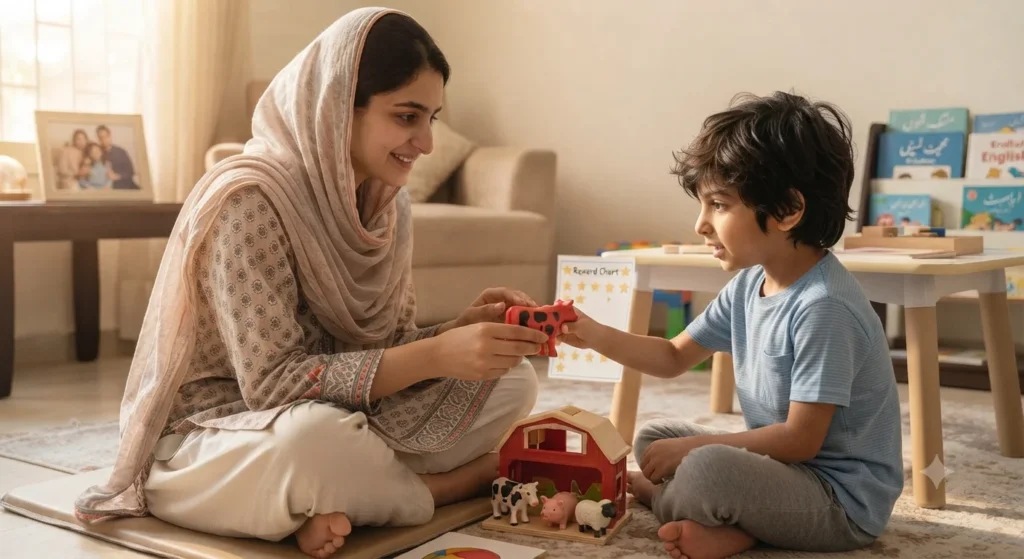
Before committing to a program, it’s reasonable to ask:
- Who conducted the assessment, and what are their qualifications?
- Who will actually be working with my child day to day, and who supervises them?
- What specific goals are being targeted, and how will progress be measured?
- How often will the plan be reviewed, and will I see the data?
- How will you involve me as a parent, not just the therapist?
A program that can’t answer these clearly is worth being cautious about.
Getting Started
If you’re considering ABA therapy for your child in Lahore, or for a family based overseas looking for guidance for a Pakistani child, the right first step isn’t jumping straight into therapy it’s a proper clinical assessment that looks at your child’s whole developmental picture, not just a single behaviour or a single concern. From there, a clear, individualised plan whether that includes ABA, speech therapy, occupational therapy, or a combination can be built around signs your child might benefit from ABA.